
Best Practices for Employer of Record Malaysia: A Non-Technical Walkthrough of Sandbox Testing for HR Teams


Best Practices for Employer of Record Malaysia: A Non-Technical Walkthrough of Sandbox Testing for HR Teams

Key Takeaways
- Testing payroll and compliance in an EOR sandbox prevents expensive statutory mistakes before you hire a real employee in Malaysia.
- A Malaysia-specific sandbox pre-populates EPF, SOCSO, EIS, and PCB data, giving HR teams an accurate preview of deduction scenarios without manual calculation.
- Always use sample worker profiles that mirror your actual hires — salary levels, age brackets, and employment status — to see how contributions shift.
- Verify that the sandbox generates compliant employment contracts with the correct Malaysian Labour Law clauses, not generic global templates.
- Run at least one full-month payroll simulation, including employer contributions, to surface hidden costs like HRDF levy for certain industries.
- Don’t assume a global EOR sandbox handles Malaysian statutory nuances; local providers like MalayHire EOR embed pre-calculated tables tied to real contribution rates.
- A sandbox is not a legal shield; after testing, confirm that your chosen EOR’s production environment mirrors the sandbox calculations exactly.
- The 48-hour onboarding promise from a local EOR becomes genuinely reliable only after you’ve stress-tested it in a sandbox with your own data.

Why a Sandbox Test Drive Matters Before You Hire
When foreign companies set out to hire in Malaysia, the excitement of locking in that Kuala Lumpur–based developer or regional sales lead can quickly get smothered by spreadsheets full of statutory acronyms. EPF, SOCSO, EIS, PCB, HRDF — the list reads like a compliance alphabet soup, and getting any one of them wrong isn’t a slap-on-the-wrist situation. It means penalties, delayed onboarding, and an awkward phone call to your new hire explaining why their first payslip looks off.
That’s exactly where an Employer of Record (EOR) sandbox changes the game. Think of it as a flight simulator for your payroll. You’re not actually moving money or signing binding contracts, but you’re working inside a mirror of the real production environment. Leading platforms like Deel explicitly build their sandbox to be completely isolated, pre-populated with sample contracts and workers so that no live data gets tangled. For an HR manager who doesn’t write code but needs certainty, this is your compliance rehearsal space.
In Malaysia, the need for a sandbox is even sharper because statutory contributions are progressive and depend on nuanced factors — employee age, wage bracket, whether they’re a Malaysian citizen or permanent resident, and if the employer is subject to HRDF levy. A generic global EOR might give you a one-size-fits-all simulation that glosses over these specifics. But a proper Malaysia-focused sandbox will let you, say, plug in a 28-year-old Malaysian employee earning RM6,500 and instantly see how the EPF allocation splits between employer and employee, how SOCSO’s new coverage for higher wage earners kicks in, and whether you owe anything to the Human Resources Development Fund. No guesswork. That kind of upfront clarity is the first best practice for any company serious about building a team in Malaysia.
Step 1: Getting Access to a Malaysia-Ready Sandbox
Your first move is finding an EOR that doesn’t treat Malaysia as an afterthought. Many global platforms have a generic sandbox — you sign up, grab some API keys or log into a developer dashboard, and start experimenting. According to Deel’s developer documentation, the setup path is straightforward: create an account, head to the Developer Center, and spin up a sandbox environment. That’s a fine starting point, but for Malaysia-specific accuracy, you’ll want a provider that has invested in pre-configuring the Malaysian statutory landscape inside that sandbox.
Why? Because if you have to manually enter EPF contribution rates or guess the latest SOCSO table, you’ve already defeated the purpose. A local EOR like MalayHire EOR, for example, positions its entire platform around rapid, digital onboarding with all Malaysian compliance built in — not bolted on as an aftermarket add-on. The moment you enter a sample employee profile, the system should already know the correct contribution percentages, income ceilings, and tax relief categories.
When evaluating a sandbox, don’t just look for whether it exists. Ask pointed questions: Is the EPF rate table updated for the latest government announcements? Does the SOCSO simulation handle both employment injury and invalidity scheme contributions separately? Can you test scenarios for employees over 60, where EPF rates halve? These granular checks separate a sandbox that merely uses the label “Malaysia” from one that actually understands the territory.
Step 2: Setting Up Your Sample Kuala Lumpur Employee
What to Look for in Pre-Populated Data
The true value of a sandbox emerges when you see that it already carries sample workers with realistic Malaysian attributes. Instead of staring at blank fields, you find a profile for “Ahmad Faisal, 31, Software Developer, Kuala Lumpur” with a base salary of RM7,000. The EPF employer share is already computed at 13% (for those earning above RM5,000), the SOCSO contribution is split by category, and the PCB (monthly tax deduction) follows the latest PCB schedule. That’s the bar. If your sandbox doesn’t offer this, you’re essentially building a payroll from scratch, which is what you were trying to avoid.
Configuring Statutory Fields Without Guesswork
Most HR teams won’t know offhand that an employee over 60 only contributes 5.5% to EPF instead of 11%, or that EIS contributions are capped at a tiny RM0.10 for employees. In a properly built sandbox, you don’t need that encyclopedic knowledge. The system should automatically adjust the amounts based on the worker’s identity card number (indicating citizen status), age, and salary band. This is where a local EOR platform shines — it’s been engineered from day one with these rules, not adapted from a generic global framework. You just verify the numbers, sanity-check them against an external source if you like, and build confidence.
Running Your First Payroll Simulation
Once the sample employee is in place, hit ‘run payroll’ for a sample month. The sandbox should immediately generate a detailed payslip and an employer contribution statement. Check that the EPF employer portion goes into a separate line item from the employee deduction. Confirm SOCSO employer and employee amounts are listed correctly. For employees above RM4,000, SOCSO covered wages are capped at RM4,000 in the contribution table; the sandbox ought to reflect that. If your payroll simulation doesn’t align with what you expect from official schedules, flag it before you ever onboard a real person.
Step 3: Verifying EPF, SOCSO, EIS, and PCB Deductions
By now you have a simulated payslip in front of you. The next best practice is a line-by-line audit of each statutory line item. Treat the sandbox output as if it were a final payroll run. Compare the figures against the official contribution schedules from Kumpulan Wang Simpanan Pekerja (KWSP), Pertubuhan Keselamatan Sosial (PERKESO), and the Inland Revenue Board (LHDN). Any deviation is a red flag — either the EOR’s logic is flawed, or you’ve misconfigured the worker’s profile.
For instance, many first-time employers forget that employees earning RM5,000 and below trigger a slightly lower employer EPF rate. If your sample worker’s salary is exactly RM5,000, the sandbox should apply 12% employer EPF, not 13%. A quality Malaysia-centric sandbox will also handle edge cases like probationary periods where some statutory payments may be deferred, or foreign workers who are not covered under SOCSO’s Invalidity Scheme. The sandbox is your magnifying glass for these details.
- EPF: Employee contribution is 11% for those below 60, employer contribution is 12% for wages RM5,000 and below, 13% for above. Check that the sandbox automatically reduces employee EPF to 5.5% for staff aged 60+, and to zero for foreign workers who can opt out of Malaysian EPF.
- SOCSO: Now a two-tier scheme — Employment Injury Scheme for all employees, and Invalidity Scheme only for those under 60. The sandbox should show employer SOCSO rates scaling with salary brackets, and the cap at RM4,000 insured salary.
- EIS: A tiny 0.2% contribution split equally between employee and employer, capped at a trivial amount per month. The sandbox should include it, because forgetting EIS still triggers non-compliance.
- PCB: Monthly tax deduction based on the employee’s taxable income, using PCB tables that consider net salary after EPF and other reliefs. If your sandbox doesn’t auto-calculate PCB based on real LHDN schedules, your net pay figures will be dangerously wrong.
- HRDF: If your company is in a manufacturing, services, or mining sector and employs more than a certain number of Malaysian workers, a 1% levy on employee wages applies. The sandbox should warn you if this levy is triggered for your sample workforce.
Step 4: Testing Employment Contracts and Onboarding Documents
Compliance isn’t just about numbers. Employment contracts in Malaysia come with specific mandatory clauses — notice periods that follow the Employment Act 1955, annual leave entitlements proportional to years of service, sick leave with hospitalisation coverage, and maternity protections. Global EOR platforms sometimes generate a generic South-East Asia contract template that misses Malaysia’s requirement for a particular clause on termination due to misconduct with domestic inquiry. Your sandbox should produce the exact PDF contract your real employee will eventually sign. Read it. Better yet, have a local HR consultant glance over it.
You’ll also want to test the onboarding document flow. Does the sandbox issue a sample offer letter that references Malaysian jurisdiction? Are the personal data protection notices compliant with the PDPA 2010? Are there correct statutory declarations for tax filing? Running the contract generation in sandbox mode gives you the chance to red-line clauses before a single real signature is exchanged. You might discover that the contract’s probation clause defaults to three months, but you need a six-month probation for a senior role — a change that’s easy to negotiate now, not after the candidate has signed.
Checking Local Compliance Clauses
- Look for a clause detailing termination with notice periods as per the Employment Act — four weeks for employees with less than two years of service, increasing with tenure.
- Ensure statutory sick leave provisions align with the law: 14 days for those with less than two years, 18 days for two to five years, etc.
- Confirm maternity leave of 98 consecutive days for female employees, and paternity leave of seven days where applicable.
- Verify the overtime calculation base — hourly rate should be 1/26th of the monthly salary, not a generic 1/22, which some US-based platforms mistakenly use.
Best Practice: Always Run a Full-Month Simulation
Many sandboxes are set up to let you run a single, one-off payroll snapshot. Resist that temptation. Set your sample employee’s start date to the first of the month and simulate an entire month that includes a public holiday and, if possible, a few hours of overtime. This exercise exposes how the EOR’s system handles pro-rata salary calculations for mid-month joiners, public holiday pay for work on a national holiday, and statutory contributions on overtime wages.
You’ll quickly see if the sandbox can manage the nuance of paying an extra day’s wages for a public holiday that falls on a working day, or if it stumbles when overtime hours push the employee’s total earnings into a higher PCB bracket. A local EOR that already knows the Malaysian labour calendar can hard-code these scenarios; a generic provider might require you to manually adjust numbers. Watching a full-cycle simulation also gives you confidence that the EOR can handle your actual month-end payroll processing without breaking a sweat.
Sandbox Limitations You Should Know
Isolation Doesn’t Mean Perfect Replication
Keep in mind, as Deel’s documentation states, that the sandbox does not trigger actual payments or create legal contracts. This is an air-gapped simulation. While that protects you from accidental transactions, it also means certain interactions — like the real-time submission of EPF contributions via the i-Akaun portal — cannot be tested end-to-end. You’re testing the calculation logic, not the actual government submission pipeline. In production, the EOR must have valid i-Akaun and ASSIST (SOCSO) portal integrations. Ask for a demonstration of those live submissions before you go live.
Pre-Populated Data May Not Match Your Sector
The sandbox might use a generic retail employee profile, but you’re hiring a fintech product manager or an oil and gas engineer. Industry-specific statutory requirements, like additional SOCSO categories for hazardous work or HRDF levy only for certain sectors, may not be reflected. Duplicate your sandbox profile and tweak it to reflect your actual role, then check for any delta in contributions.
Latency and Currency Handling
When you eventually move to an API-driven or platform-based EOR, latency in payroll calculations might affect your integration. For now, just observe whether the sandbox shows amounts in Malaysian Ringgit only, or if currency conversion is introduced unnecessarily. A local EOR will naturally work in MYR; some global platforms might default to USD before conversion, adding an extra rate step you don’t need.
Making the Jump: From Sandbox to Real Hire
Once your sandbox sessions leave you feeling comfortable with the numbers and the contract language, you’re ready to transition. A critical best practice here is to request a side-by-side comparison of the sandbox output against what the EOR will produce in production for the exact same profile. Some providers can generate a dummy payslip in their live environment as a final validation step — no money moves, but the document is generated on real infrastructure. If the numbers match to the sen, you’ve just eliminated the largest source of payroll anxiety.
At this stage, you should also revisit the overall onboarding timeline. MalayHire EOR, for instance, promotes a 48-hour onboarding process. If you’ve done your sandbox homework, you’ll know exactly what data you need to supply (employee MyKad copy, bank details, EPF nomination form, etc.) and can shave even more time off that window. The sandbox taught you the prerequisites; now you execute them in the real world with zero surprises.
Questions to Ask Your EOR Provider Before You Commit
Choosing an EOR is a strategic decision, not a purchase-order click. The sandbox testing phase naturally surfaces the right questions. Write them down, and send them to the EOR’s support or sales team as a formal checklist. Their responses will tell you a lot about their true depth of Malaysia expertise. A platform that brushes off questions about HRDF levy applicability or cannot produce a sample PCB calculation on the spot is likely relying on a thin localization layer over a global engine.
Remember, the monthly per-employee fee — whether it’s MalayHire EOR’s fixed $165 or a competing provider’s tiered pricing — should include access to this kind of transparency. If a provider treats sandbox access as a premium feature or limits the number of simulations you can run, that’s a signal that they might prioritize sales over compliance confidence. The best practice is to treat the sandbox as a non-negotiable part of your evaluation, not a nice-to-have.
- Can you show me a sandbox environment with a pre-populated Kuala Lumpur–based employee, including the exact EPF, SOCSO, and PCB calculations?
- Does your sandbox auto-update when the Malaysian government announces new contribution rates, or do I need to manually adjust parameters?
- How do you handle statutory contributions for employees who are above 60, or foreign employees with different EPF opt-out rules?
- What happens in the sandbox when I run overtime or bonus payments — do the PCB and EPF amounts adjust automatically based on total monthly earnings?
- Will the sandbox-generated employment contract match the exact version I’ll send to a live candidate, including all Malaysia-specific clauses?
- After I’m satisfied with the sandbox, can you generate a production-side preview payslip without triggering any real payment?
- Do you have a local team in Malaysia who handles the physical submission of documents to KWSP and PERKESO, or is everything digital?
Frequently Asked Questions
How do I know if a Malaysia-ready sandbox includes the latest EPF, SOCSO, EIS, and PCB rates?
You should ask your provider directly whether the sandbox updates its deduction rates in real time to match the latest government regulations. A reliable sandbox will clearly label its rate versions and notify users of any changes. Always verify a sample employee's payslip against official calculators before committing to the service.
Can I test multiple employee types like expatriates or part-time workers in a Malaysia EOR sandbox?
Most sandboxes support testing for local and expatriate employees, but part-time or contractor scenarios may have limited functionality. You should confirm with the provider which employment categories are preloaded in the sandbox environment. Testing a diverse set of profiles ensures the system handles varying EPF tiers, tax codes, and visa requirements accurately.
What should I do if the sandbox deduction calculations do not match my manual calculations for a sample Kuala Lumpur employee?
First, double-check that you used the correct salary amount and current statutory rates for EPF, SOCSO, EIS, and PCB. If discrepancies persist, contact the provider's support team with your manual calculations and screenshots. This issue often reveals a misconfiguration in the sandbox, which should be resolved before you proceed with live hires.
How long does it typically take to complete a full-month simulation in an EOR sandbox for Malaysia?
A thorough full-month simulation usually takes between two and four hours, depending on your familiarity with payroll processes and the number of test scenarios you run. This time includes setting up a sample employee, running monthly payroll, generating payslips, and verifying statutory deductions. Dedicate an uninterrupted block to ensure you catch all potential errors.
undefined
undefined
After testing the sandbox, what key documents should I request from the EOR provider before signing a contract?
You should request a sample employment contract that complies with Malaysia's Employment Act 1955, a service-level agreement outlining response times, and a data protection addendum. Additionally, ask for a detailed fee schedule and a list of all statutory filings the provider will handle. These documents confirm the sandbox functionality translates to real-world compliance.
Can a sandbox test reveal hidden costs like onboarding fees or termination penalties from a Malaysia EOR provider?
Yes, a well-designed sandbox should simulate all applicable charges, including one-time onboarding fees, monthly management fees, and early termination penalties. However, not all providers embed these costs in the sandbox interface. You should explicitly ask for a cost breakdown during the trial to avoid surprises when you transition to live hiring.
What happens if I find a critical error in the sandbox—does that mean the provider is unreliable for real hires?
Finding a critical error does not automatically disqualify the provider, but it should trigger a thorough investigation into their correction process. A trustworthy provider will acknowledge the issue promptly, explain the root cause, and fix it within a reasonable timeframe. If the provider dismisses your findings or delays resolution, consider it a red flag for long-term reliability.
Is it possible to integrate the sandbox with my existing HR systems for a more realistic payroll test in Malaysia?
Some EOR providers offer sandboxes with API access or manual data export options to simulate integration with your HRIS or accounting software. However, full integration testing is rarely available in a sandbox environment. Ask the provider if they have a test integration environment or if they can share sample data formats for your team to validate compatibility.
MalayHire is your most cost-effective Employer of Record (EOR) in Malaysia
Hire full-time employees in Malaysia and save costs by avoiding hefty contractor fees. MalayHire handles payroll, employment contracts, statutory compliance (EPF, SOCSO, EIS), and HR admin. Start onboarding your Malaysian hire now, with MalayHire.
Trusted by global companies hiring in Malaysia





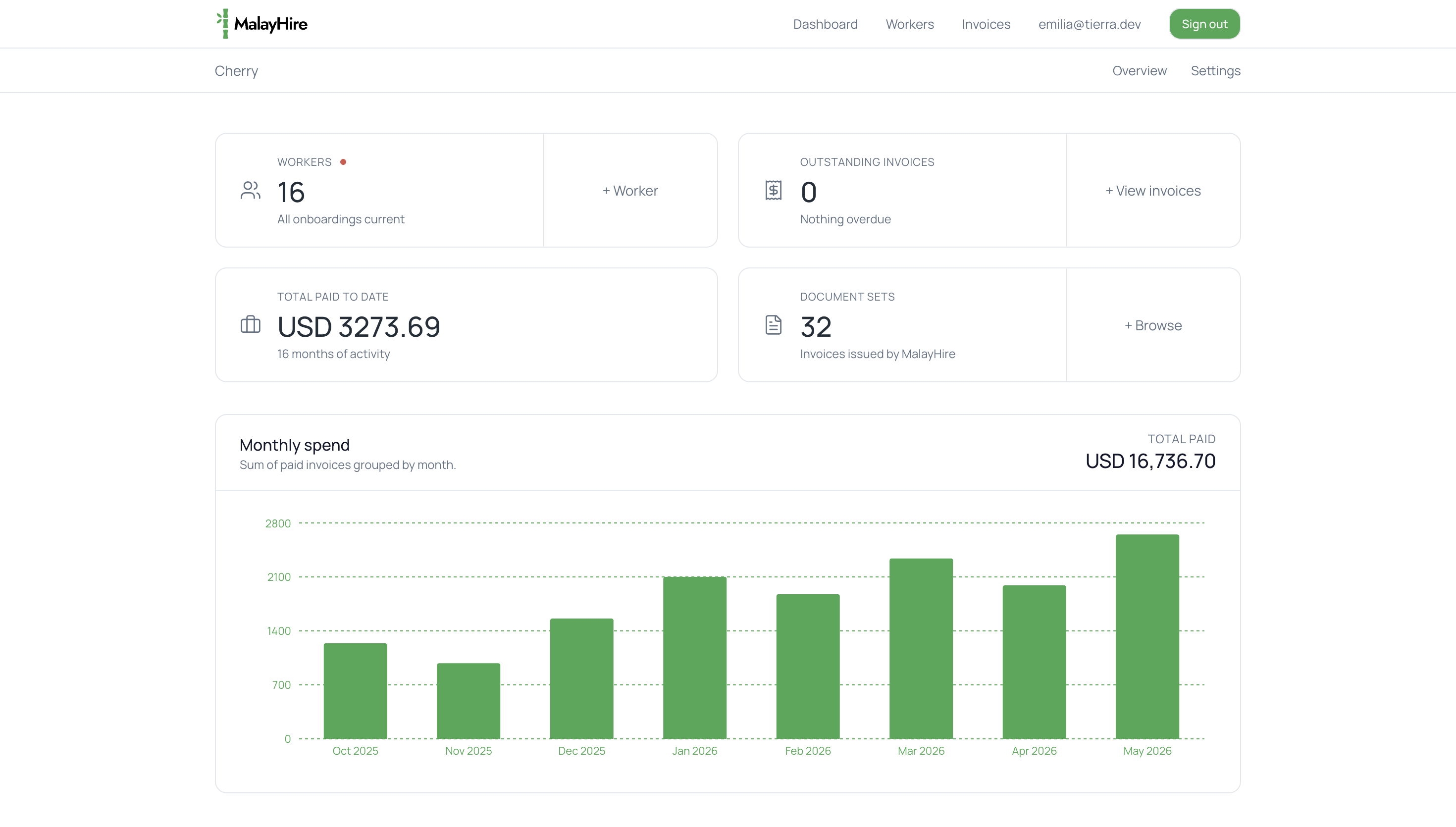
Manage your Malaysian team, payroll & EOR compliance in one place.