
Common Mistakes When Hiring Employees in Malaysia: The Technical HR Ops Guide to Avoiding Payroll and Compliance Disasters


Common Mistakes When Hiring Employees in Malaysia: The Technical HR Ops Guide to Avoiding Payroll and Compliance Disasters

Key Takeaways
- Most hiring mistakes in Malaysia stem from treating statutory contributions (EPF, SOCSO, EIS, HRD Corp) as a manual back-office task rather than an automated workflow.
- API-first Employer of Record platforms eliminate the gap between onboarding and first payroll, but only if the integration covers local filing deadlines.
- PDPA compliance failures — especially around who can view and edit employee records — can trigger penalties even when payroll itself is correct.
- Choosing international payment rails over local options like DuitNow, MEPS, and FPX adds days to settlement and increases hidden fees.
- Termination costs in Malaysia depend on notice period, tenure, and contract type; getting this wrong at sign-off creates liability later.
- A 48-hour onboarding benchmark is achievable with a local EOR, but only when data validation and statutory registration happen in parallel.
- Traditional PEO providers often rely on spreadsheets and email, while API-based platforms give you audit trails and token-scoped permissions.

Why Malaysian Hiring Mistakes Compound Faster Than You Expect
When you hire employees in Malaysia, the margin for error is thinner than most global teams assume. The statutory framework is mature, the deadlines are strict, and the penalties for misclassification or missed contributions are not theoretical. Yet the most common mistakes when hiring employees in Malaysia are rarely about malice. They are about speed, assumption, and the belief that a generic global payroll provider understands local nuance. A technical HR operations lead or IT team member will recognise the pattern: someone sets up an integration, maps the wrong field, and suddenly the EPF submission is late. The employee doesn't care that the EOR's API had a webhook failure — they care that their retirement contribution is missing.
This article goes deep on the specific technical and operational mistakes that foreign employers make when using an Employer of Record Malaysia service to onboard local talent. We will not repeat the statutory contribution rate tables you can find elsewhere. Instead, we focus on the integration layer, the data access controls, the payment rails, and the contract clauses that cause the most expensive reversals. Whether you are evaluating a Malaysia EOR platform for the first time or you already run payroll through one, the mistakes below are the ones that show up in audits, employee complaints, and unexpected invoices.
Mistake #1: Treating Statutory Contributions as a Manual Afterthought
The single most damaging mistake when hiring employees in Malaysia is treating EPF, SOCSO, EIS, and HRD Corp as a once-a-month manual task. Many foreign employers sign a contract with an EOR and assume the provider handles everything magically. The reality is that even the best EOR needs clean data inputs, correct salary bands, and accurate employee classification to compute contributions correctly. If your HR team uploads a spreadsheet with a missing start date or a wrong citizenship flag, the EOR's system may process the payroll on time but with the wrong statutory deductions. That error may not surface until an employee checks their EPF statement months later.
For technical teams, the solution is not more manual checks but automated validation at the point of data entry. An API-first EOR platform should reject incomplete records before they enter the payroll run. It should also expose contribution calculations in real time so you can verify EPF and SOCSO amounts before the cut-off date. The mistake is not that calculations are hard — they are not — but that companies treat them as a downstream accounting function rather than an upstream data governance problem.
Mistake #2: Assuming Every EOR Handles Malaysian Payroll the Same Way
A common error is to think that any Employer of Record Malaysia provider will produce the same outcome. That assumption is dangerous because the underlying operational models differ dramatically. Traditional PEO providers in Malaysia often rely on a combination of manual spreadsheets, email attachments, and shared drives. They may have local legal expertise, but their payroll processing is paper-driven and slow. API-first platforms, by contrast, give you structured endpoints for employee onboarding, payroll runs, and statutory filing status. That difference matters when you need to onboard a developer in Kuala Lumpur within 48 hours and run the first payroll without a sales call or a PDF form.
If your internal team is already comfortable with REST APIs and server-to-server authentication, you should demand that your Malaysia EOR service exposes the same level of automation. The mistake is settling for a provider that says "we handle compliance" but cannot show you a real-time audit log or a webhook for EPF filing completion. The technical capability of the EOR directly determines whether you will catch errors before they become penalties.
Mistake #3: Overlooking PDPA Data Access Controls for Malaysian Employee Records
Foreign employers frequently underestimate the Personal Data Protection Act (PDPA) when building their Malaysian HR stack. The law requires that personal data — including employee records, salary details, and bank account numbers — be protected from unauthorised access. The mistake is not just about where the data is stored; it is about who inside your organisation and the EOR's platform can view, edit, or export that data. A single admin account with full read/write privileges for every HR system is a compliance violation waiting to happen.
Technical teams should treat Malaysian employee data with the same access control rigour they apply to production databases. Role-based access, token-scoped permissions, and full audit logging are not optional extras. If your EOR platform does not let you configure least-privilege access for different internal roles — payroll admin, compliance officer, engineering lead — then you are accepting a structural PDPA risk. That risk becomes a real incident when an employee discovers that a former contractor still had read access to salary slips six months after their engagement ended.
Mistake #4: Choosing the Wrong Payment Rails for Salaries and Contractor Payments
Many foreign employers assume that paying Malaysian employees is as simple as wiring money from a US or European bank account. That assumption leads to the fourth major mistake: ignoring local payment rails. Malaysia has a well-developed domestic payment infrastructure — DuitNow, MEPS, and FPX — that settles in real time or near-real time with minimal fees. International SWIFT transfers, by contrast, can take two to five business days and incur intermediary bank charges. For an employee who expects their salary on the 25th, a SWIFT delay is not a minor inconvenience; it is a breach of the employment contract.
An EOR platform that uses local rails for salary disbursement removes that failure mode entirely. The provider holds funds in a local account and pays out via DuitNow or bank transfer within Malaysia. The mistake is not just about speed, though. It is about visibility. With local rails, you get settlement confirmations and can reconcile payroll within minutes. With international rails, you are left waiting for the correspondent bank to confirm the transaction, and that uncertainty cascades into employee trust issues.
Mistake #5: Ignoring Local Termination and Notice Period Nuances
Hiring someone is easy. Ending the employment relationship in Malaysia without triggering a dispute is harder. Foreign employers often rely on the notice period written in their home-country contract template, which may not match Malaysian statutory requirements or common practice. The Malaysian Employment Act sets minimum notice periods based on tenure, but many contracts also include contractual notice periods that exceed the statutory minimum. The mistake is not checking which one applies at the moment of termination.
An EOR provider with deep local expertise will flag these issues at the contract drafting stage, before you sign. They will also calculate termination payments — including accrued leave, pro-rated bonuses, and any contractual severance — correctly. If your EOR platform only handles payroll and not HR advisory, you may discover the mismatch only when the employee files a complaint with the Labour Department. The cost of resolving that dispute is always higher than the cost of getting the notice period right on day one.
A Practical Playbook for Avoiding These Mistakes with an API-First EOR
The common mistakes when hiring employees in Malaysia share a root cause: treating local compliance as a checklist rather than an integrated workflow. The practical fix is to choose a Malaysia Employer of Record service that exposes an API for onboarding, payroll, and statutory filing, and then to use that API correctly. Here is a step-by-step playbook that technical HR operations leads and IT teams can follow.
First, map every statutory contribution to a data field in your HRIS. EPF, SOCSO, EIS, and HRD Corp all depend on employee attributes like age, citizenship, and wage band. If those attributes are missing or incorrect, the EOR's calculation engine will produce wrong results. Second, configure webhooks for every filing deadline. The moment the EOR submits EPF or SOCSO, you should receive a structured event with a timestamp and a filing reference. Third, enforce PDPA access controls by issuing scoped API tokens for each internal role. The payroll admin token should not have permission to read termination letters; the compliance officer token should not be able to edit bank details. Finally, run a monthly reconciliation against the EOR's payroll report and your own general ledger. If the numbers do not match to the sen, investigate before the statutory filing window closes.
What This Means for Your Malaysia Expansion
If you are planning to hire employees in Malaysia through an EOR, the mistakes outlined above are not hypothetical. They are the exact failure modes that show up in post-mortem reviews after a compliance audit, an employee complaint, or a payroll failure. The good news is that each mistake is preventable with the right platform and the right internal discipline. A Malaysia EOR that offers 48-hour onboarding, fixed monthly pricing, and an API for payroll automation is not a luxury — it is the operational baseline for any company serious about scaling a Malaysian team without an entity.
The technical team's role is just as important as the HR team's role. You are responsible for integrating the EOR's API with your internal systems, enforcing data access controls, and monitoring payment settlement. Do not outsource that responsibility to a spreadsheet. Treat Malaysian statutory compliance the same way you treat application uptime: monitor it, alert on it, and never assume it is working just because no one has complained yet. The companies that get this right are not the ones with the biggest legal budget. They are the ones that understand that every EPF contribution, every SOCSO filing, and every DuitNow payment is a transaction that must be treated with the same care as a production database write.
Frequently Asked Questions
What happens if a Malaysian employer fails to pay statutory contributions on time?
Late statutory contributions trigger automatic penalties from agencies such as KWSP, SOCSO, and LHDN. Penalties include compounding late payment fines and interest charges that accrue daily until full settlement. Persistent non-compliance can escalate to personal liability for company directors under Malaysian law. These financial and legal consequences rapidly compound with each payroll cycle.
How do Malaysian termination notice periods differ from those in other countries?
Malaysian employment law bases notice periods primarily on the employee's length of service and the contract terms under the Employment Act 1955. Contracts that specify shorter periods than the statutory minimum are automatically void and replaced with the legal default. This complexity makes it dangerous to apply a foreign termination playbook to your Malaysian workforce.
What specific data protection requirements apply to employee records in Malaysia?
Under the Personal Data Protection Act (PDPA), employers must obtain explicit consent before collecting and processing employee personal data. You must appoint a Data Protection Officer and register a formal notice of data processing activities. Your payroll and HR systems require granular access controls to ensure only authorized personnel view sensitive records.
Can a foreign employer hire Malaysian employees without setting up a legal entity?
Yes, a foreign company can hire through a licensed Employment Outsourcing agency or a reputable Employer of Record (EOR) service. The EOR becomes the legal employer and handles all statutory registrations and compliance on your behalf. However, you must verify the EOR's Malaysian employment and payroll licenses to avoid engaging an unqualified provider.
What is the correct payment method for monthly salaries in Malaysia?
Salaries must be paid through the Malaysian banking system, usually using MEPS or GIRO transfers, to ensure proper audit trails. Cash payments are risky and often non-compliant because they do not generate verifiable proof of salary disbursement. Your chosen payroll partner must support local banking integration to execute timely and traceable salary credits.
How are contractor payments treated differently from employee salaries in Malaysia?
Payments to Malaysian contractors trigger mandatory withholding tax under Section 107A unless the contractor holds a valid tax exemption certificate. Failure to withhold can make the payer legally liable for the unpaid tax amount plus penalties. Contractor invoicing also demands careful distinction from employment remuneration to avoid misclassification risks under labor law.
What key details must appear on a Malaysian employee termination letter?
The termination letter must state the exact notice period calculation, the effective last working day, and any unused annual leave payout amount. It must also confirm all statutory contributions will be settled with KWSP, SOCSO, and LHDN by statutory deadlines. Omitting these details invalidates procedural fairness and opens the door to wrongful dismissal claims.
Why do some Employer of Record services fail to handle Malaysian payroll properly?
Many EORs follow a one-size-fits-all global platform that does not address Malaysia's unique local payroll and contribution rules. Each EOR also has different integration capabilities with Malaysian banks, tax authorities, and the Employment Pass system. You must audit their local expertise and technical approach before delegating payroll to avoid critical compliance oversights.
MalayHire is your most cost-effective Employer of Record (EOR) in Malaysia
Hire full-time employees in Malaysia and save costs by avoiding hefty contractor fees. MalayHire handles payroll, employment contracts, statutory compliance (EPF, SOCSO, EIS), and HR admin. Start onboarding your Malaysian hire now, with MalayHire.
Trusted by global companies hiring in Malaysia





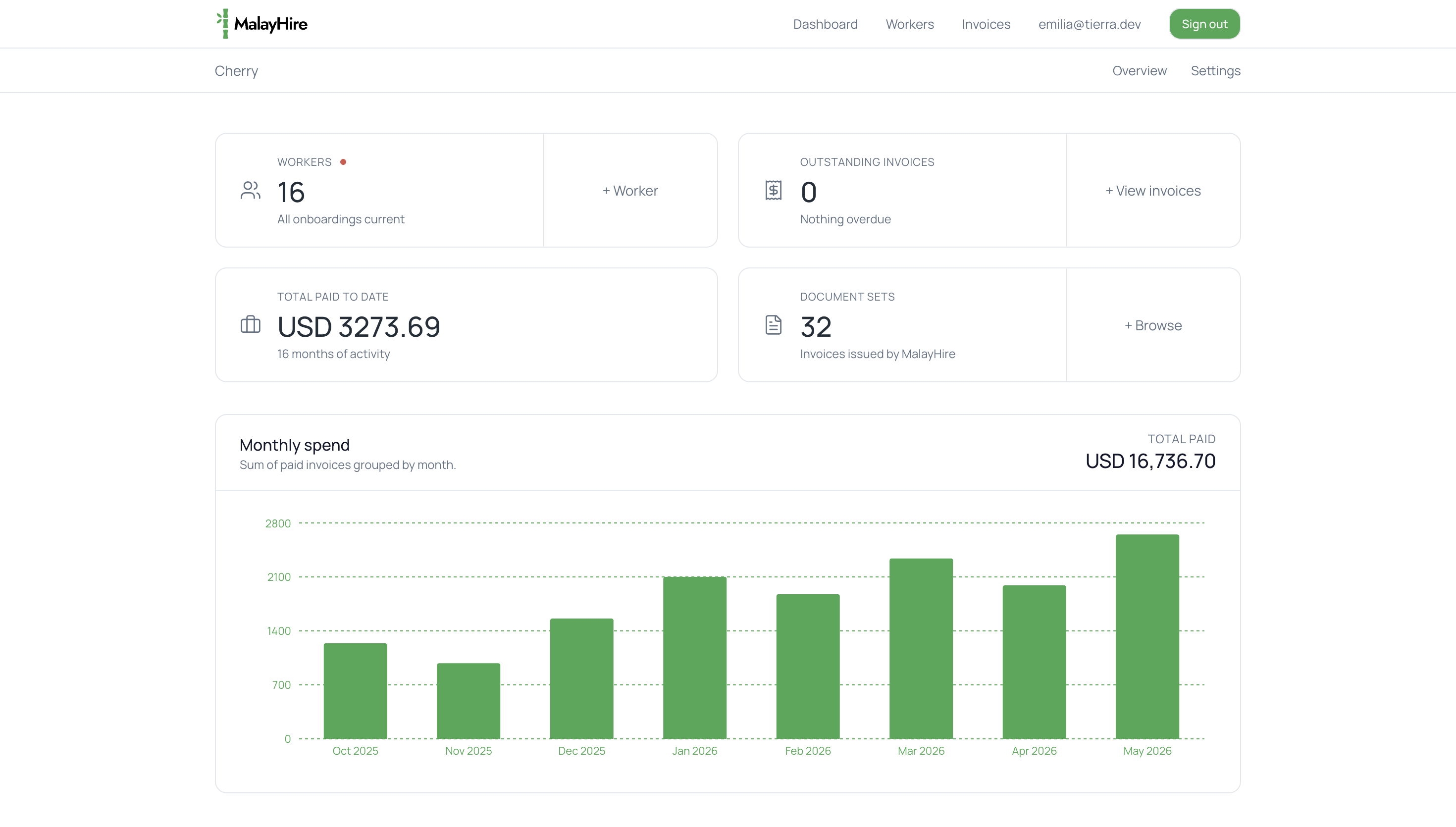
Manage your Malaysian team, payroll & EOR compliance in one place.