
Difference Between EOR and PEO in Malaysia: API-Based Platforms vs Traditional Providers


Difference Between EOR and PEO in Malaysia: API-Based Platforms vs Traditional Providers

Key Takeaways
- An EOR becomes the legal employer in Malaysia, handling contracts, payroll, EPF, SOCSO, EIS, and HRD Corp on your behalf without requiring a local entity.
- A PEO uses a co-employment model that typically assumes you already have or will set up a Malaysian subsidiary, sharing employer responsibilities rather than absorbing them.
- API-based EOR platforms automate statutory filings and payroll through machine-to-machine integrations, while traditional PEOs often rely on manual spreadsheets and email chains.
- MalayHire EOR’s 48-hour digital onboarding and fixed $165 per-employee monthly fee stand in sharp contrast to traditional PEO retainers and multi-week paper processes.
- Deel’s developer documentation confirms that all API requests require authentication over HTTPS, supporting both API tokens and OAuth2—an infrastructure approach rarely seen in legacy PEOs.
- For a foreign company hiring employees in Malaysia without an entity, an EOR is almost always the faster and lower-risk route; a PEO only makes sense if you already own a local company.
- PDPA compliance, data access controls, and auditability are built into modern EOR platforms, whereas traditional PEOs often leave sensitive employee records scattered across email attachments.

What an EOR and PEO Actually Do in Malaysia
The difference between EOR and PEO in Malaysia boils down to one question: who carries the legal employer burden? An Employer of Record, or EOR, becomes the official employer for your Malaysian hires. It signs the employment contract, runs payroll, deducts EPF and SOCSO, remits taxes, and handles termination according to local labour law—all while your company directs day-to-day work. A Professional Employer Organization, or PEO, uses a co-employment model. You and the PEO share employer responsibilities, but your company must often have a local entity to fall back on.
Think of an EOR like renting a fully furnished apartment: you get the keys, the furniture, and the utility accounts without owning the building. A PEO is more like bringing in a property manager for a building you already own. In Malaysia, that ownership question matters enormously because setting up a Sendirian Berhad takes months and involves registered capital, a local director, and company secretarial fees.
Modern EOR platforms have pushed this further. API-based EORs treat employment as a data problem, not a paperwork problem. Traditional PEOs still lean on manual coordination between your HR team, their local partner, and Malaysian authorities. That gap in speed, transparency, and control is the real dividing line for companies hiring employees in Malaysia.
The Entity Question: Why PEOs Often Assume You Have a Local Company
Here is the uncomfortable truth many foreign employers discover too late: a Malaysian PEO is usually not a shortcut to market entry. It is a compliance layer for companies that already have, or are willing to set up, a local subsidiary. Under a co-employment arrangement, the PEO handles payroll administration, benefits, and some HR functions, but the local entity remains the legal employer of record for statutory purposes. That means you still need a registered company, a local bank account, and often a resident director before the PEO can onboard your first employee.
An EOR removes that prerequisite. The EOR itself is the registered Malaysian entity. Your foreign company signs a service agreement with the EOR, the EOR signs the employment contract with your worker, and you get to direct the work without owning a single share in a Malaysian company. For a startup testing the Malaysian market, a PEO can feel like buying a factory to make a prototype.
Some global providers blur this line by offering both EOR and PEO services. But under the hood, if you do not have a Malaysian entity, you are using their EOR arm. If you do have an entity, their PEO arm kicks in. Understanding that distinction prevents you from paying for a co-employment service that legally cannot onboard your first hire without a subsidiary.
Compliance Under the Surface: EPF, SOCSO, EIS, and HRD Corp
Malaysia’s statutory contribution system is dense, and nobody gets a pass. EPF retirement savings, SOCSO injury and invalidity coverage, EIS unemployment benefits, and HRD Corp training levies all come with monthly filing deadlines, percentage caps, and late-payment penalties. The difference between an EOR and a PEO shows up in how these obligations are executed.
An API-based EOR typically calculates and files these contributions automatically as part of payroll runs. The system reads employee salary data, applies the correct statutory rates, generates payment instructions, and submits e-filings to the relevant Malaysian bodies without human re-keying. A traditional PEO often relies on a local partner’s payroll team to manually compute contributions, send spreadsheet summaries by email, and then upload files to government portals. That manual chain works, but it is slower, more error-prone, and harder to audit.
This is not a cosmetic difference. A single missed EPF or SOCSO filing can trigger fines and damage your reputation with Malaysian employees. The tighter the automation loop, the fewer places a compliance failure can hide.
API-Based EORs vs Traditional Malaysian PEOs: A Feature Comparison
The most visible difference between EOR and PEO in Malaysia comes down to infrastructure. API-based EOR platforms expose programmatic endpoints for onboarding, payroll, and document management. Traditional PEOs are service firms first and software companies second. That gap shapes everything from onboarding speed to data security.
According to Deel’s developer documentation, all API requests require authentication and must be made over HTTPS. Deel supports two authentication methods: API tokens for server-to-server integrations and OAuth2 for user-authorized app access. That kind of API-first architecture is what separates modern EORs from legacy PEOs. It means your HRIS can talk directly to the EOR’s systems, pulling employment data in real time instead of waiting for a monthly CSV export.
Below is a practical side-by-side for companies hiring employees in Malaysia:
- Legal employer: EOR is the legal employer; PEO co-employs with your existing Malaysian entity.
- Entity required: EOR requires no local entity; PEO typically requires a Sendirian Berhad or Labuan company.
- Onboarding speed: API-based EORs can onboard in 48 hours with digital contracts; traditional PEOs often need 2–4 weeks of paperwork.
- Statutory filings: EOR platforms auto-calculate and submit EPF, SOCSO, EIS, and HRD Corp; PEOs rely on manual payroll runs.
- Data access: EOR APIs provide granular, token-based access; PEOs commonly use email and shared folders.
- Pricing model: Modern EORs charge a fixed monthly fee per employee, like MalayHire EOR’s $165; PEOs often quote percentage-based or retainer fees.
- Audit trail: EOR platforms log every API call and approval; PEOs produce paper-based or spreadsheet-based records.
Onboarding Speed: Why 48 Hours Beats a Three-Week Paper Chase
Speed is not a luxury when you are trying to close a Malaysian developer who has three other offers. A traditional PEO onboarding flow often looks like this: your HR team emails a request to the PEO account manager, the account manager forwards it to a local Malaysian partner, the partner sends back PDF forms, you chase signatures, and then someone manually enters employee data into a government portal. If any step stalls, the whole chain slows. Three weeks is not unusual.
An API-based EOR collapses that sequence into a single digital workflow. Employee data is collected once through a secure form or API call. The EOR platform generates a compliant Malaysian employment contract, triggers e-signatures, and registers the employee with EPF and SOCSO in the same motion. MalayHire EOR, for example, advertises a 48-hour onboarding process that bypasses traditional sales calls and paperwork entirely. You submit the worker’s details, the platform handles the rest, and your new hire gets a fully compliant contract without a single PDF attachment.
That speed has a direct business value. A faster onboarding means your Malaysian employee can start contributing before a slower competitor even gets their first signature. It also reduces the administrative window where a candidate might accept a counteroffer.
Data Security and PDPA: Where Digital EORs Outpace Legacy PEOs
Malaysia’s Personal Data Protection Act, or PDPA, requires employers to protect employee data with access controls, consent management, and breach notification procedures. Traditional PEO workflows are a compliance nightmare under this lens. Sensitive data—NRIC numbers, bank details, salary records, medical certificates—gets passed around in email threads, stored in shared drives, and printed for filing. Once an attachment leaves your inbox, you have lost control over who reads it, copies it, or forwards it.
API-based EOR platforms solve this by treating employee records as structured data with permissioned endpoints. Using OAuth2 scopes, for example, you can grant your payroll manager read-only access to salary data while blocking access to medical records. Every API request is authenticated and logged, giving you an audit trail that an email chain simply cannot match. The data never leaves the encrypted system as an attachment.
For compliance officers evaluating a Malaysia EOR, this is not a nice-to-have. PDPA enforcement is becoming more active, and a breach caused by a leaked payroll spreadsheet can expose your company to fines and reputational damage. A digital EOR bakes least-privilege access into the platform from day one, while a traditional PEO leaves you hoping that nobody accidentally CCs the wrong person.
When a Traditional PEO Might Still Make Sense in Malaysia
None of this means PEOs are obsolete. There are specific scenarios where a co-employment model with a Malaysian entity makes practical sense. If your company already owns a fully operational Sendirian Berhad and has an in-house HR team that wants to retain legal employer status, a PEO can supplement that team with payroll processing, benefits administration, and compliance guidance. Large enterprises with hundreds of employees sometimes prefer a PEO because they want their own employment brand on contracts and want to directly control statutory account numbers.
A PEO can also work for companies that need flexible HR consulting alongside payroll—unions, collective agreements, complex bonus structures, or industrial court disputes often benefit from a local service provider who can sit in the same room. But for a foreign company entering Malaysia for the first time, a PEO without an entity is a square peg in a round hole. You end up paying for co-employment services while still carrying the legal entity burden yourself.
The middle ground is evolving. Some modern EORs now offer PEO-style services for companies that later establish an entity, allowing you to transition from full EOR to co-employment without switching vendors. That flexibility is worth asking about when you compare Malaysia employer of record services.
Making the Final Call: A Decision Framework for Foreign Employers
Use this practical framework to choose between an EOR and a PEO in Malaysia. Answer the following questions honestly:
- Do you have a registered Malaysian entity today? If no, a PEO cannot legally onboard your first employee—choose an EOR.
- How fast do you need to hire? If the role must start within days or a couple of weeks, an API-based EOR is your only realistic option.
- Who should carry statutory compliance risk? If you want to transfer EPF, SOCSO, EIS, and HRD Corp filing responsibility to a third party, an EOR does that more completely.
- What is your budget predictability? Fixed monthly per-employee pricing, like MalayHire EOR’s $165, is easier to model than percentage-based PEO retainers.
- How much do you care about audit trails? If your compliance team needs an immutable log of every data access, an EOR’s API-first approach wins.
- Do you expect to set up a Malaysian entity within 12 months? If yes, ask the EOR whether they offer a transition path to co-employment or PEO services.
If You Have No Entity
Go with an EOR. It is the only model that lets you hire employees in Malaysia without owning a local company, and the compliance burden sits with the EOR. Modern API-based EORs also give you the speed and data controls that make remote workforce management tolerable from abroad.
If You Already Have an Entity
Compare EOR and PEO side by side. A PEO can reduce costs if your local HR team is strong and you want to retain some employer functions in-house. But if you want faster onboarding and cleaner data, an EOR is still often competitive, especially with fixed pricing and no long-term contracts.
What MalayHire EOR Brings to the Table
MalayHire EOR is built specifically for the Malaysian market, which means it does not treat Malaysia as one more country in a global dashboard. The platform offers a 48-hour digital onboarding process that bypasses traditional sales calls and paperwork. You submit employee details through a secure interface, and MalayHire handles local compliance including employment contracts, payroll, EPF, SOCSO, EIS, and tax filings.
Pricing is transparent: a fixed monthly fee starting at $165 per employee, with no percentage-based surcharges that scale as your engineers earn more. That matters in Malaysia because skilled tech salaries can vary widely, and a flat fee keeps your budget predictable. MalayHire also positions itself as a faster and more transparent alternative to global competitors, with deep local expertise and an on-the-ground presence in Kuala Lumpur—meaning someone can physically attend a government office or meet a client when a purely remote global provider cannot.
For technical HR operations leads and IT teams, the API-first approach means you can integrate employee data into your own systems instead of managing another vendor portal. While not every feature of MalayHire is public, the design philosophy aligns with what modern EORs should be: fast, compliant, and transparent. If you are evaluating Malaysia EOR services, this local depth is worth putting on your shortlist.
Frequently Asked Questions
How do EOR and PEO services differ in liability for employee termination in Malaysia?
An EOR becomes the legal employer, so it bears full responsibility for lawful termination and severance under Malaysian labor law. A PEO only handles HR administration while your local entity remains the employer, meaning your company assumes all termination liabilities. This distinction critically impacts risk management.
Does using an API-based EOR in Malaysia provide real-time access to EPF and SOCSO submissions?
Yes, leading API-based EORs in Malaysia provide real-time visibility into statutory submissions, including EPF, SOCSO, EIS, and HRD Corp contributions. Traditional providers often rely on manual batch processing, which can delay reporting and obscure compliance status. Digital platforms automatically sync payroll data with these agencies, ensuring accurate and timely filings.
What are the hidden costs of using a traditional PEO in Malaysia that may not be obvious upfront?
Traditional PEOs often hide costs through separate charges for onboarding, document handling, and compliance updates, which can inflate your total expense. Additionally, they may impose higher per-employee fees for legacy paper-based processes. Always request a fully itemized quote covering statutory contributions, administration, and support to avoid surprise billing.
Can a foreign startup legally hire Malaysian employees without establishing a local entity?
Absolutely, a foreign startup can hire Malaysian employees without a local entity by engaging an EOR in Malaysia. The EOR legally employs the workers and handles all statutory registrations, payroll, and tax matters. This setup enables rapid market entry, sidestepping the lengthy process and high cost of company incorporation.
How does an API-based EOR ensure PDPA compliance for employee data in Malaysia?
An API-based EOR ensures PDPA compliance through encrypted data transmission, access controls, and audit trails within its digital platform. Unlike traditional providers that rely on spreadsheets, these systems automatically apply data minimization and retention policies. This proactive approach reduces the risk of unauthorized access, which is crucial since PDPA violations carry substantial penalties.
What is the typical onboarding period for a traditional PEO versus a digital EOR in Malaysia?
A traditional Malaysian PEO usually requires three to six weeks for onboarding due to manual paperwork and back-and-forth communications. In stark contrast, an API-based EOR can complete onboarding in as little as 48 hours through automated workflows and e-signatures. This speed advantage is critical for startups needing to launch operations quickly.
When should a company choose a traditional PEO over an EOR in Malaysia despite the compliance risks?
Choose a traditional PEO when you already have a Malaysian entity and need specialized HR support, not legal employment. This model suits companies managing complex local benefits or requiring deep integration with existing HR processes. Additionally, if you prefer hands-on account management, traditional providers may offer more personalized support than fully automated platforms.
Are HRD Corp levy contributions mandatory for foreign employees hired through an EOR in Malaysia?
The HRD Corp levy applies only to Malaysian citizens and permanent residents, not expatriates or foreign workers. Both EOR and PEO providers must collect and contribute the levy for eligible local employees within their payroll systems. However, your responsibilities differ since an EOR handles this directly as the legal employer.
MalayHire is your most cost-effective Employer of Record (EOR) in Malaysia
Hire full-time employees in Malaysia and save costs by avoiding hefty contractor fees. MalayHire handles payroll, employment contracts, statutory compliance (EPF, SOCSO, EIS), and HR admin. Start onboarding your Malaysian hire now, with MalayHire.
Trusted by global companies hiring in Malaysia





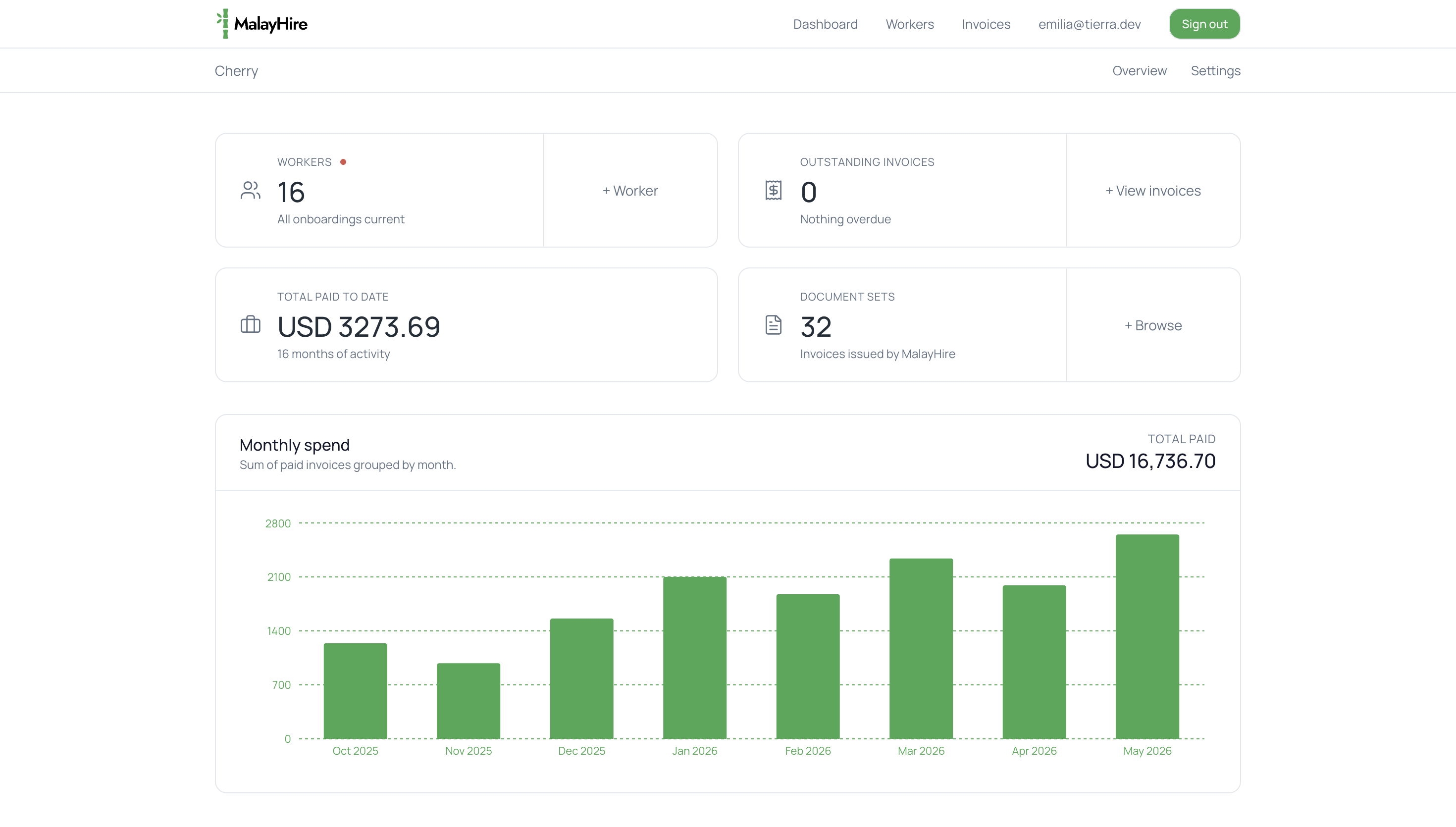
Manage your Malaysian team, payroll & EOR compliance in one place.