
Doing Business in Malaysia: An API-First Approach to Payroll Compliance Testing with EOR Sandboxes


Doing Business in Malaysia: An API-First Approach to Payroll Compliance Testing with EOR Sandboxes

Key Takeaways
- Sandbox testing is not a luxury—it's a necessity for any foreign company that wants to run payroll in Malaysia without triggering EPF, SOCSO, or PCB penalties.
- A dedicated Malaysia EOR sandbox mirrors the real statutory deadlines and contribution tables that generic global sandboxes often approximate or omit entirely.
- API authentication for Malaysian payroll compliance demands scope definitions that go beyond global token types, specifically around foreign worker levy and minimum wage adjustments.
- Deel’s sandbox provides full API access and sample organizations, but local labor law simulation gaps appear when you try to validate HRDF levy tiers or EIS eligibility criteria.
- Forward-thinking teams are moving to a 48-hour sandbox-to-production workflow where they validate EPF scheduling, PCB calculations, and SOCSO contributions before the first employee ever logs in.
- Common sandbox pitfalls include ignoring non-standard allowances that affect PCB, skipping EIS for employees over 60, and forgetting that HRDF registration rules change based on industry classification.
- You can dramatically compress your market entry timeline by choosing an EOR platform that exposes compliance-check endpoints directly in its sandbox API, rather than treating sandbox as a simple payroll calculator.
- Real-world case studies prove that a single sandbox simulation can expose a 6-figure compliance gap—and fix it before a single ringgit changes hands.

Introduction: Why Sandbox Compliance Testing Changes Everything About Doing Business in Malaysia
When most people hear 'doing business in Malaysia,' they picture KL skyscrapers, halal supply chains, or maybe a digital nomad sipping kopi at a co-working space. But the real story—the one that actually determines whether your expansion survives year one—happens inside a payroll sandbox. It’s not sexy, but it’s where the margin between a seamless launch and a bureaucratic nightmare lives.
Malaysia’s statutory framework isn’t just a checklist you can tick after hiring. EPF contributions have strict tiered rates based on age and wages. SOCSO splits into Employment Injury Scheme and Invalidity Scheme with separate ceilings. EIS adds another layer for employees under 60. Then HRDF kicks in for certain industries, levying a percentage on top. If you’re a foreign company, the Ministry of Human Resources expects these deductions to be filed accurately and on time—every month. No grace period for 'just testing.'
This is precisely why smart teams are turning to EOR sandboxes: fully isolated environments pre-loaded with sample Malaysian employee profiles, designed to simulate actual payroll runs before a real hire is made. By pushing compliance checks earlier in the process—into a space where mistakes cost nothing—you’re essentially redefining what doing business in Malaysia looks like. It’s no longer about filling out forms after the fact; it’s about validating your entire payroll engine weeks or months before you press go.
How Malaysia’s Statutory Landscape Demands a Sandbox, Not Just a Calculator
Some entrepreneurs assume a simple gross-to-net spreadsheet can handle local payroll. That might work until you encounter Malaysia’s tiered statutory contributions. Let’s take EPF alone: the employee’s share drops from 11% to 0% for those aged 60 and above, while the employer’s rate shifts from 12–13% for most to just 4% for older workers. Miss that cut-off by one month, and you’ve under-contributed—something KWAP (the EPF body) will flag during an audit.
SOCSO isn’t any simpler. The Employment Injury Scheme is mandatory for all employees earning under RM4,000, while the Invalidity Scheme coverage is required for employees under 60—but only if they haven’t opted for exemption. Then there’s EIS, which funds re-employment programs and is compulsory for workers under 60. If your sandbox doesn’t simulate these age-based triggers automatically, you’re flying blind.
HRDF adds an industry dimension. Companies in manufacturing, services, and certain other sectors must register and contribute a levy for each Malaysian employee. The levy rates vary, and failure to register can result in fines of up to RM10,000 or even imprisonment. A generic global sandbox might not even include HRDF at all—it’s often treated as a footnote, not a core component of Malaysian compliance.
The Real Cost of Payroll Guesswork
Think about this: a European startup hires a Malaysian sales director at RM15,000 per month. They apply a flat 12% employer EPF rate, but the director is 57—the employer should only pay 4% once they turn 60. In a sandbox simulation, that error surfaces immediately. In the real world, it surfaces 18 months later with backdated contributions, compounded interest, and a compliance officer demanding explanations. A sandbox flips this dynamic, letting you play out the entire calendar year of statutory changes before spending a real cent.
Beyond Deductions: Statutory Filing Deadlines Matter
A sandbox isn’t just about getting numbers right—it’s about timelines. EPF contributions are due by the 15th of the following month. SOCSO and EIS by the 15th as well. PCB (monthly tax deductions) by the 15th, unless you’re under the e-PCB system which aligns with payroll dates. HRDF follows a similar schedule. In a sandbox, you can simulate what happens when your May payroll run gets delayed to the 16th. The system should flag late filing penalties, prompting you to build internal calendar controls. Global sandboxes might not enforce these calendar limits at all.
A Deep-Dive into Global EOR Sandboxes: Deel's Offering vs a Malaysia-Dedicated Approach
Deel’s developer documentation describes their sandbox as 'a completely isolated environment pre-populated with sample data, including sample workers and organizations,' offering 'Full API Access' to experiment with all production endpoints. That’s genuinely useful for testing authentication flows, webhook triggers, and basic payroll calculations. However, when you drill into Malaysia-specific compliance, the simulation fidelity begins to fray.
For instance, Deel’s sandbox includes sample workers, but does it automatically age them up so you can test the EPF rate change at 60? Does it simulate an employee’s EIS eligibility flag flipping off the moment they turn 60? These are edge cases a Malaysia-dedicated sandbox would bake into its sample data from day one. A local EOR sandbox—like the kind a provider wholly focused on Malaysia might offer—would likely include pre-built worker profiles at ages 29, 45, 61, and 64, each with correct statutory defaults. It would also have industry-coded organizations so you can toggle HRDF levy applicability on or off, something global sandboxes often bypass by asking you to fill in the levy manually rather than triggering it via API rules.
Where Global Sandboxes Excel—and Fall Short
Global sandboxes shine at API coverage breadth. According to Deel’s docs, the sandbox lets you test 'all production endpoints,' which means you can trial-run creating entities, assigning contractors, and pulling reports—all without touching live data. The authentication layer supports both API Tokens and OAuth2, so you can model your production security posture. But local Malaysian statutes like the Employees' Minimum Standards of Housing, Accommodations, and Amenities Act 1990 (Act 446)—which mandates housing allowances for plantation workers—or the nuanced PCB categories for non-resident employees simply aren’t endpoints on a global API. They require local domain knowledge that gets encoded into the sandbox logic of a dedicated Malaysian EOR.
The MCP Protocol and What It Means for Compliance Automation
Deel’s introduction of the Model Context Protocol (MCP) is fascinating. It’s an open standard connecting AI models to external services, communicating over HTTP using JSON-RPC 2.0 with SSE for streaming. Imagine an AI agent that can query your EOR sandbox for compliance status. That’s the future. But again, the tools exposed through MCP—across three permission levels—are designed for global functionality. A Malaysia-specific sandbox could expose fine-grained tools: 'simulate_end_of_year_aging' to trigger EPF rate changes, or 'trigger_hrdf_inspection' to generate sample audit reports. Right now, those don’t exist on global MCP servers. The gap is clear: global sandboxes give you a blank canvas; local sandboxes give you a pre-drawn map of Malaysian statutory terrain.
The API Authentication Blueprint for Malaysian Payroll Sandboxes
Every EOR API requires authentication—that’s table stakes. Deel’s documentation states all requests must be made over HTTPS, and they support API Tokens (used as bearer tokens) and OAuth2. But when you’re integrating with a sandbox specifically for Malaysia, the token scopes you request matter more than the auth method itself.
Consider what a global API token typically includes: read/write access to workers, entities, payments, contracts. Now layer in Malaysia-specific scopes. You’ll likely need 'epf:read,' 'socso:write,' 'eis:calculate,' and 'hrdf:status.' A dedicated EOR sandbox would let you create an API token with a scope like 'msia_statutory_full,' which automatically bundles all four bodies. In a global environment, you might have to request 'financials:write' (too broad) and hope EPF updates get included, or cobble together multiple scopes—creating security bloat.
The authentication flow itself is straightforward: generate a token in the sandbox UI, store it in your environment variables, and pass it as a bearer token. But the real test comes when you try to invoke a PCB calculation endpoint. If your token doesn’t have the scope to access the automated PCB scheduler based on LHDN’s e-PCB tables, the sandbox will return a 403. You’ll waste hours debugging auth issues that trace back to scope design, not code.
API Token Scopes: Global vs Malaysia-Specific
- Global scopes like 'payroll:admin' give blanket access but lack granularity to enforce least-privilege for statutory bodies.
- A Malaysia-dedicated sandbox might expose scopes like 'socso:read' for validation-only, 'socso:submit' for actual filing, and 'socso:migrate' for historical data import.
- The foreign worker levy (PLKS) introduces another scope dimension: global tokens rarely have a 'foreign_worker_levy' scope—you’d tap into 'payroll:duties' instead, which could inadvertently expose confidential salary data.
- Minimum wage adjustments (currently RM1,500–RM1,700 depending on location and employer size) require a scope that reads regional wage zones; in a local sandbox, 'minimum_wage:zone' could be a distinct scope, preventing accidental overrides.
- OAuth2 with granular consent screens allows your app to request exactly what it needs, but only if the authorization server defines those granular scopes—something global providers often skip for smaller markets.
- A well-designed sandbox will let you test token expiration and refresh token flows against mock Malaysian statutory filing deadlines, ensuring your integration doesn’t break on the 15th of the month.
Practical Token Architecture for a Two-Person Dev Team
You don’t need a fintech-grade OAuth2 setup to do meaningful sandbox work. A simple API token with scopes for 'epf:simulate,' 'pcb:calculate,' 'eis:check,' and 'socso:simulate' gets you 90% of the way. Store it in a .env file, and prefix every sandbox request with a header that identifies the call as a simulation. This lets you run side-by-side comparisons: one set of calls with the Malaysia-specific scopes, another with generic global scopes, and diff the outputs to spot gaps.
Step-by-Step: Validating EPF, SOCSO, EIS, and HRDF in a Sandbox Environment
Let’s move from theory to action. Below is a workflow you can execute in any EOR sandbox, though the fidelity of results will be substantially higher in a Malaysia-dedicated one. We’ll assume you’ve already authenticated and have your sample organization set up.
- **1. Create sample employees with age variations.** Build at least five profiles: a 25-year-old earning RM2,500, a 40-year-old at RM6,000, a 57-year-old at RM8,000, a 62-year-old at RM4,000, and a 66-year-old at RM3,000. Tag each with a start date at least 12 months in the past so you can simulate anniversary-based events.
- **2. Run a full payroll cycle for Month 1.** Generate EPF, SOCSO, EIS, and PCB calculations. Verify that the 62-year-old’s EPF employee share is 0% and employer share is 4%, not the default 12–13%. Confirm that EIS is not calculated for anyone aged 60 or above.
- **3. Simulate a mid-year birthday transition.** Fast-forward the sandbox calendar so that the 57-year-old turns 60 exactly on June 15. Run the June payroll. Did the system automatically switch EPF rates for the second half of the month? Does SOCSO Invalidity Scheme coverage drop? A robust sandbox will show prorated changes; a basic one might keep the old rates for the full month.
- **4. Introduce HRDF levy logic.** Tag your organization as 'manufacturing' with more than 10 Malaysian employees. Run payroll again. The sandbox should calculate the HRDF levy at 0.5% or 1.0% depending on employee count and sector. If the sandbox doesn’t automatically apply it, you’ll know HRDF integration is missing.
- **5. Generate statutory contribution statements.** Pull the Form 8A (EPF), Form 8B (SOCSO), and the monthly PCB statement. Compare these against manual calculations using LHDN’s monthly tax deduction tables. Look for rounding discrepancies—some sandboxes use different rounding rules than the official schedules.
- **6. Simulate a late payment.** Shift the payroll processing date to the 20th. The sandbox should generate late payment interest: for EPF, that’s a dividend-based rate plus 1% per annum; for PCB, it’s a 10% penalty plus late payment charges. If the sandbox doesn’t enforce these, you’ve identified a critical gap.
- **7. Test foreign worker levy (PLKS).** Add a sample employee with a foreign worker status and an approved PLKS renewal date. Check if the sandbox calculates the employer levy for the sector (manufacturing, construction, agriculture) and includes it in the cost breakdown.
- **8. Document anomalies.** Every deviation between expected statutory treatment and sandbox output becomes a flag for your production implementation. These aren’t bugs—they’re compliance risks that need mitigation before you go live.
Real-World Case Study: Simulating a Malaysian Hire in 48 Hours Using an EOR Sandbox
A European SaaS startup—call them CloudVest—decided to hire a Kuala Lumpur-based customer support team of four people. They had zero prior footprint in Asia, and their finance team was nervous about Malaysia’s multi-layered statutory deductions. Instead of spending weeks reading through PDFs from the Employees Provident Fund, they turned to an EOR platform that offered a Malaysia-specific sandbox.
On a Monday morning, their HR lead created a sandbox organization, uploaded dummy identities matching their intended hires’ age brackets, salaries, and start dates. By Monday afternoon, the sandbox had generated the first payroll simulation. Immediate red flag: one hire was 59 years and 10 months old. The sandbox projected that in just two months, the employer EPF rate would drop from 13% to 4%, resulting in an employer savings of over RM720 per month—but also requiring updated employment contract terms. Without the sandbox, this transition would have been missed, leading to erroneous contributions that the company would later have to reclaim.
By Tuesday, the team ran a full 12-month simulation using the sandbox’s calendar-advancement feature. They discovered that the annual EIS cap maxed out earlier than expected for the highest earner, meaning the system should stop deducting EIS after reaching a certain total contribution. The sandbox showed exactly when that would happen, allowing CloudVest to schedule a mid-year payroll adjustment. By Wednesday, they had validated all contribution forms, matched them against manual calculations, and signed off on the production configuration. Within 48 hours of starting, they went from zero confidence to a signed EOR service agreement—and their first employee was onboarded the following week without a single compliance hiccup.
What made this possible wasn’t just any sandbox, but one that embedded Malaysian statutory calendars, age-triggered rate adjustments, and contribution ceilings directly into its simulation logic. A generic sandbox would have required manual calendar manipulation and table lookups, adding days—not hours—to the testing cycle.
Common Pitfalls in Sandbox-Based Compliance Testing and How to Avoid Them
Even with a good sandbox, smart people make predictable mistakes. Recognizing these patterns can save you from a false sense of security.
- **Assuming all allowances are PCB-exempt.** Travel allowances, meal allowances, and certain perquisites have specific PCB treatment. In a sandbox, if you don’t configure allowance types correctly, your PCB calculations will be too low. Always check if the sandbox includes an allowance taxonomy aligned with LHDN guidelines.
- **Forgetting that EIS stops at 60, but SOCSO Employment Injury Scheme doesn’t.** Employees beyond 60 still need EIS if they haven’t opted out? Actually, EIS is for workers under 60 only. But SOCSO Employment Injury Scheme continues even after 60. A sandbox that lumps all age-based rules together might incorrectly drop SOCSO for older workers, causing an under-contribution.
- **Ignoring the HRDF industry classification toggle.** Not every sector pays HRDF. Some startups assume they’re exempt, but if your business falls under 'selected services'—which includes IT services—you might be liable. Use the sandbox to test with and without an HRDF-registration flag to see the levy impact.
- **Using a single sample employee for all tests.** A 30-year-old earning RM5,000 won’t surface EPF tier changes or EIS contribution ceilings. Your sandbox test suite needs a demographic spread that mirrors your actual hiring plan.
- **Testing only nominal payroll runs.** Simulate bonuses, backdated salary increments, and termination payments. These trigger edge cases in PCB formula (using the averaging method) and EPF/SOCSO treatment that a simple monthly run won’t reveal.
- **Overlooking PCB for non-resident employees.** If you plan to hire expats on Employment Pass, their PCB is handled differently—often at a flat rate of 30% or under a double taxation agreement. The sandbox should allow you to toggle residency status and see the correct withholding.
Key Considerations When Choosing an EOR with a Robust Sandbox for Malaysia
Not every EOR platform makes sandbox testing easy. When you’re evaluating providers, dig into their sandbox capabilities with the same rigor you’d apply to their compliance promises.
Evaluate Sandbox Fidelity, Not Just API Coverage
A platform might boast 'full API access' in the sandbox, but can it model the exact EPF rate table for employees aged 60 and above? Ask the provider for a sample sandbox run showing an employee aging from 59 to 60 mid-month. If they can’t produce that in a meeting, the simulation fidelity is likely low. Also check whether the sandbox incorporates the latest statutory updates: minimum wage changes effective May 2022 and July 2024, SOCSO contribution rate adjustments from 2023, and any COVID-era relief measures that may have expired.
- Request a sandbox demo with pre-built Malaysian worker profiles that span all age brackets and salary tiers.
- Test whether HRDF levy is automatically triggered by industry code, not manually entered by the user.
- Confirm that foreign worker levy calculations distinguish between manufacturing, construction, and agricultural sectors.
Look for Sandbox-Specific Documentation on Malaysian Statutory Endpoints
Deel’s developer portal is a good benchmark—it clearly documents API tokens, OAuth2, and MCP protocol. But you’ll also need endpoints that explicitly call out EPF scheduling, SOCSO contribution tiers, and EIS eligibility. A provider that doesn’t have dedicated documentation for these will leave you reverse-engineering from generic payroll endpoints.
Consider the Timeline from Sandbox to Production
The ultimate goal is speed and confidence. A platform like MalayHire EOR, for example, positions itself on a 48-hour onboarding flow. If the sandbox environment is tightly integrated with the live EOR service, you can simulate a payroll run on Tuesday, and by Thursday have your first employee legally hired. Ask about the hand-off: does the sandbox configuration export directly to production, or do you have to re-enter everything manually? The former slashes time-to-hire dramatically.
What This Means for You: Doing Business in Malaysia Without the Compliance Anxiety
We’ve spent a lot of time in the technical weeds, but the big picture is this: doing business in Malaysia is overwhelmingly attractive from a market perspective—strategic location, talent pool, infrastructure. Yet the compliance ecosystem remains one of the most under-prepared-for aspects of market entry. A sandbox-first approach flips the narrative. Instead of worrying whether you’ll miss an EPF contribution or misclassify a foreign worker, you can validate every line of statutory deductions before a single employee knows your company name.
This approach also changes your internal conversation. Your CFO doesn’t need to trust that 'the EOR will handle it'—you hand them a generated compliance report from the sandbox, showing month-by-month contributions, tax filings, and audit trails. That’s the kind of evidence that gets expansion budgets approved.
Finally, remember that sandbox testing isn’t a one-and-done exercise. Each time Malaysia updates its minimum wage, changes SOCSO rates, or tweaks the PCB formula, you’ll want to spin up the sandbox again and re-validate. Make configuration re-testing part of your quarterly compliance rhythm. Because in the world of Malaysian statutory contributions, surprise is not a strategy.
Frequently Asked Questions
What is the difference between an EOR sandbox and a standard payroll calculator for Malaysia compliance testing?
An EOR sandbox simulates the entire payroll process for Malaysia including EPF, SOCSO, EIS, and HRDF contributions using real-time data and API calls, while a standard calculator only provides static estimates based on manual inputs without integration testing. This distinction matters for verifying accurate compliance with Malaysia's statutory requirements during onboarding.
How do I authenticate API calls when testing Malaysian payroll compliance in a sandbox environment?
You authenticate API calls for Malaysian payroll sandboxes by using OAuth 2.0 tokens or API keys provided by your EOR platform after generating them in the developer dashboard. Always include these credentials in the request header for security authorization and validate token expiration periods to avoid failed compliance simulations during testing.
Can I simulate a full employee lifecycle for a Malaysian hire in an EOR sandbox before going live?
Yes, you can simulate a full employee lifecycle in an EOR sandbox including onboarding, salary calculations, statutory deductions for EPF, SOCSO, EIS, and HRDF, as well as offboarding events, to verify compliance end-to-end. This approach allows you to identify and resolve payroll errors without financial risk or legal exposure.
What are the most common errors that occur when testing EPF contributions in a Malaysia payroll sandbox?
The most common errors in EPF sandbox testing include incorrect categorization of employee residency status for contribution rates, mismatched wage ceilings based on monthly salary tiers, and failure to apply proper employer share percentages for different age groups. These mistakes can trigger non-compliance alerts that require data adjustments.
How long does it typically take to validate SOCSO and EIS contributions using an EOR sandbox for Malaysia?
Validating SOCSO and EIS contributions in an EOR sandbox typically takes 48 to 72 hours including initial setup, API credential configuration, and running multiple test scenarios with different salary bands. This timeframe allows you to verify contribution ceilings and employer-employee ratios accurately against Malaysia's official schedules.
What specific statutory data does an EOR sandbox need to simulate accurate HRDF contributions for Malaysia?
An EOR sandbox for HRDF simulations requires employee nationality, monthly salary amount, employment sector classification, and company levy registration status to calculate contributions correctly. The system applies a 1% employer-only rate based on salary thresholds and generates reporting data for monthly remittance.
Does an API-first EOR sandbox work differently for foreign versus local employees in Malaysia payroll testing?
Yes, an API-first EOR sandbox applies different rules for foreign employees including higher EPF contribution rates for non-citizens, exemption from certain SOCSO categories like employment injury coverage, and distinct HRDF levy obligations based on work permit types. Proper sandbox configuration flags these differences automatically during testing.
What should I do if my sandbox compliance test shows a discrepancy between calculated and expected statutory contributions for Malaysia?
If you find a discrepancy in statutory contributions, first verify the employee data inputs including base salary, allowances, and employment type against Malaysia's official contribution tables. Then review your API call parameters for correct employee categorization and re-run the simulation after adjusting values to confirm compliance alignment.
MalayHire is your most cost-effective Employer of Record (EOR) in Malaysia
Hire full-time employees in Malaysia and save costs by avoiding hefty contractor fees. MalayHire handles payroll, employment contracts, statutory compliance (EPF, SOCSO, EIS), and HR admin. Start onboarding your Malaysian hire now, with MalayHire.
Trusted by global companies hiring in Malaysia





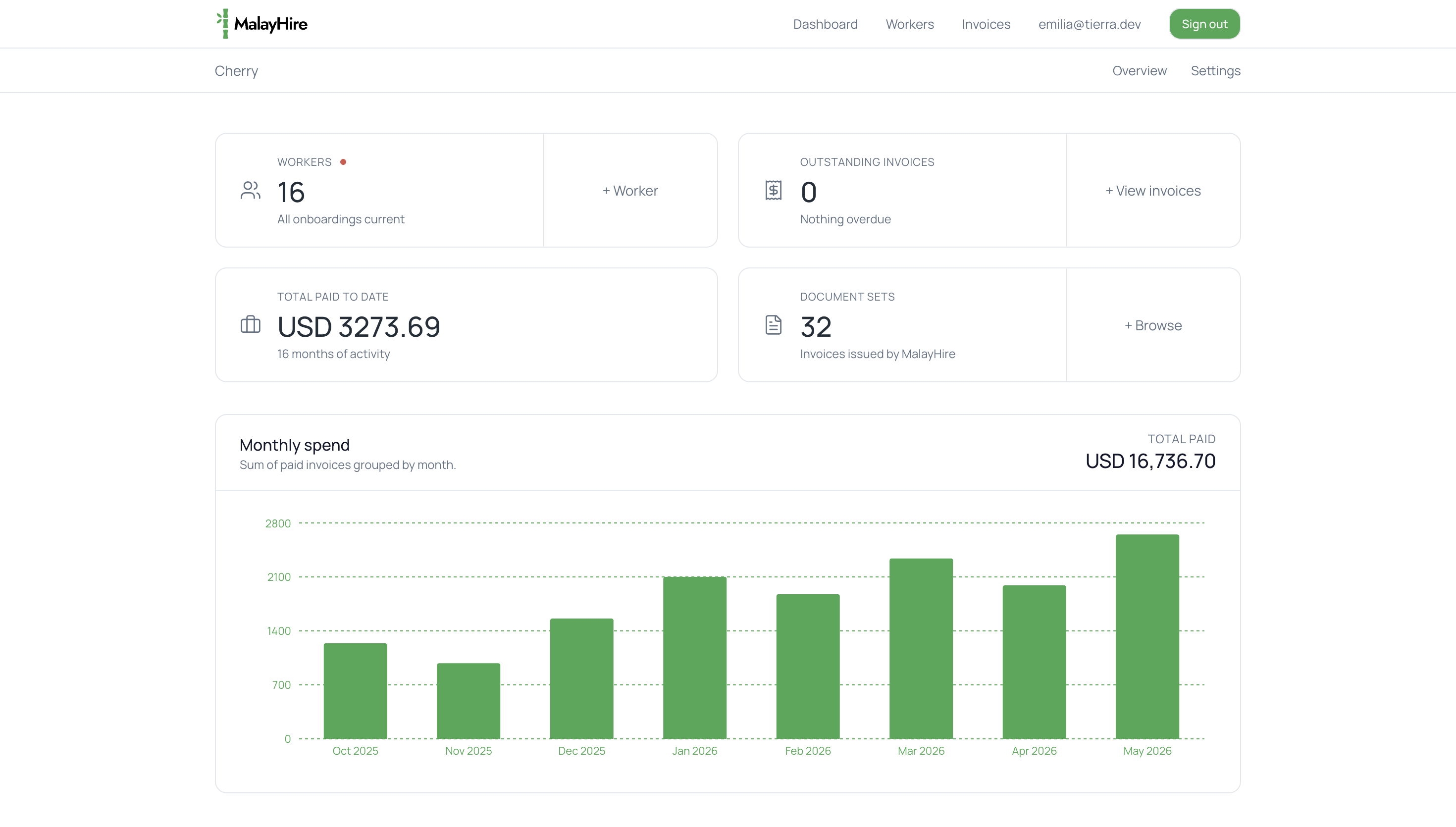
Manage your Malaysian team, payroll & EOR compliance in one place.