
EIS Malaysia Employer Obligations Explained: A Practical Guide for Companies Hiring Locally


EIS Malaysia Employer Obligations Explained: A Practical Guide for Companies Hiring Locally

Key Takeaways
- The Employment Insurance System (EIS) is a mandatory safety net requiring both employer and employee monthly contributions, separate from EPF and SOCSO.
- Employers must register all eligible Malaysian employees immediately and ensure contributions start from their first month of employment — there's no grace period.
- Contribution rates are fixed at 0.2% of the employee's monthly wage for the employer and 0.2% for the employee, capped at a wage ceiling of RM5,000.
- EIS provides financial aid such as job search allowance, re-employment programs, and training for employees who lose their jobs involuntarily.
- Failures like missing registration deadlines, misclassifying workers, or late payments can incur fines up to RM10,000 or imprisonment under the EIS Act 2017.
- Foreign employees are generally not covered under EIS, but special rules apply to permanent residents and expatriates with specific visa categories — always verify with PERKESO.
- Modern Employer of Record (EOR) platforms automate EIS registration, payroll deductions, and monthly contributions alongside other statutory obligations, eliminating manual errors.
- EIS compliance isn't just about paying contributions; it also involves maintaining records for seven years and informing PERKESO of terminations within 30 days.

What Exactly Is the EIS and Why Does It Matter for Employers?
If you're hiring in Malaysia, you've likely encountered the acronyms EPF, SOCSO, and maybe PCB — but EIS tends to fly under the radar until an auditor knocks on your door. The Employment Insurance System, launched in 2018 under the Employment Insurance System Act 2017, is a social safety net funded by monthly contributions from both you and your employees. It isn't optional. Like SOCSO and EPF, it's a statutory requirement with real teeth. The system is administered by PERKESO (the Social Security Organization), the same body that handles SOCSO.
The core purpose is straightforward: when an employee loses their job involuntarily, EIS steps in with temporary financial assistance and re-employment support. For you as an employer, this means every month you're obligated to deduct the employee's share from their wages, add your own share, and pay the total to PERKESO. It's not a heavy financial burden — the rates are low — but the compliance requirements are precise and non-negotiable. Miss a contribution, register an employee late, or misreport wages, and you could be facing penalties that range from small fines to a court summons.
Understanding EIS inside out isn't just about avoiding trouble. It directly affects your employment contracts, payroll processes, and even how you handle terminations. If you're a foreign company without a local entity, the obligation still exists for your Malaysian employees, and an EOR like MalayHire absorbs that responsibility on your behalf. But whether you handle payroll in-house or outsource it, knowing the employer's obligations under EIS is essential for anyone managing a Malaysia-based team.
Employer Obligations at a Glance: Registration, Contributions, and Beyond
You can think of your EIS duties in three buckets: registration, monthly contributions, and reporting obligations. Each one is tightly regulated. The moment an employee walks in the door on their first day, the clock starts ticking. You don't get a trial period to figure out whether EIS applies — if the person is a Malaysian citizen (or a permanent resident) and working under a contract of service, they're covered, period. The only thing you need to check is whether any exemption criteria exist, and those are narrow.
- Mandatory registration: All eligible employees must be registered with PERKESO within 30 days of their employment start date. Late registration is a common compliance gap.
- Fixed contribution rates: Employer pays 0.2% of the employee's monthly wage, employee pays 0.2%, based on a wage ceiling of RM5,000. If salary exceeds RM5,000, the contribution is capped at RM10 per party.
- Monthly payment deadlines: Total EIS contributions are due by the 15th of the following month, same as SOCSO. Use the PERKESO portal or appointed banks.
- Record keeping: Keep payroll records showing EIS deductions for at least seven years. Audits can happen without warning.
- Termination notification: If an employee is terminated, laid off, or resigns under circumstances that may qualify them for EIS benefits, you must inform PERKESO within 30 days.
- No partial compliance: Even if an employee works part-time or on a fixed-term contract, as long as they earn a wage, EIS applies unless they fall under a specific exempt category (e.g., foreign domestic helpers, self-employed individuals).
Who Is Covered and Who Isn't: The Fine Print That Trips Up Employers
Here’s where a lot of companies stumble. The EIS Act covers employees — defined as anyone who works under a contract of service or apprenticeship, whether written or implied. That sounds broad, and it is. Malaysian citizens and permanent residents are automatically subject to EIS, unless the employee is aged 60 or over (optional, but contributions stop at age 60), or the person is employed in a few specific categories like domestic servants, self-employed individuals, or members of the armed forces. Foreign workers, however, are generally excluded from EIS coverage. This can be confusing because the same foreign employee might be covered by SOCSO's Employment Injury Scheme but not by EIS.
If you hire an expatriate on a work permit or a foreign worker, double-check with PERKESO whether EIS applies. The rule of thumb: if the employee doesn’t have a Malaysian MyKad or a permanent resident MyPR card, they’re probably not covered. But there’s an edge case: Employees who are permanent residents and hold a MyPR card are treated the same as citizens for EIS purposes. So if you’ve got a foreigner who has obtained Malaysian PR, EIS contributions must start immediately.
For companies using an EOR, part of the value is that compliance experts flag these nuances before payroll runs. Without that, it’s easy to either incorrectly charge EIS to a foreign employee (over-deducting) or fail to deduct for an eligible PR holder (under-deducting), both of which raise red flags during a SOCSO audit.
Calculating EIS Contributions: Numbers That Keep You Out of Trouble
The math is simple — so simple that it’s almost embarrassing to get it wrong, yet errors happen all the time because payroll systems aren't configured correctly. For every eligible employee, the monthly EIS contribution is calculated as 0.2% of their monthly wages. The employer matches that 0.2%. So total contribution is 0.4% of wages, split equally. But the wages subject to EIS are capped: you only calculate on the first RM5,000 of an employee's gross monthly salary. If someone earns RM7,000, you calculate as if they earn RM5,000. That makes the maximum monthly contribution RM10 from the employer and RM10 from the employee — a flat RM20 total for high earners.
Wages for EIS purposes include basic salary, fixed allowances (like housing or transport), and commissions. Overtime, bonuses, and travel reimbursements are usually excluded. If you have employees on variable income — say a salesperson with a low base and high commission — you'll need to calculate EIS each month based on the actual payable amount, still capped at RM5,000. Let’s look at a few quick examples:
- Employee A earns RM2,800 basic: Employer and employee each pay RM5.60 (0.2% of RM2,800), total RM11.20.
- Employee B earns RM6,200: Contribution capped at RM5,000, so employer and employee each pay RM10.00, total RM20.00.
- Employee C earns RM1,200 (part-time): Both parties pay RM2.40 each, total RM4.80.
- Penalty if missed: Late payment interest of 6% per year on outstanding amounts, plus potential compound and prosecution.
EIS vs. SOCSO: Clarifying the Overlap That Confuses Finance Teams
It's common for employers new to Malaysia to assume EIS and SOCSO are the same thing or that contributing to SOCSO covers EIS obligations. They are two separate schemes run by the same organization, PERKESO, with different contribution tables, different objectives, and different coverage rules. SOCSO provides employment injury and invalidity benefits; EIS is a re-employment safety net. You cannot combine them or skip one because you pay the other.
Here's the practical distinction: SOCSO contributions are tiered based on wage brackets, with employer shares ranging from about 1.25% to higher percentages depending on the scheme (Employment Injury and Invalidity). EIS is a flat rate regardless of wage bracket, as long as you're under the ceiling. This means in your payroll system, you'll see separate line items for SOCSO (employer), SOCSO (employee), EIS (employer), and EIS (employee). If your finance team only looks at the total deduction, they might miss that EIS isn't being paid.
When auditing your payroll, a quick check is to ensure every eligible employee has all four deduction columns. If a payslip shows only SOCSO but not EIS for a Malaysian employee under 60, you've got a compliance gap. Using a localized payroll provider or an EOR that understands these granularities eliminates the risk of such omissions. They'll automatically set up the correct statutory tables for each employee based on citizenship status and age.
How EIS Claims Affect Employers: What You Need to Know After a Termination
Most employers only think about contributions, but the EIS system also has obligations after a dismissal. When an employee is terminated, laid off, or their contract isn't renewed, the employer must issue a termination letter stating the reason. The employee can then apply for EIS benefits (Job Search Allowance, Early Re-Employment Allowance, or Training Fee). Your responsibility at this stage is to provide accurate documentation and cooperate with any PERKESO verification. If you misrepresent the reason for termination or fail to notify PERKESO within 30 days, you could be penalized.
There's a direct impact on your business, too. EIS claims can be denied if the employer didn't make adequate contributions during the qualifying period. For example, to be eligible for Job Search Allowance, the employee must have paid contributions for at least 12 months in the 18 months before job loss. If your payroll missed contributions, or if you never registered the employee, they lose their social protection — and you lose trust, potentially face legal risks. Moreover, PERKESO may pursue you for back contributions with interest.
This is another reason why a digital-first approach to payroll compliance matters. Platforms that automate contributions and track each employee's contribution history in real-time ensure there are no gaps. For employers scaling fast, especially those hiring 10, 20, or 50 Malaysian employees in a short window, manually checking EIS registration for each person becomes a administrative nightmare. An EOR that guarantees 48-hour onboarding and immediate statutory registration solves this before it becomes a liability.
Common Compliance Pitfalls and How to Sidestep Them
Over the years, PERKESO audits have revealed a pattern of mistakes. The most frequent is simply forgetting to register an employee at all. Startups and fast-growing SMEs are especially guilty — an HR manager onboards a remote worker and assumes the payroll provider will handle it, but the registration wasn't triggered because the employee's status wasn't properly classified in the system. Another classic: misclassifying a short-term contractor as self-employed and not paying EIS, even though the working relationship clearly constitutes a contract of service.
- Delayed registration: Even if contributions are backdated, the initial failure to register within 30 days is a violation. Automate new-hire triggers in your HR system.
- Incorrect wage ceiling: Some payroll systems apply the ceiling only after salary reaches RM5,000 in total, but it must be applied monthly for each employee individually.
- Assuming foreign employees are covered: Deducting EIS for a foreign worker on a work permit is incorrect and requires refunds, which can be messy.
- Missing termination notifications: Create a standard offboarding checklist that includes sending Form P46 (or the relevant PERKESO termination form) within the deadline.
- Not reconciling PERKESO statements: Compare your internal payroll report with the monthly PERKESO statement to catch discrepancies early.
Streamlining EIS Management: Why More Employers Are Turning to Digital EOR Solutions
If you're headquartered overseas, hiring Malaysians without a local entity used to mean setting up a subsidiary — an expensive, months-long process — or risking non-compliance with piecemeal contractor arrangements. Employer of Record services changed that. A localized EOR like MalayHire acts as the legal employer, handling all statutory registrations, including EIS, EPF, SOCSO, and HRDF, while you manage the day-to-day work. The 48-hour onboarding that MalayHire offers means a new hire is registered for EIS before their first month's contribution is due, eliminating the late registration trap entirely.
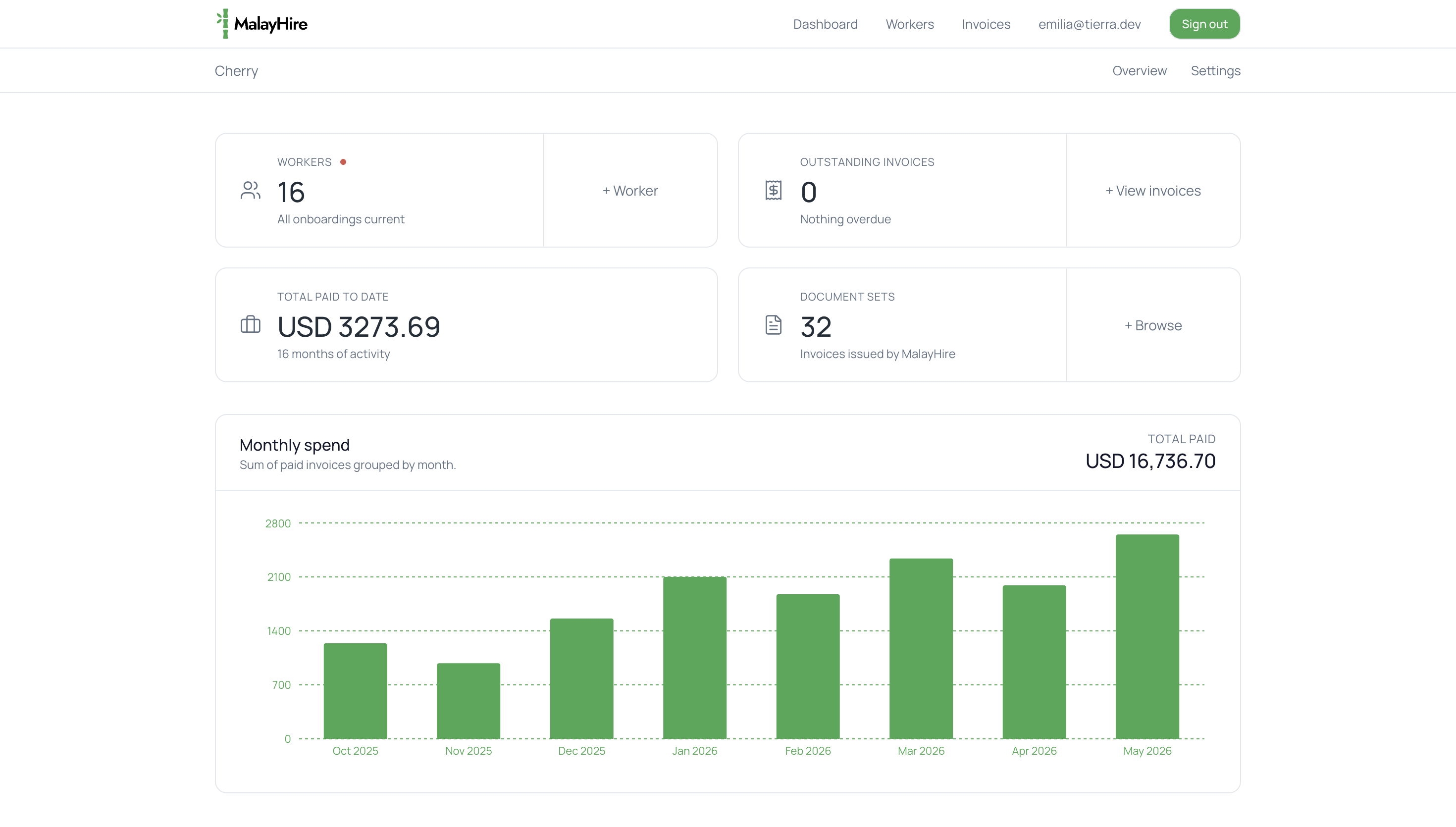
Beyond registration, a digital EOR platform provides a single dashboard where you can see all contributions for each employee, generate compliance reports, and store the mandatory seven-year records. Instead of chasing paper forms or navigating the PERKESO online portal as a foreign company, you upload the employee's details once, and the system automatically calculates the correct EIS (and other) deductions for each payroll cycle. This accuracy is especially critical when employees have variable pay or move in and out of the wage ceiling. Moreover, when an employee leaves, the EOR handles termination documentation and PERKESO notification, ensuring you never miss that 30-day window.
Cost-wise, the financial commitment is predictable — a fixed monthly per-employee fee that typically covers all statutory compliance. Considering the fines for non-compliance can reach RM10,000 per offense, and the time your HR or finance team spends reconciling contributions, the business case for an EOR often writes itself. For companies that value speed and want to avoid building local payroll expertise from scratch, it’s a pragmatic choice.
Questions to Ask Your Payroll Provider About EIS Compliance
Whether you manage payroll in-house or use a service, you need certainty that EIS obligations are met. Here are some pointed questions to put to your provider. If they hesitate or can’t answer clearly, that’s a red flag.
- How do you determine EIS eligibility for new hires, and what proof of registration do you provide?
- Can your system differentiate EIS rules for Malaysian citizens, permanent residents, and foreign workers automatically?
- What happens if an employee’s salary fluctuates — does the system recalculate EIS each month based on actual gross pay up to the ceiling?
- How are termination notifications and PERKESO reporting handled within your service?
- Do you provide a monthly reconciliation report showing each employee’s EPF, SOCSO, and EIS contributions separately, with PERKESO reference numbers?
- What records do you maintain, and for how long, to satisfy the seven-year audit requirement?
Frequently Asked Questions
What happens if an employer fails to register for EIS in Malaysia?
Employers who fail to register for the Employment Insurance System face legal penalties under the Social Security Act. PERKESO can impose fines up to RM10,000 or imprisonment for up to two years for non-compliance. Additionally, the employer remains liable for all unpaid contributions plus a compounded late payment fee of six percent per annum.
Can an employer deduct the EIS contribution from an employee's salary?
Yes, the employee's share of the EIS contribution can be deducted directly from their monthly wages, but the employer must contribute their matching share separately. The combined deduction must appear clearly on the payslip for transparency and audit purposes. Employers cannot shift their statutory contribution portion onto employees under any circumstances.
Is EIS contribution mandatory for foreign workers employed in Malaysia?
No, the Employment Insurance System does not cover foreign workers, expatriates, or domestic servants under current Malaysian legislation. Only Malaysian citizens and permanent residents who fall within the specified age and wage brackets are subject to mandatory EIS contributions. Employers hiring non-citizens should ensure they exclude these workers from EIS calculations to avoid overpayment errors.
How does late payment of EIS contributions affect an employer's business operations?
Late EIS contributions trigger automatic penalties and interest charges that accumulate until full settlement is made. PERKESO may also issue a notice of demand and initiate legal recovery proceedings, which can damage the company's reputation and credit standing. Persistent non-compliance can lead to prosecution, potentially resulting in fines or imprisonment for responsible company officers.
What is the deadline for paying EIS contributions each month in Malaysia?
Employers must remit both employee and employer EIS contributions to PERKESO by the 15th day of the following month. For example, contributions for January wages are due on or before February 15. Failure to meet this monthly deadline triggers a late payment penalty of six percent per annum calculated on the outstanding amount.
Are EIS contributions tax-deductible for employers in Malaysia?
Yes, employer EIS contributions are fully deductible as a business expense under the Income Tax Act 1967. This deduction applies to the employer's portion only and not to the employee's share that is withheld from wages. Companies should maintain proper documentation of contributions to support their tax filings and potential audits.
Can an employer opt out of EIS if they provide private insurance coverage?
No, private employment insurance policies cannot replace the statutory EIS requirement under Malaysian law. EIS participation is mandatory for all eligible employers, regardless of any additional voluntary benefits they offer. Opting out or substituting with private coverage is not permitted and exposes the company to full legal penalties for non-compliance.
Does EIS apply to employees on probation or temporary contracts?
Yes, EIS coverage begins from the first day of employment for all eligible workers, including those on probation, temporary, or fixed-term contracts. There is no minimum service period exemption under the Employment Insurance System. Employers must register new hires and start contributing from the first wage cycle to avoid compliance gaps and potential penalties.
MalayHire is your most cost-effective Employer of Record (EOR) in Malaysia
Hire full-time employees in Malaysia and save costs by avoiding hefty contractor fees. MalayHire handles payroll, employment contracts, statutory compliance (EPF, SOCSO, EIS), and HR admin. Start onboarding your Malaysian hire now, with MalayHire.
Trusted by global companies hiring in Malaysia





Manage your Malaysian team, payroll & EOR compliance in one place.