
Hire Foreign Workers in Malaysia: A Step-by-Step Guide for Business Owners


Hire Foreign Workers in Malaysia: A Step-by-Step Guide for Business Owners

Key Takeaways
- Hiring foreign workers in Malaysia requires a valid Employment Pass (EP) for skilled professionals, and the process is strict about job justification and minimum salary thresholds.
- Companies must first prove the role cannot be filled locally and meet paid-up capital requirements before applying for any foreign worker pass.
- The EP application involves two stages: Expatriate Committee or MDEC approval (Stage 1), followed by the actual pass issuance from Immigration (Stage 2).
- Even with thorough planning, incomplete documentation and job justification rejections are the top reasons applications fail — plan for a 6–8 week timeline if everything goes smoothly.
- Short-term Professional Visit Passes (PVPs) offer a faster route for temporary assignments but cap the stay at 12 months and prohibit direct employment relationships.
- Employer of Record (EOR) platforms can collapse the entire setup timeline to 48 hours by absorbing compliance, contracts, payroll, EPF, and SOCSO under their existing infrastructure.
- Budget realistically: a single Employment Pass can cost RM 1,000–2,000 in government fees alone, excluding agent, legal, or EOR service charges.
- Cultural nuances matter — written justifications must be framed around skills transfer and training of Malaysian counterparts, not just filling a gap.

Why Bringing in Foreign Talent Demands a Different Playbook
If you're running a business in Malaysia and looking to hire foreign workers, you're not alone. The country's ambition to become a high-income economy by 2025 has created intense demand for specialised skills that the local talent pool can't always meet. But navigating the process to legally bring in a foreign professional isn't as simple as extending an offer letter.
The moment you decide to hire foreign workers in Malaysia, you step into a regulatory environment that blends immigration law, labour policy, and economic development goals. You're dealing with two distinct government bodies — the Expatriate Services Division (ESD) under Immigration and, depending on your sector, the Malaysian Investment Development Authority (MIDA) or Malaysia Digital Economy Corporation (MDEC). Each has its own checklist, processing time, and invisible tripwires that can stall your hiring for weeks.
Yet, when you get it right, the payoff is substantial. You bring in expertise that accelerates projects, fills critical gaps, and transfers knowledge to your Malaysian team. This guide is built for business owners like you — HR leads, operations directors, and founders — who need a practical, no-nonsense walkthrough of the entire foreign worker hiring lifecycle. We'll dissect the permits, the paperwork, the costs, and the common mistakes that send applications into a black hole. By the end, you'll know exactly what you're up against and which path — DIY, agency, or EOR — makes sense for your timeline and budget.
The Two-Tier System: Employment Pass vs. Everything Else
Malaysia doesn't offer a single generic 'work visa' for foreign hires. The government has deliberately segmented its foreign workforce into skilled professionals and semi-skilled or unskilled labour. The line is sharp: if your hire holds a degree or has specialised experience and will earn above a salary threshold, they fall under the Employment Pass (EP) category. For short-term gigs, technical support, or machine installation, there's the Professional Visit Pass (PVP). For manual labour, the system uses a separate levy-based Temporary Employment Visit Pass (PLKS), but that route is topic for another discussion.
Your first step is identifying the right pass category. Guessing wrong means the application either gets bounced immediately or, worse, passes initial checks only to be rejected at the endorsement stage. This section breaks down the primary pathways so you can confidently pick the one that matches the role.
Employment Pass (EP) — The Gold Standard for Skilled Hires
The Employment Pass is what you need for any professional, managerial, or technical role that requires a foreign national to reside and work in Malaysia. The EP falls into three tiers based on monthly salary: Category I (RM 10,000 and above), Category II (RM 5,000 to RM 9,999), and Category III (RM 3,000 to RM 4,999, typically for roles in specific industries like hospitality or manufacturing that have approved quotas).
The higher the category, the longer the pass duration — up to five years for Category I, two years for Category II, and one year for Category III, renewable. But don't let the tiers fool you; the real gatekeeper is the 'job justification' requirement. Immigration wants to see a compelling argument that no Malaysian can perform this exact role at this exact salary. That means market salary surveys, detailed job descriptions, and sometimes company-specific training plans for local staff. Without this, even a Category I application can stall.
- Minimum salary RM 3,000/month; RM 5,000 for most professional roles outside hospitality.
- Valid for 1–5 years depending on salary tier and category.
- Requires an approved contract of employment and evidence of the company's paid-up capital.
- Dependents (spouse, children) can apply for a Dependant Pass, and spouses may work with an endorsement.
Professional Visit Pass (PVP) — Short-Term, High Impact
If you need a foreign specialist for a temporary stint — say, to install industrial equipment, train Malaysian staff, or provide consultancy for a specific project — the Professional Visit Pass is your friend. It allows the individual to stay for up to 12 months, usually issued in 6-month increments. The PVP doesn't create an employer-employee relationship under Malaysian law, meaning the foreign national remains employed by their home entity. That simplifies tax obligations and avoids the need for full-blown EP documentation.
Many tech companies use PVPs to rapidly deploy engineers or product managers while they sort out a permanent EP for longer-term roles. The catch? The individual can't receive a salary directly from your Malaysian entity; payments happen via service agreements with the overseas employer. Also, a PVP cannot be converted to an EP in-country — the person must exit Malaysia first, which can disrupt project continuity if you're not careful.
Can Your Company Even Sponsor a Foreign Worker?
Before you even think about drafting a job description, you need to confirm your company checks the boxes on sponsorship eligibility. Many business owners only discover this after they've already identified a candidate and started the paperwork — a recipe for frustration. The baseline requirements vary slightly by industry and whether your company is 100% foreign-owned, but the core checks remain consistent.
Immigration looks at your paid-up capital, the nature of your business activity, and the proportional ratio of expatriates to local employees. For service-based companies, the approved guidelines often require a minimum paid-up capital of RM 250,000 to RM 500,000. Manufacturing or MSC-status companies might qualify with lower thresholds, especially if endorsed by MIDA or MDEC.
You'll also need to demonstrate that your company has actively recruited locally — a record of JOBsMalaysia postings or recent recruitment drives helps. If your business was set up less than a year ago, you may face tougher scrutiny, as immigration often views new entities as higher risk for expatriate misuse unless you have strong endorsements from a statutory body.
Paid-Up Capital and Local Directorship
The paid-up capital requirement is often the first major hurdle. For a wholly foreign-owned company, expect to show RM 500,000 or more in paid-up capital to sponsor an EP holder. If you have a local Malaysian director owning at least a minority stake, that figure can drop to RM 250,000. Some sector-specific agencies like MDEC for MSC-status tech firms relax the capital requirements entirely for 'knowledge workers' if the company is endorsed.
But it's not just a number on the SSM profile. Immigration will scrutinise when the capital was injected and whether it's genuinely used for business operations. A cosmetic injection right before the application can trigger a request for bank statements and a justification letter. If you're still in the planning stages, consider restructuring your paid-up capital at least three months ahead of your first foreign hire.
The Employment Pass Application: A Walkthrough From Desk to Endorsement
Now we get into the mechanics. The EP application typically flows in two distinct stages. Stage 1 is the approval in principle — the government body that oversees your sector reviews the expatriate position and grants a quota or clearance. Stage 2 is the actual pass application through the Immigration Department's ESD system. Understanding which body owns Stage 1 for your company type is what separates a smooth three-week process from a six-month limbo.
If your company falls under the purview of MIDA (manufacturing, selected services) or MDEC (IT, digital, creative multimedia), you'll submit your Expatriate Post application through those agencies. For other sectors, the Expatriate Committee under the Ministry of Home Affairs handles it. MDEC is often the fastest, turning around applications in 5–7 working days if the documentation is complete. The Expatriate Committee meets periodically and can take 4–6 weeks. Build your timeline around the slowest agency in your chain.
Pre-Application Preparation That Saves Weeks
Before you even touch the online portal, assemble the following: a comprehensive job description with the exact experience required, a justification letter explaining why this role needs a foreigner and detailing the knowledge transfer plan for a Malaysian understudy, the candidate's degree certificates and professional credentials (all academic documents must be in English or accompanied by a certified translation), a copy of the employment contract with full salary and benefits breakdown, and your company's Form 9, Form 24, and Form 49 from SSM plus the latest audited accounts.
A common pitfall is submitting an employment contract with generic duties. Immigration officers will compare the job description against your company's core business activity. If you're a software house applying for a 'Business Development Manager' with no local market justification, expect a rejection. Tie every responsibility to a specific, measurable business outcome that requires foreign expertise.
- Degree certificates and transcripts — scanned, preferably in colour.
- Detailed job description tied to a specific project or business gap.
- Justification letter with a clear knowledge transfer and mentorship plan for Malaysian staff.
- Employment contract with a salary at or above the EP threshold for the category.
Stage 2: The Immigration Endorsement
Once you receive the Stage 1 approval letter (from MIDA, MDEC, or the Expatriate Committee), you have six months to proceed to Stage 2. In this phase, you'll log into the ESD portal, upload the approval letter, candidate's passport copy with at least 18 months validity, recent passport-size photographs, and medical examination results from an approved panel clinic in Malaysia (or an equivalent from the candidate's home country if they're abroad).
The medical exam is a non-negotiable — it screens for infectious diseases like tuberculosis and HIV. Any positive result automatically disqualifies the candidate. The processing time at ESD is typically 5–7 working days, after which you'll receive a 'Visa With Reference' (VDR) if the candidate is overseas. They then use this to enter Malaysia and, within 30 days, must undergo a post-arrival medical and submit their passport for the final EP sticker endorsement at the Immigration office.
The Hidden Time Bombs: Why Applications Get Rejected
Even experienced HR professionals watch perfectly good applications disappear into a black hole. The good news: most rejections stem from a handful of predictable mistakes. Address these before submission, and you dramatically reduce your drama.
The single most common trigger is an insufficient job justification. Immigration officers see hundreds of applications; they can smell a thinly veiled attempt to bring in a friend or family member. Your letter needs to be persuasive, quantitative, and show direct alignment with the company's revenue or strategic growth. Another frequent failure point is the mismatch between the position's educational requirements and the candidate's credentials — saying a role requires a master's degree when the candidate holds a diploma only, for instance.
Timing also plays a role. Submitting an application during Ramadan when government processing slows, or forgetting that the Expatriate Committee only meets twice a month, can add weeks you didn't budget for. And if your company's current expatriate ratio exceeds the permitted ceiling (typically 20–25% of total workforce for non-MSC companies), any new application is almost guaranteed to hit a wall.
Documentation Gaps That Cost You Resubmissions
You'd be surprised how often a simple missing page in a company profile or an outdated SSM printout kills a submission. Immigration systems are strict: if the portal asks for a specific form version, any deviation is an instant return. Ensure all documents are scanned at high resolution, less than 2 MB in size, and named exactly as per the checklist. Notarised translations for any non-English academic documents are mandatory, not optional.
Another subtle trap: the address on the candidate's CV must match the location in their passport application — any inconsistency between the candidate's declared address, employment history, or passport issuance place can raise red flags. Cross-check every detail before uploading.
When DIY Isn't Efficient: The Employer of Record Shortcut
If you're reading this and feeling the weight of the timelines, documentation, and regulatory alphabet soup, you're not alone. For many foreign companies without a registered Malaysian entity, or for businesses that want to hire a small number of foreign workers without establishing a full local payroll infrastructure, an Employer of Record (EOR) changes the equation entirely.
An EOR already has a legal entity in Malaysia with the necessary paid-up capital, active EP quotas, and established relationships with Expatriate Services Division officers. Instead of setting up your own Sdn Bhd and going through the multi-month approval cycle, you essentially 'dock' your foreign hire onto the EOR's existing framework. The EOR becomes the legal employer on paper — handling contracts, payroll, EPF, SOCSO, and income tax — while you retain day-to-day management control.
Platforms like MalaysiaHire EOR have pushed this model even further. They can onboard a foreign professional in as little as 48 hours, eliminating the traditional back-and-forth of sales calls and manual paperwork. Their monthly flat fee starts at $165 per employee, absorbing all compliance complexity. That means for the cost of roughly a couple of nice dinners, you skip the entire EP application headache, reduce your time-to-hire from months to days, and get guaranteed compliance with the Ministry of Human Resources. For startups, project-based teams, or companies testing the Malaysian market before committing to a full subsidiary, this route often makes more financial and strategic sense than the DIY path.
The Compliance Safety Net
Beyond speed, the real value of an EOR is the compliance shield. If you get the EP application wrong on your own, you're the one facing delays, potential rejections, and, in worst-case scenarios, penalties for inadvertently employing someone without a valid pass. An EOR bears that risk because they are the official employer. They assure that every EP is job-justified, accompanied by the correct SOCSO registration, and that payroll deductions align with the latest LHDN (Inland Revenue Board) schedules.
For business owners with limited experience in Malaysian employment law, this safety net can prevent a misstep that might jeopardise the entire operation. It also simplifies the exit process — when the assignment ends, the EOR handles pass cancellation and final tax clearance, which can be a paperwork quagmire if you're doing it solo.
What This Actually Costs: A Realistic Budget Breakdown
Let's talk numbers, because the official fees are only a fraction of the total. For a standard Category II Employment Pass, the government processing fee is RM 800 per year (so RM 1,600 for a two-year pass) plus a RM 125 visa fee if the candidate enters with a VDR. If the candidate's spouse enters on a Dependant Pass, that's another RM 90 per year. Medical checks run RM 200–350 per person, and if you use a third-party agency to coordinate, expect to add RM 2,000–5,000 in professional fees.
If you're hiring through an EOR model, the cost structure shifts to an ongoing monthly service fee rather than a lump-sum application cost. For reference, MalaysiaHire EOR's starting price of $165/month per employee covers not just the EP facilitation but also ongoing payroll, statutory contributions, and HR support. When you compare that against the fully loaded cost of setting up an internal entity, hiring a local HR staffer, and maintaining compliance internally, the monthly fee often undercuts the in-house approach until you scale to 10+ employees.
Don't forget the hidden costs: the time your team spends chasing documents, the revenue delay if your new hire can't start because the EP is pending, and the potential cost of re-application if a mistake forces a reset. Factor these into your decision framework, and the 'cheap' do-it-yourself route often doesn't look as cheap.
- EP government fee: RM 800/year for Category II, RM 1,200/year for Category I.
- Visa With Reference issuance: RM 125.
- Medical exam: RM 200–350 per person, plus possible repeat post-arrival.
- Agency/consultant coordination: RM 2,000–5,000 per application if outsourced.
- EOR monthly fee: typically $150–$300/employee, reflecting the compliance burden absorbed.
- Dependant Pass: RM 90/year per dependent.
Next Steps: Getting Your First Foreign Hire Across the Line
You've now got the blueprint. The decision tree is straightforward: If you have an established Malaysian entity with adequate paid-up capital and an HR team that can dedicate focused time to the application, going the direct route with meticulous preparation can work. Start by identifying your approving agency (MIDA, MDEC, or Expatriate Committee), draft that airtight job justification, and budget for a 6–8 week timeline from submission to endorsement.
If you lack a local entity, or you value speed and risk reduction, an Employer of Record model is the pragmatic alternative. It sidesteps the capital requirements, slashes the onboarding timeline to days, and ensures that your first foreign hire doesn't become a case study in immigration frustration.
Whichever path you choose, remember that Malaysia's foreign worker framework rewards preparation and penalises shortcuts. The companies that succeed are those that treat the application not as a bureaucratic hurdle but as a narrative — one that convincingly tells the government why this specific person, at this specific moment, will make the Malaysian economy and your local team stronger. Get that story right, and the rest is just paperwork.
- Confirm your company's eligibility and required approving body before anything else.
- Draft the job justification letter as a persuasive business case, not a formality.
- If timeline is critical, evaluate an EOR vs. direct application based on your entity readiness.
- Never submit a candidate's documents without cross-checking every detail against their passport and CV.
- Plan for the full cost including dependant passes, medicals, and agency or EOR fees — not just the EP sticker price.
Frequently Asked Questions
How long does it take to get an Employment Pass approved in Malaysia?
A complete Employment Pass application typically takes 4 to 8 weeks for approval, depending on the applicant’s nationality, company compliance, and document accuracy. Expedited processing may be available for certain categories through the Malaysia Digital Economy Corporation or similar agencies. Delays often occur when supporting documents require verification or additional submissions.
Can a foreign worker bring their family to Malaysia on an Employment Pass?
Yes, Employment Pass holders earning at least RM5,000 per month can apply for a dependent pass for their spouse and children under 18. Dependents are allowed to live in Malaysia but require separate approvals for work or study. The application must be submitted together with the principal pass or during renewal.
What happens if my company fails to comply with Malaysian foreign worker regulations?
Non-compliance can result in fines up to RM50,000 per offence, revocation of the company's hiring quota, or even legal action against directors. Common violations include employing workers without valid passes, underpaying salaries, or failing to report termination. The Immigration Department conducts routine audits, and penalties escalate for repeat offenders.
Is it possible to switch from a Professional Visit Pass to an Employment Pass while in Malaysia?
Switching from a Professional Visit Pass to an Employment Pass within Malaysia is generally not allowed unless the applicant leaves and re-enters with the new pass. The Immigration Department requires applicants to obtain the Employment Pass endorsement abroad. However, certain exemptions exist for intra‑company transfers or specialised roles under the Malaysia Digital Economy Corporation.
How much does it cost to hire an Employer of Record service in Malaysia?
Employer of Record services in Malaysia typically charge between RM1,500 and RM4,000 per month per foreign worker, depending on the scope of services included. This fee covers payroll processing, compliance management, work pass applications, and statutory contributions. Additional charges may apply for visa processing, recruitment, or expedited services.
What are the common reasons for Employment Pass rejection besides those in the article?
Beyond missing documents or quota issues, rejections often occur due to an insufficient salary compared to the industry benchmark, a mismatch between the job title and the applicant’s experience, or a poor company track record on local hires. The Immigration Department may also reject if the business lacks a physical office or registered address in Malaysia.
Do I need to advertise the job locally before hiring a foreign worker in Malaysia?
Yes, most Employment Pass categories require employers to advertise the position on the national job portal, JobsMalaysia, for at least 30 days before applying. This proves that no suitable local candidate was available. Failure to complete this step may cause the application to be rejected outright, regardless of the applicant’s qualifications.
Can a foreign worker on an Employment Pass change employers easily?
Changing employers while holding an Employment Pass requires the new company to submit a fresh application and obtain a new pass. The worker must also surrender the existing pass and may need to leave the country if there is a gap in endorsement. The process typically takes 4 to 6 weeks and involves the same approval steps as a new hire.
MalayHire is your most cost-effective Employer of Record (EOR) in Malaysia
Hire full-time employees in Malaysia and save costs by avoiding hefty contractor fees. MalayHire handles payroll, employment contracts, statutory compliance (EPF, SOCSO, EIS), and HR admin. Start onboarding your Malaysian hire now, with MalayHire.
Trusted by global companies hiring in Malaysia





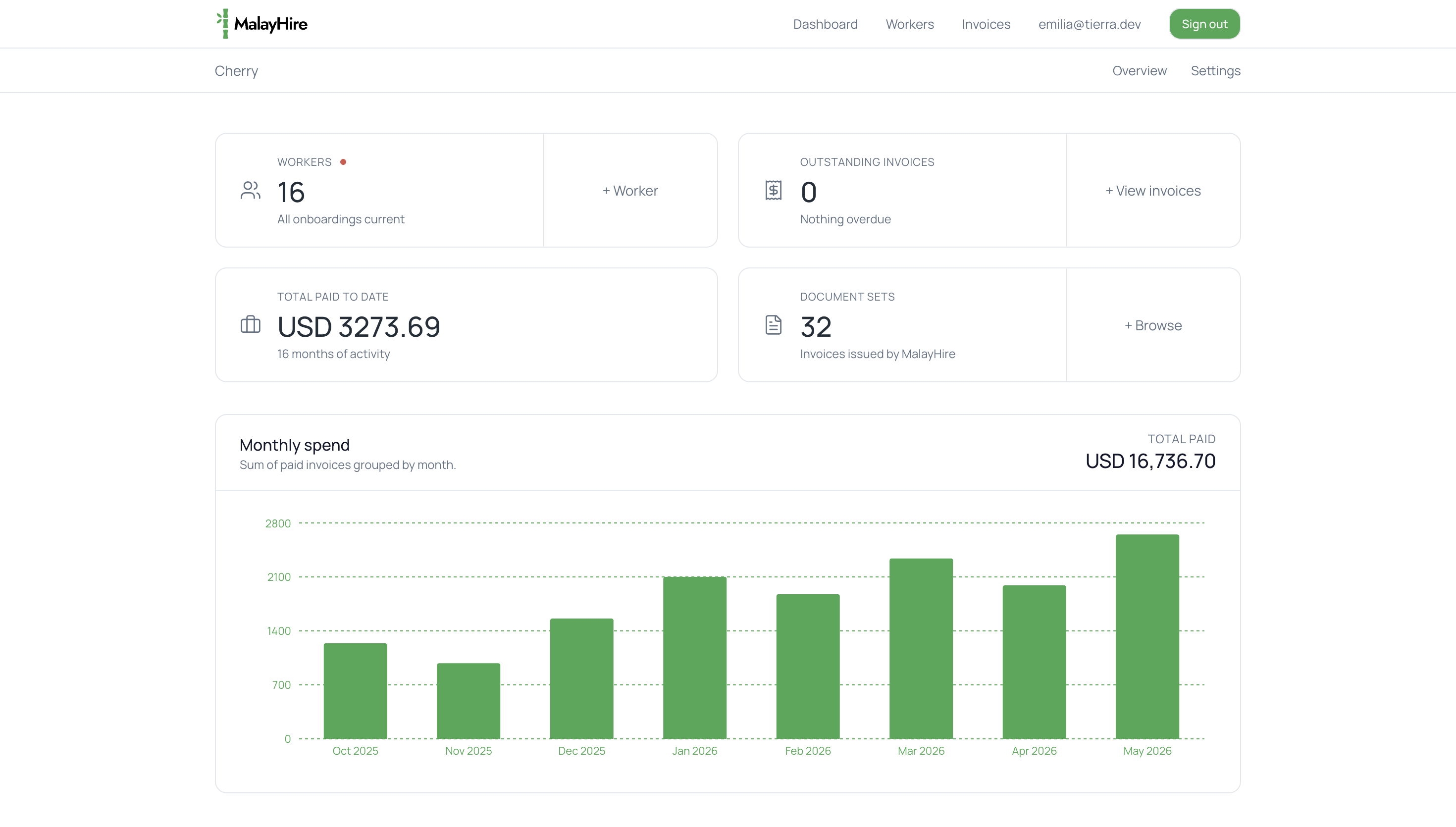
Manage your Malaysian team, payroll & EOR compliance in one place.