
How to Calculate EPF in Malaysia: The Step-by-Step Guide That Prevents Costly Payroll Errors


How to Calculate EPF in Malaysia: The Step-by-Step Guide That Prevents Costly Payroll Errors

Key Takeaways
- EPF (Employees Provident Fund) is a mandatory retirement savings scheme in Malaysia, with contribution rates based on employee age and monthly wages.
- The statutory contribution rates differ for employees earning RM5,000 and below versus those above RM5,000, and change again at age 60.
- Calculation involves applying the correct percentage from the EPF contribution schedule to the employee's gross monthly wage, then splitting into employer and employee portions.
- Foreign employers hiring in Malaysia must also calculate EPF correctly — missteps here can trigger compliance audits, penalties, and reputational damage with local authorities.
- A sandbox environment (like the one Deel API provides) lets you test EPF calculations with sample worker data before running live payroll, eliminating manual errors.
- Common pitfalls include misclassifying wages as allowances, applying outdated rate tables, and forgetting that EPF applies to all employees regardless of nationality.
- Automating EPF calculation through an EOR platform or payroll API removes the guesswork and ensures each contribution is accurate every month.
- When you integrate EPF into a broader Malaysia payroll compliance workflow, you also need to synchronize SOCSO, PCB, and HRDF — and a local EOR can handle all that in one digital dashboard.
The Real Reason EPF Calculation Trips Up Foreign Employers
If you're building a team in Kuala Lumpur from a headquarters in Berlin or San Francisco, Malaysia's EPF system can feel like a puzzle missing the picture on the box. You know it's a mandatory retirement fund. You know you have to pay it. But the moment you open the official KWSP contribution table, you're staring at rows of percentages that shift based on monthly wages, employee age, and even citizenship status. Get one digit wrong, and you're not just under-contributing — you're potentially flagging your company for a payroll audit.
This isn't a simple flat-rate deduction. Malaysia's EPF framework is a gradated, wage-band system that rewards higher contributions as income climbs, then reduces employer obligations after the employee turns 60. For someone running payroll from abroad, manually calculating this each month is a recipe for mistakes that could cost thousands in back payments and penalties.
In this guide, I'll walk you through exactly how to calculate EPF in Malaysia — the real method, not the oversimplified version. I'll cover the actual rate tables, the math behind employer and employee contributions, and how to validate your numbers using a payroll sandbox before a single ringgit leaves your account. Whether you're handling payroll in-house or evaluating an Employer of Record, you'll leave with a clear, repeatable process that keeps you compliant from day one.
EPF Contribution Basics: What You’re Actually Paying For
Before we crunch numbers, it pays to understand what the Employees Provident Fund actually is. EPF (Kumpulan Wang Simpanan Pekerja, or KWSP) is Malaysia's national compulsory savings scheme. Every month, both employer and employee contribute a percentage of the employee's gross wage into an EPF account. The money gets invested, earns annual dividends historically hovering around 5–6%, and becomes available for withdrawal at retirement, for housing, education, or certain medical expenses.
For you as an employer, EPF is not an optional tax. The Employees Provident Fund Act 1991 mandates it for all private-sector employees, including foreign workers who hold a valid work permit. From a payroll perspective, you have two obligations: deduct the employee's share from their salary, then add your own employer's share on top and remit the total sum to KWSP before the 15th of the following month.
The actual percentage you pay depends on two variables — the employee's monthly wage and their age bracket. That's where the rate table comes in, and we'll dissect it shortly.
Employee and Employer Contributions: Who Pays What
Every month, the contribution is split unevenly. For most employees under 60 earning RM5,000 or less, the employer contributes 13% of gross wages, while the employee contributes 11%. That's a combined 24% going into retirement savings. Once the employee's monthly pay exceeds RM5,000, those rates drop to 12% employer and 11% employee — a combined 23%. At age 60 and above, the employer portion falls to just 4% (or 6.5% if the employer chooses a higher rate) and the employee pays zero, on the premise that the individual is already in or near withdrawal phase.
These percentages aren't negotiable, though some employers opt to contribute above the statutory minimum as an employee benefit. For calculation purposes, stick to the statutory rates unless you have a documented policy stating otherwise. The EPF Board publishes an official contribution schedule that breaks this down into fine wage bands, so you're never multiplying a giant percentage blindly across every salary line.
The Two Age Brackets That Change Everything
Age is the pivot that can drastically alter your EPF liability. There are effectively three brackets: below 60, 60 and above, and (more rarely) employees who reach age 55 and retire but continue working — though the same age-60 rules typically apply. For simplicity, commercial payroll systems focus on under 60 and 60+. The contribution rates flip sharply at 60: the employer's share drops to 4% or 6.5%, the employee pays nothing, and the combined amount falls to a fraction of what it was the month before the birthday. If your payroll doesn't have an automatic age-bracket trigger, an employee turning 60 could easily be over-contributed unless you manually override the rate. That's a compliance error that also cheats the employer out of cash better spent elsewhere.
The Step-by-Step Calculation Formula That Leaves No Room for Error
Let's turn theory into a clean, repeatable process. Here's the exact formula I use when setting up Malaysia payroll for our clients on the MalayHire EOR platform.
Step 1: Determine the employee's gross monthly wage. This includes base salary, fixed allowances (like housing or transport allowances that are contractual), and commissions if guaranteed. Exclude overtime if variable, but EPF covers all regular wages.
Step 2: Identify which EPF contribution schedule row the wage falls into. The KWSP table groups wages into salary bands (e.g., for under-60 with wages RM5,000 and below, there are 30 wage ranges starting from RM0.01 up to RM5,000, each with a specified contribution amount in ringgit).
Step 3: Use the exact wage band to look up the total contribution, then split it into employer and employee portions per the table. If the wage exceeds RM5,000, it’s simpler: multiply gross wage by 23% for combined (11% employee, 12% employer) or the applicable employer rate if over 60.
Step 4: Deduct the employee's contribution from their net pay. The employer's contribution is booked as an additional payroll cost, not a deduction.
Step 5: Sum both portions and remit to KWSP before the monthly deadline.
This approach ensures you're using the legally mandated ringgit amounts rather than rough percentages for lower-wage earners, which can cause rounding discrepancies that auditors love to flag.
Wage Categories and Rate Tables: Navigating the Gradated System
The EPF contribution schedule is not a simple percentage. For employees earning RM5,000 or less, the EPF Board uses a graduated table that lists exact contributions in ringgit and sen for every RM20 wage band. For example, an employee earning RM2,230 per month will have a different total EPF than someone earning RM2,245, even if they're in the same general income range. The table looks like: Wage RM2,220.01 - RM2,240.00, employee contribution RM246, employer contribution RM291, total RM537. It's precise to the sen.
Above RM5,000, the table morphs into a flat percentage: 11% from employee and 12% from employer. No more wage bands. And for employees aged 60+, the employer contributes only 4% (or 6.5% at employer’s discretion) and the employee pays 0%. Some companies mistakenly apply the flat percentage even for below-RM5,000 salaries, which can result in under-contributions and potential fines.
For Employees Earning RM5,000 and Below
This is where laborious table lookups happen. KWSP publishes a 30-row schedule. Let's say your employee earns RM3,750. That falls into the RM3,730.01–RM3,750.00 band. The table dictates: employee contribution RM413, employer contribution RM488, total RM901. If you had simply multiplied 3,750 by 11% and 13% respectively, you'd get RM412.50 and RM487.50 — off by 50 sen each, which is still non-compliant because the EPF system expects the exact ringgit from the table. So every Mid-Malaysia payroll must reference this table unless you use a validated payroll engine that automates it. EOR platforms like MalayHire embed the official schedule and update it whenever KWSP changes rates, saving you from manual table-hopping.
For Employees Earning Above RM5,000
Once gross wages exceed RM5,000 per month, the contribution becomes a straightforward percentage calculation. Under 60? Multiply the entire wage by 11% for employee and 12% for employer. The combined 23% is remitted. No wage bands to fuss over. However, if a component of the wage is a variable bonus or commission, you must still include it in the monthly gross when calculating EPF, so a salesperson with a RM4,000 base and a RM2,500 commission has a total RM6,500 that qualifies for the above-RM5,000 rule. Missing that inclusion is a frequent oversight that leads to underpayment.
The Special Case of Employees Aged 60 and Above
The moment an employee hits 60, the EPF burden shifts dramatically. Employee contribution drops to 0% (completely). Employer contribution becomes a flat 4% or optionally 6.5%. The wage bands still apply for those with wages below RM5,000, but the contribution amounts are much lower. For instance, a 61-year-old earning RM3,000 falls into the wage band RM2,950.01–RM3,000.00, with employee 0 and employer RM120.00. If you accidentally continue the old under-60 rates, you're grossly over-contributing — an error that not only wastes company money but creates messy EPF records that the employee will have to sort out later.
Practical Calculation Examples Using Real Malaysian Ringgit
Nothing beats concrete numbers. I'll run three scenarios you'll likely encounter.
Scenario A: Aminah, 35 years old, monthly base RM3,200, no variable pay. She's in wage band RM3,180.01–RM3,200.00. From the schedule, employee contribution RM352, employer contribution RM416. Total monthly remittance RM768. Aminah's net salary after EPF deduction: RM3,200 – RM352 = RM2,848.
Scenario B: Chee Kwan, 28, monthly salary RM8,000. Above RM5,000 threshold. Employee: 11% × 8,000 = RM880. Employer: 12% × 8,000 = RM960. Total EPF remittance RM1,840. No table needed.
Scenario C: Margaret, 63, monthly RM4,500. She's in wage band RM4,480.01–RM4,500.00, over-60 column. Employee 0, employer RM180.00 (based on 4% rate in the schedule). If the employer opts for 6.5%, contribution becomes RM292.50.
How a Sandbox Environment Lets You Test EPF Calculations Risk-Free
When you're managing payroll for a new Malaysian entity, or even just verifying an EOR provider's statutory calculations, the last thing you want is to discover an error in a live production payroll. That's why we recommend testing everything in a sandbox before money moves. Deel's API Sandbox, for example, is a completely isolated testing environment pre-populated with sample data, including sample workers, contracts, and organizations. You can simulate payroll runs with EPF, SOCSO, and PCB calculations without any real money or legal implications.
For a Malaysia-specific hire, you would create a sandbox worker with a Malaysian bank account, a KWSP number, and a monthly wage. Run the payroll simulation. The system should output the exact EPF contributions. Compare those figures against your manual calculations using the official KWSP schedule. If they match, your calculation logic is sound. If they differ, you've spotted a bug before it hits a real paycheck. At MalayHire EOR, we embed this same sandbox concept right inside our digital onboarding flow — you can simulate an employee's first pay run during the 48-hour setup window and confirm every statutory deduction before you ever press "approve."
Common Mistakes Foreign Employers Make When Calculating EPF
- Applying the flat percentage method to employees earning RM5,000 or below, which ignores the official wage-band schedule and results in incorrect remittances.
- Forgetting to include fixed allowances (travel, housing) in the gross wage that forms the EPF base, leading to systematic under-contributions.
- Using outdated contribution rate tables — rates and wage bands get revised occasionally, and an old spreadsheet can persist for years if not audited.
- Assuming EPF does not apply to expatriates or foreign nationals with valid work permits. It does, and failing to register them attracts penalties.
- Not adjusting the contribution the month an employee turns 60, causing over-contributions that are a pain to reclaim from KWSP.
- Confusing EPF with SOCSO or PCB — each has its own calculation and wage ceiling, and lumping them together in a formula will produce wrong numbers.
- Manually keying EPF amounts into a non-compliant payroll system that doesn't produce the official KWSP AHD form, so contributions sit unremitted.
Expert Tips for Automating EPF Calculations in Your Payroll
The most reliable EPF calculation is the one you don't have to perform manually. If you're running an in-house team, invest in a Malaysia-certified payroll software that stores the official contribution table and updates it whenever KWSP announces rate changes. If you prefer an API-driven approach, you can integrate EPF calculations directly into your workflow. For instance, using a payroll API that takes employee wage and age as inputs and returns the precise employer and employee contributions — much like the Deel API sandbox does in pre-populated environments. At MalayHire EOR, our clients never touch a rate table; the platform applies the correct contributions for EPF, SOCSO, PCB, and HRDF automatically, and the built-in validation checks flag anomalies before submission. But if you're coding something yourself, consistently test your logic against the KWSP schedule using a sandbox worker with known wage values. It's a small effort that prevents huge compliance failures.
Why a Localized EOR Platform Eliminates Calculation Risk
When you engage a Malaysia-focused Employer of Record, payroll statutory calculations become the provider's responsibility — but you still need to verify. That's where the sandbox becomes your audit tool. Before your first employee goes live, request a simulated payroll run. Check that the EPF amounts match your own independent calculation. A good EOR will provide a transparent breakdown, not a black box. MalayHire EOR, for instance, uses a digital dashboard that shows each contribution line item with the exact ringgit figure and the legal basis (the contribution table row). This transparency means you don't have to trust a promise; you can validate the math yourself during a 48-hour pre-onboarding trial.
What This Means for Your Next Hire in Malaysia
EPF calculation is not just an arithmetic exercise — it's the front line of your company's compliance profile in Malaysia. When you get it right, you keep your employees' retirement savings on track, avoid costly penalties, and pass any potential audit by KWSP with flying colors. When you get it wrong, you create a paper trail of non-compliance that can trigger back-payment demands, interest charges, and a sour relationship with regulators.
For a foreign company expanding into Malaysia, the smartest approach is to build EPF correctness into your hiring process from day zero. Whether you're working with an EOR or standing up your own entity, use a sandbox to test your calculations before you onboard that first marketing manager or software engineer. The 30 minutes you spend validating EPF in a safe environment will save you days of untangling errors later. And if you choose a local EOR partner like MalayHire that already knows every comma in the KWSP schedule, you get both speed and surety — your team in Malaysia goes live in 48 hours, with every contribution from EPF to SOCSO to PCB calculated to the last sen, without you ever cracking open a rate table yourself.
Frequently Asked Questions
What happens if I miscalculate employee EPF contributions in Malaysia?
Miscalculating employee EPF contributions in Malaysia can result in penalties, fines, and legal consequences from the Employees Provident Fund. Employers must correct errors promptly by submitting a rectification form and paying any outstanding contributions plus late payment interest. Repeated mistakes may trigger audits and reputational damage, so precise payroll processing is essential.
Do foreign employers need to contribute EPF for expatriate workers in Malaysia?
Foreign employers are generally not required to contribute EPF for expatriate workers under Malaysian law, unless the expatriate holds Malaysian permanent residency. However, voluntary contributions can be made through a separate arrangement with EPF. Always verify the worker’s residency status and employment pass conditions before deciding, as misclassification leads to compliance risks.
How do I calculate EPF for an employee earning RM5,000 per month with overtime pay?
For an employee earning RM5,000 per month with overtime pay, calculate EPF on the total ordinary wages plus additional wages like overtime. The employee contribution rate depends on their age below 60 (11%) or above 60 (5.5%), while the employer share remains at 13% or 12% for wages under RM5,000. Apply monthly wage ceiling limits to determine the cap.
Can I use a sandbox environment to test EPF calculations before running payroll?
Yes, the EPF’s i-Akaun employer portal offers a sandbox environment allowing you to test contributions without real financial impact. This tool simulates payroll submissions, validates computation accuracy, and identifies errors before actual payroll processing. It is a recommended practice to avoid costly miscalculations, especially when handling multiple wage categories or new employees.
What is the late payment interest rate for overdue EPF contributions in Malaysia?
The late payment interest rate for overdue EPF contributions in Malaysia is 12% per annum, compounded monthly from the due date until full payment. This penalty applies immediately if contributions are not remitted by the 15th of the following month. Employers must calculate interest precisely and include it with arrears to avoid further compounding and compliance actions.
How does the gradated EPF contribution system work for employees earning under RM5,000 monthly?
For employees earning under RM5,000 monthly, the gradated EPF contribution system requires an employer share of 13% and an employee share of 11% (under age 60). If wages exceed RM5,000, the employer share drops to 12%. The contribution is based on total ordinary wages, not including bonuses, and applies a monthly wage ceiling of RM20,000 for computation.
Can I automate EPF calculations in payroll software for multiple employees?
Yes, you can automate EPF calculations by integrating compliant payroll software like i-Account or PayrollPanda that updates rates and wage ceilings automatically. Automation reduces manual errors, ensures accurate contributions per employee category, and generates EPF submission files directly. Always validate settings after system updates to align with EPF’s latest guidelines and avoid compliance gaps.
What is the maximum EPF contribution amount for an employee earning RM20,000 per month?
For an employee earning RM20,000 monthly, the maximum EPF contribution amount is capped at the wage ceiling, meaning contributions are calculated on the first RM20,000 only. At 11% employee rate, the maximum employee contribution is RM2,200, while the employer share at 12% would be RM2,400. Earnings above this ceiling do not attract further EPF deductions.
MalayHire is your most cost-effective Employer of Record (EOR) in Malaysia
Hire full-time employees in Malaysia and save costs by avoiding hefty contractor fees. MalayHire handles payroll, employment contracts, statutory compliance (EPF, SOCSO, EIS), and HR admin. Start onboarding your Malaysian hire now, with MalayHire.
Trusted by global companies hiring in Malaysia





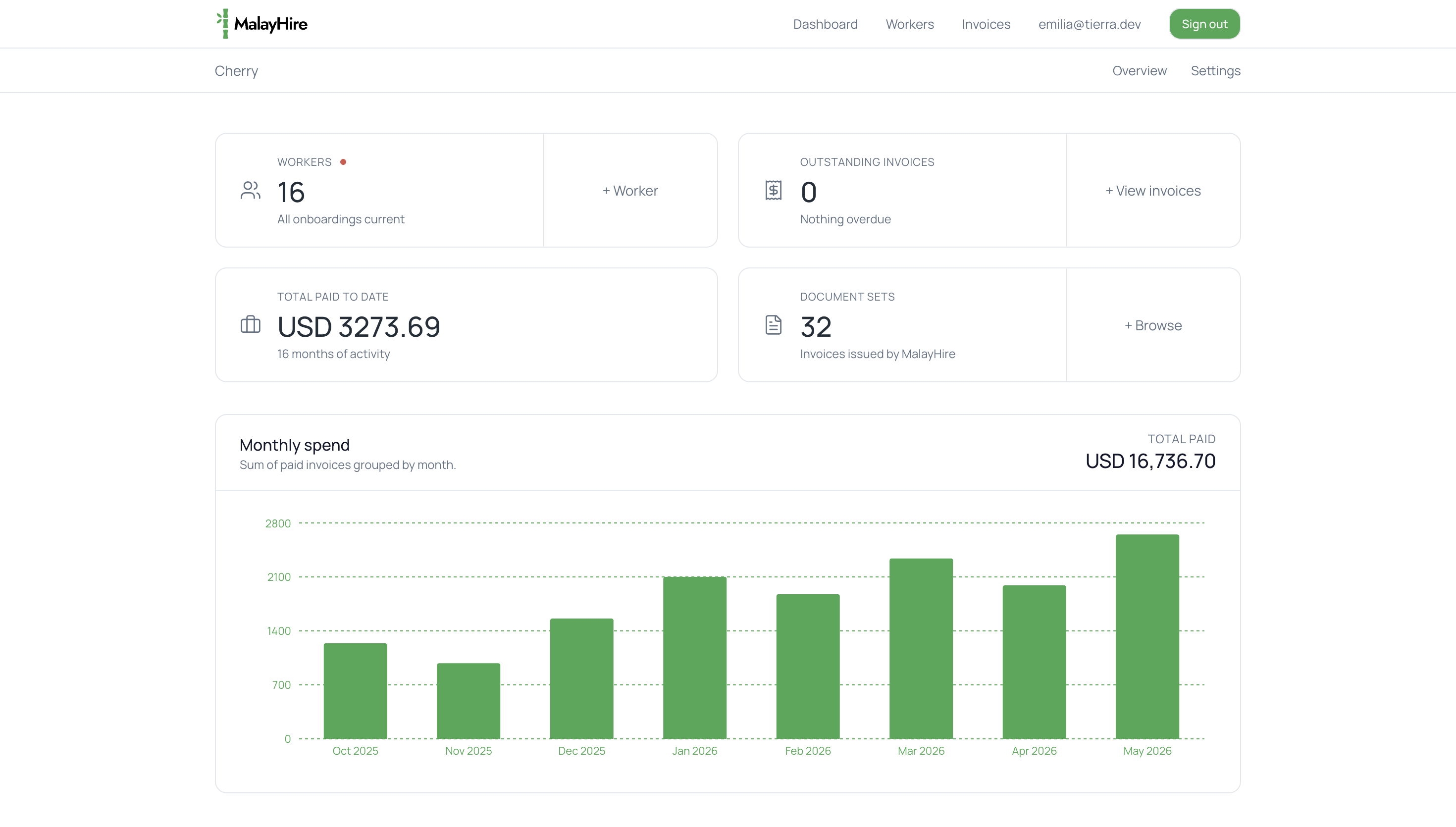
Manage your Malaysian team, payroll & EOR compliance in one place.