
How to Calculate Salary Deductions in Malaysia: A Payroll-Ready Formula for Employers


How to Calculate Salary Deductions in Malaysia: A Payroll-Ready Formula for Employers

Key Takeaways
- Mandatory salary deductions in Malaysia include EPF, SOCSO, EIS, and PCB (monthly tax deduction); voluntary deductions such as zakat and insurance require employee consent.
- For most Malaysian employees under 60, the EPF employee share is 11% of wages, while the employer share is either 12% or 13% depending on the monthly wage band.
- SOCSO and EIS contributions are calculated on a capped monthly wage ceiling, not your entire gross salary, which reduces the effective deduction for higher earners.
- PCB/MTD is calculated using LHDN's monthly tax deduction schedules or the official e-PCB calculator after subtracting eligible deductions like EPF.
- A wrong calculation can trigger audit flags with EPF, LHDN, or SOCSO even when the error appears to benefit the employee.
- API-driven payroll tools and Malaysia EOR platforms can automate deduction calculations, but token scoping and PDPA compliance matter for sensitive salary data.
- Foreign employers without a local entity typically rely on a Malaysia employer of record to calculate, deduct, and remit all statutory contributions correctly.

What Salary Deductions in Malaysia Actually Include
If you are trying to work out how to calculate salary deductions in Malaysia, the first thing to drop is the idea that there is one flat percentage applied to gross pay. Malaysian payroll deductions sit in several legal buckets, and each has its own set of rules, wage ceilings, and deadlines. Some are imposed by law, some are allowed only with written consent, and some are entirely optional.
The statutory bucket gets most of the attention because it includes EPF, SOCSO, EIS, and PCB. These four lines appear on every compliant payslip for a full-time employee. The voluntary bucket includes zakat, insurance premiums, and union fees, which depend on the employee's religion, contract terms, or membership.
If you are a foreign company hiring employees in Malaysia, you also have to decide whether to run these calculations manually, through payroll software, or through a Malaysia employer of record services provider. The wrong method is not just an admin annoyance; it can trigger statutory audits and underpayment claims. The calculation itself is straightforward once you understand the order of operations and which wage base each deduction uses.
Mandatory, Authorised, and Voluntary Deductions
Malaysian employment law groups salary deductions into three practical categories. Mixing them up is one of the fastest ways to create a compliance issue, because each category carries different consent rules and remittance obligations.
Mandatory Statutory Deductions
These are EPF, SOCSO, EIS, and PCB. They must be deducted from wages and paid to the relevant authorities by the 15th of the following month for EPF, SOCSO, and EIS. PCB must be remitted to LHDN within the same monthly window. You cannot ask an employee to waive these deductions.
- EPF: retirement savings managed by KWSP
- SOCSO: employment injury and invalidity coverage
- EIS: employment insurance for retrenchment and job search
- PCB: monthly tax deduction under the Income Tax Act
Authorised Deductions
These are deductions allowed by written law or with employee consent. Examples include overpayment recovery, union subscription fees, and salary advances. A common mistake is assuming an employee's verbal agreement is enough. In practice, a signed authorisation protects you during an audit and is expected by the Labour Department.
- Overpayment recovery from previous months
- Union membership fees covered by a collective agreement
- Salary advance repayment in agreed instalments
Voluntary and Employer-Sponsored Deductions
Voluntary deductions cover zakat, additional insurance premiums, and loan repayments. Zakat is a monthly deduction for Muslim employees and is remitted to the relevant state religious authority. You should keep a separate file of employee authorisation letters, because LHDN may ask for evidence that a deduction was not disguised compensation.
- Zakat through the state zakat collection centre
- Additional life or medical insurance premiums
- Staff loan repayments arranged by the employer
How to Calculate Salary Deductions in Malaysia: The Core Formula
The core formula is simple: start with gross monthly salary, apply each statutory deduction on its own wage base, then subtract authorised and voluntary deductions. The order matters because PCB is calculated after reducing gross pay by eligible EPF contributions. If you reverse the order, you will produce an incorrect tax amount and possibly under-remit PCB.
A working formula for a standard full-time Malaysian employee under 60 is: Net pay = Gross salary minus employee EPF minus employee SOCSO minus employee EIS minus PCB minus authorised or voluntary deductions. Employer contributions are separate and should never be deducted from the employee's salary. The employer share of EPF, SOCSO, and EIS is a cost above the gross salary.
The Basic Net Pay Formula
Net pay = gross salary − employee EPF − employee SOCSO − employee EIS − PCB − other authorised deductions. This formula gives you the amount actually paid into the employee's bank account. Employer contributions are booked as payroll overhead, not as a deduction from the employee's line.
- Always calculate employee contributions first
- Treat employer contributions as a separate payroll expense
- Use the exact statutory wage base for each contribution
Applying Wage Ceilings and Age Bands
EPF uses the full gross wage for employee contributions, but SOCSO and EIS use a capped monthly wage. The current SOCSO and EIS wage ceiling is RM6,000, which means an employee earning RM10,000 only pays SOCSO and EIS on RM6,000. EPF also has different contribution rates for employees aged 60 and above, so age matters during onboarding.
- EPF: no wage ceiling for employee contribution under age 60
- SOCSO and EIS: capped at RM6,000 monthly wage
- Age 60+ employees have lower EPF and SOCSO rates
Where Statutory Rates Change
Rates change when an employee crosses the RM5,000 EPF wage threshold, reaches age 60, or changes nationality status. Non-Malaysian citizens are subject to different EPF and SOCSO rules in some cases. If you hire employees in Malaysia through a Malaysia EOR, the provider typically maintains these rate tables so you do not have to track every revision manually.
- EPF employer rate drops from 13% to 12% above RM5,000 monthly wage
- Employees aged 60 and above have a zero employee EPF rate
- Non-Malaysian employees may opt for different EPF treatment
EPF, SOCSO, and EIS: Breaking Down the Statutory Lines
These three contributions form the social security backbone of Malaysian payroll. The calculation logic is different for each, which is why payslips show them as separate line items.
EPF Contribution Rates for Most Employees
For Malaysian employees below 60, the employee contributes 11% of gross monthly wages. The employer contributes 13% for monthly wages up to RM5,000 and 12% for monthly wages above RM5,000. These percentages apply to the full gross wage, not a capped amount.
- Employee share: 11% of gross monthly wages for those under 60
- Employer share: 13% for wages RM5,000 and below
- Employer share: 12% for wages above RM5,000
SOCSO Contribution Categories
SOCSO has two main schemes: employment injury and invalidity. The standard combined employee rate is 0.5% of the capped wage, while the employer rate is 1.75% of the capped wage. The wage ceiling applies after the rate, so you cap the monthly salary at RM6,000 before multiplying.
- Employee SOCSO: 0.5% of capped monthly wage
- Employer SOCSO: 1.75% of capped monthly wage
- Ceiling: RM6,000 per month before rate application
EIS Contribution
EIS is the simplest line. Both employee and employer contribute 0.2% of the capped monthly wage, with the same RM6,000 ceiling. The total employee EIS for a salary of RM6,000 or above is RM12 per month, and the employer mirrors that amount.
- Employee EIS: 0.2% of capped wage
- Employer EIS: 0.2% of capped wage
- Maximum employee deduction: RM12 monthly
PCB/MTD: The Monthly Tax Piece That Catches People Out
PCB, also called MTD, is the monthly tax deduction administered by LHDN. It is not a flat percentage of gross salary. LHDN publishes a schedule of deduction amounts based on an employee's category, marital status, and number of dependents. Many employers mistakenly apply a rough percentage and later face underpayment penalties.
The correct method is to determine the employee's chargeable income for the month by subtracting eligible deductions like employee EPF from gross salary. Then you look up the relevant LHDN PCB schedule, or use the official e-PCB calculator, to find the exact deduction.
Using the LHDN Schedule or e-PCB Calculator
LHDN's e-PCB calculator is the most reliable way to calculate PCB for a single employee. You enter gross salary, EPF deduction, category, and number of dependents, and the tool returns the statutory amount. For bulk payroll, many Malaysia EOR platforms automate this lookup.
- Start with gross monthly salary
- Subtract employee EPF to get chargeable income
- Apply the LHDN PCB schedule for the employee's category
Special Cases: Bonuses, Leavers, and New Hires
Bonuses are taxed using a different LHDN formula based on cumulative annual income. New employees need a completed TP3 form to determine whether PCB applies from the first month. Leavers require a final PCB calculation using the leaving month's schedule, and the employer must issue an EA form at year end.
- Bonuses use a cumulative income formula, not the standard monthly schedule
- New hires below the taxable threshold may be exempt for early months
- Leavers need final-month PCB based on the leaving date
A Full Worked Example: From Gross Salary to Net Pay
Here is a simplified calculation for a Malaysian employee under 60 with a gross monthly salary of RM8,000, single, with no dependents. The example assumes PCB is RM520 based on an illustrative LHDN lookup. The purpose is to show the order of operations, not to replace the official calculator.
- Gross monthly salary: RM8,000
- Employee EPF: 11% of RM8,000 = RM880
- Employee SOCSO: 0.5% of capped RM6,000 = RM30
- Employee EIS: 0.2% of capped RM6,000 = RM12
- Chargeable income for PCB: RM8,000 − RM880 = RM7,120
- PCB for this example: RM520 (illustrative, from LHDN schedule)
- Net pay: RM8,000 − RM880 − RM30 − RM12 − RM520 = RM6,558
Avoiding Costly Deduction Mistakes
Most payroll errors in Malaysia are not malicious. They happen because someone applies the wrong wage base, forgets an age band, or uses a flat 20% estimate for PCB. Even a small monthly error compounds into a large annual underpayment across a workforce.
- Using gross salary instead of the capped wage for SOCSO and EIS
- Forgetting that employees aged 60 and above have different EPF rates
- Applying the employer PCB method to employee deductions
- Deducting employer contributions from the employee's net pay
- Missing the RM5,000 EPF threshold for the employer share
- Failing to obtain written consent for voluntary deductions
Automating Deduction Calculations with Payroll Software and EOR APIs
Once payroll headcount passes a handful of employees, manual calculation becomes fragile. Payroll software can handle statutory tables, but API-driven integrations with a Malaysia EOR go further by submitting EPF, SOCSO, and PCB data directly to the relevant systems.
According to Deel's developer documentation, all API requests require authentication and must be made over HTTPS. Deel supports two authentication methods: API tokens for server-to-server integrations and OAuth2 for user-authorized app access. API tokens are used as Bearer tokens in the Authorization header, but the token variant determines who the token represents. These authentication mechanics matter when you automate payroll data flows.
What API Token Authentication Actually Does
API token authentication proves that the system requesting payroll data is allowed to receive it. For payroll integrations, you typically generate a scoped token that can only read deduction data or submit a specific file. Using a full-access token for a routine payroll sync is unnecessary and increases exposure.
- Tokens act as Bearer credentials in the Authorization header
- OAuth2 suits user-authorized access for HRIS integrations
- API tokens are simpler for scheduled server-to-server syncs
Scoped Tokens and PDPA Compliance
Malaysia's Personal Data Protection Act applies to salary and statutory deduction data. If you build an integration to pull EPF or PCB data from an EOR platform, generate a scoped token that allows only the endpoints your payroll system actually needs. Over-permissioning a token is a data protection risk and a common audit finding.
- Scope tokens to read-only payroll endpoints where possible
- Rotate tokens when a payroll administrator leaves
- Revoke unused tokens immediately after a sandbox test
EOR Platforms as a Shortcut
For foreign employers without a local entity, a Malaysia employer of record handles the deduction calculations, statutory submissions, and payment remittance. MalayHire EOR, for example, positions its service around fast onboarding and local compliance for EPF, SOCSO, and tax. This removes the need for in-house rate-table maintenance.
- Local EOR calculates EPF, SOCSO, EIS, and PCB every month
- No legal entity required to remit statutory deductions
- Fixed monthly pricing replaces hidden payroll-setup overhead
Compliance Checkpoints for Foreign Employers Hiring in Malaysia
If you hire employees in Malaysia without a local entity, you cannot directly register for EPF or SOCSO. You need either a local subsidiary or a Malaysia EOR to act as the employer of record. The EOR becomes the legal employer for statutory purposes, while you direct the employee's daily work. This is the cleanest way to stay compliant before you have an on-the-ground presence.
- Confirm the employee's age and nationality before applying rates
- Use the official LHDN e-PCB calculator for every new hire
- Keep signed authorisation letters for all voluntary deductions
- Submit EPF, SOCSO, and EIS payments by the 15th monthly deadline
- Retain payslips and deduction records for at least seven years
- If using payroll APIs, enforce scoped tokens and PDPA safeguards
Frequently Asked Questions
What is the maximum amount an employer can deduct from an employee's salary in Malaysia?
Under Section 24 of the Employment Act 1955, an employer can only deduct from an employee's salary for specific statutory contributions and deductions authorized by written law or a written agreement. While there is no blanket percentage cap in the Act, total deductions cannot leave an employee with a wage below the statutory minimum or an amount that constitutes an unlawful deduction. Courts interpret the permitted list strictly, so any amounts beyond statutory and agreed items require explicit employee consent.
How do I calculate PCB or MTD for an employee's monthly salary in Malaysia using the net method?
Use the the LHDN's MTD calculation procedure under the net method, which involves a specific formula referencing the Schedule PCB. First, determine the employee's net remuneration after deducting EPF, SOCSO, EIS, and other approved deductions. Then, apply the annual chargeable income formula based on that net figure and the number of months of working, and finally subtract the quarterly rebate and monthly tax deduction. The result is the monthly MTD amount to withhold, with precise steps in the LHDN guide.
Can an employer deduct salary for damages caused by an employee in Malaysia without a court order?
Yes, but only under very strict conditions as outlined in Section 24(2)(c) of the Employment Act. The deduction for loss or damage must be agreed upon in writing by the employee, and the total deduction cannot exceed half of the employee's total wages for that pay period. Additionally, the employer must give the employee a reasonable opportunity to be heard, and the deduction cannot apply if it would leave the employee with insufficient wages for basic support. This process requires meticulous adherence to compliance.
What are the differences between mandatory deductions, authorised deductions, and voluntary deductions in Malaysian payroll?
Mandatory deductions are those required by law, such as EPF, SOCSO, EIS, and PCB/MTD, and an employer can deduct them without employee consent. Authorised deductions are those permitted under a written agreement or employment contract, like loan repayments, rental deductions, or salary advances, as specified in the Employment Act. Voluntary deductions are optional reductions chosen by the employee, such as for medical insurance premiums, union dues, or charitable contributions, and they always require written authorization from the employee.
How does having foreign employees change salary deduction requirements in Malaysia?
For foreign employees, the deduction landscape shifts because they are generally not covered by EPF, SOCSO, and EIS, with individual exemptions based on their residency status and citizenship. However, monthly PCB/MTD is still mandatory for any foreigner who charges income in Malaysia, unless they hold a valid exemption or a tax deduction certificate. Employers are required to ensure that these foreigners also pay their taxes through a higher withholding rate, often 30% initially, unless they apply for a lower rate from the LHDN. This situation demands specific compliance knowledge to avoid penalties.
What happens if an employer fails to deduct EPF or SOCSO from employee salaries?
Failure to deduct and remit statutory contributions like EPF and SOCSO constitutes an offense under the respective laws, namely the EPF Act 1991 and the Employees' Social Security Act 1969. Employers face prosecution, heavy fines, and even imprisonment for non-compliance, and they also become liable to pay the full contribution plus interest and penalties. The relevant authorities conduct routine audits, and back-payment schedules can be imposed for any arrears. Therefore, accurate and timely deduction calculation is an essential payroll duty for any employer.
Is it legal to deduct a salary advance from an employee's monthly pay in Malaysia without a signed agreement?
No, deducting a salary advance without a signed agreement is not legal under Malaysian employment law. An authorised deduction under Section 24(2)(b) mandates that the deduction for a salary advance must be made in writing and agreed upon by the employee. The document must outline the repayment amount, the number of installments, and the specific frequency to ensure full transparency. Without such explicit written consent, the deduction becomes an unlawful withholding, exposing the employer to liability and potential breach of contract claims.
How can payroll software or EOR APIs help prevent salary deduction calculation errors in Malaysia?
Payroll software and EOR APIs automate the calculation of all statutory deductions, utilizing up-to-date EPF, SOCSO, EIS, and PCB tables and rules. They integrate with financial systems to keep the database current with legal changes and reduce manual data entry risks. These tools also provide audit trails, generate payslips, and run compliance checks to flag any discrepancies before processing. By replacing manual calculations, they significantly lower the chance of under-deductions or over-deductions, protecting the employer from fines and ensuring correct net pay.
MalayHire is your most cost-effective Employer of Record (EOR) in Malaysia
Hire full-time employees in Malaysia and save costs by avoiding hefty contractor fees. MalayHire handles payroll, employment contracts, statutory compliance (EPF, SOCSO, EIS), and HR admin. Start onboarding your Malaysian hire now, with MalayHire.
Trusted by global companies hiring in Malaysia





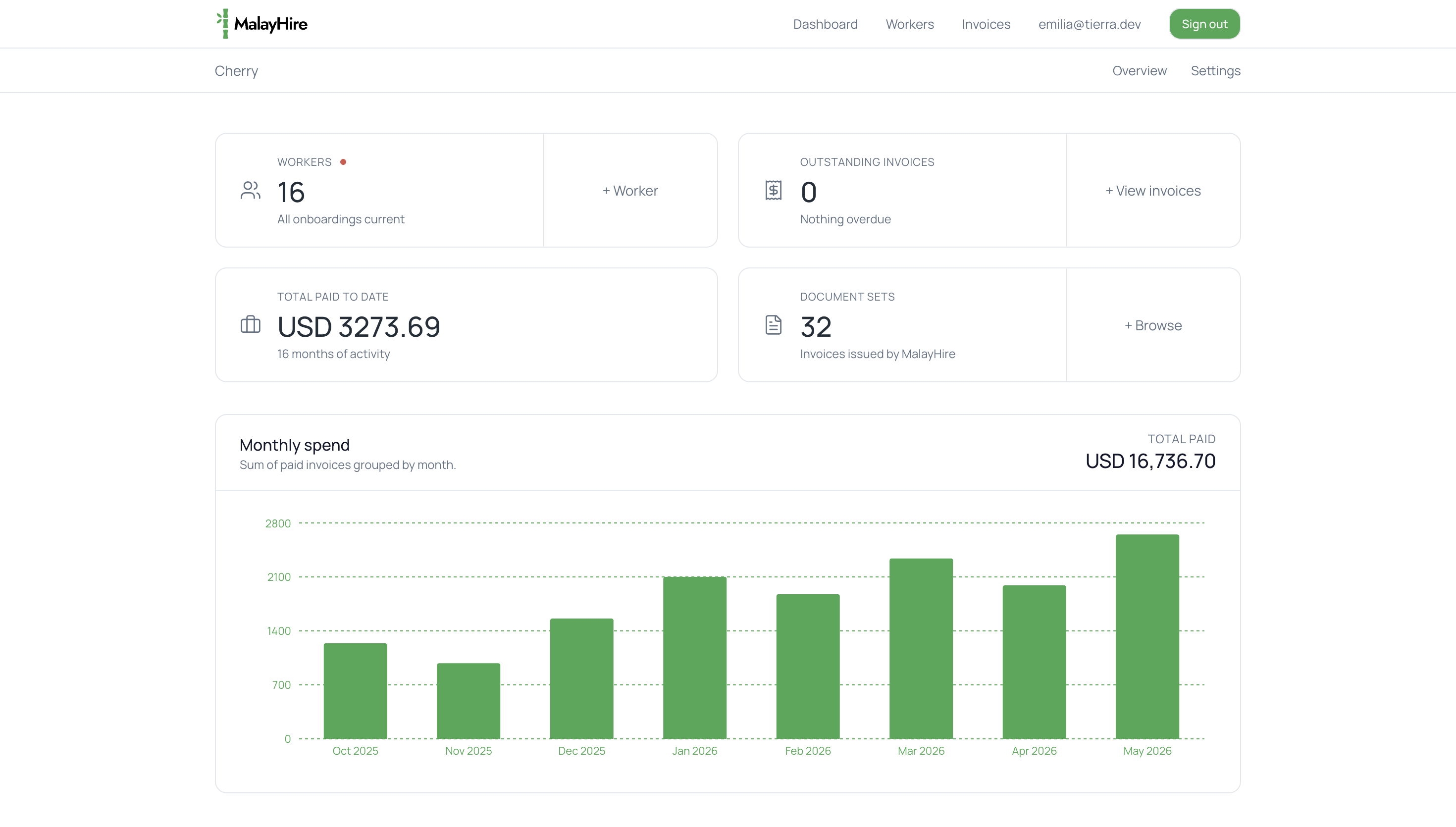
Manage your Malaysian team, payroll & EOR compliance in one place.