
How to Hire Foreign Talent in Malaysia 2025: Your Step-by-Step Guide to Onboarding Without an Entity


How to Hire Foreign Talent in Malaysia 2025: Your Step-by-Step Guide to Onboarding Without an Entity

Key Takeaways
- Hiring foreign talent in Malaysia in 2025 is easier than ever for global employers — the EOR route bypasses the need for a local entity and cuts onboarding from months to hours.
- You can legally engage Malaysian employees in as little as 48 hours if you use a local Employer of Record that pre‑registers for EPF, SOCSO, EIS, and HRDF.
- Understanding the real differences between setting up a Sdn. Bhd. and using an EOR will save you tens of thousands in upfront costs and ongoing compliance headaches.
- Statutory contribution rates and rules have been tweaked for 2025, especially around SOCSO coverage thresholds and HRDF levy for new employers.
- Malaysia’s PDPA 2024 amendments enforce stricter data residency requirements — your EOR must store payroll data locally, not offshore.
- Fixed‑fee EORs starting at $165 per employee per month offer a transparent alternative to percentage‑based global platforms that get expensive as you scale.
- Vetting your EOR’s compliance infrastructure — not just their marketing — is the single most important step before onboarding your first hire.
- Real‑world cases show that API‑connected EORs eliminate manual data‑entry errors that trigger EPF or LHDN audits, giving you audit‑ready records from day one.

Why Global Employers Are Looking to Malaysia in 2025
If you’ve been keeping an eye on Southeast Asia, you already know Malaysia is having a moment. The digital economy is expanding faster than the local talent pool can keep up, which means foreign companies that move now can still snap up top-tier developers, finance managers, and shared‑service experts before the market gets frothier. Kuala Lumpur in particular has turned into a hub for regional operations — think Singapore’s cost structure scares companies away, but they still want a sophisticated, English‑proficient workforce within the same time zone.
What’s new in 2025 is the sheer accessibility. You no longer need to spend six months and a lot of cash setting up a Malaysian subsidiary just to hire a few people. The EOR model has matured, and localised providers have ironed out the wrinkles that made global platforms feel generic. At the same time, Talent Insights tools from players like Remote now cover 55+ countries, giving you real‑time salary benchmarking for roles in KL and Penang without phoning a dozen recruiters. So the question has moved from “Should we hire in Malaysia?” to “How fast can we get started without tripping over compliance wires?”
The Talent Pool Foreign Employers Are Actually Competing For
It’s not just about cheap labour. Malaysia’s workforce blends multilingual capabilities (English, Mandarin, Bahasa) with solid tertiary education and a surprising depth of shared‑service experience. The government’s push towards IR4.0 means you’ll find machine‑learning engineers alongside chartered accountants who’ve run APAC consolidations. The competition isn’t local SMEs either — it’s other international firms poaching the same limited pool of candidates who already know how to work across cultures. That’s why speed of hiring matters: a candidate you identified on Monday can get three offers by Wednesday. An EOR that onboards in hours, not weeks, becomes your hidden weapon.
Regulatory Shifts That Make 2025 Different
Malaysia’s labour regulations didn’t stand still. SOCSO coverage has expanded incrementally, and the Employees Provident Fund (EPF) tightened rules around employer obligations for foreign workers (though as a foreign employer hiring local talent, you mostly follow the same EPF rates as local employers). The Personal Data Protection Act (PDPA) 2024 amendments sharpened data residency requirements — any platform that pushes payroll data to servers in the US or EU without local mirroring could land you in regulatory trouble. Plus, the Human Resource Development Fund (HRDF) levy now applies to a broader set of employers from the moment they hire, not after a threshold. These changes are exactly why local EORs have an edge: they’re already wired into the system.
The Two Paths to Hire Foreign Talent: Local Entity vs Employer of Record
When you want to hire a Malaysian employee, you legally need a Malaysian employer. That sounds circular, but it’s the fundamental fork in the road. You either become that employer by incorporating a local entity, or you partner with an EOR that acts as the legal employer on your behalf. Both paths lead to a compliant employment relationship; the difference is time, cost, and administrative burden. In 2025, the EOR route has become the default for companies that aren’t ready to commit to a full subsidiary — not because it’s the easy way out, but because it’s often the only way to hire someone next week without violating EPF or tax laws.
Setting Up a Local Sdn. Bhd. (The Long Game)
Incorporating a Sendirian Berhad (Sdn. Bhd.) gives you full control, a Malaysian bank account, and the ability to sign contracts directly. But it’s not a quick process. You’ll need a minimum paid‑up capital, a company secretary, a named director who is ordinarily resident in Malaysia (which often isn’t your own hire), and a physical registered office address. The setup alone takes 4–8 weeks, and that’s before you register for EPF, SOCSO, PCB (income tax deduction), EIS, and HRDF. Then you need to open a corporate bank account — another 2–4 weeks. So you’re realistically 2–3 months away from issuing a first payslip. For a company testing the market, that’s an eternity.
Using an Employer of Record (The 48‑Hour Lane)
An EOR legally employs the worker for you. The worker signs an employment contract with the EOR, the EOR runs payroll, pays contributions, and handles tax filings, while you retain day‑to‑day management. Because the EOR already has all tax and social security registrations in place, you skip the entity‑setup delay entirely. A localised EOR like MalayHire EOR that operates on a fixed monthly fee per employee can onboard a new hire in as little as 48 hours — that’s not a marketing slogan; it’s the time it takes to collect the employee’s documentation, register them with EPF and SOCSO, and set up payroll records when the EOR’s platform is pre‑integrated with statutory systems. For many foreign SMEs and even mid‑market firms, this approach turns a months‑long project into a Monday‑to‑Wednesday task.
Inside the 48‑Hour Onboarding: What Actually Happens Behind the Scenes
The magic of rapid onboarding isn’t magic at all — it’s the result of a systematic, API‑driven workflow that a local EOR has refined to the point where manual paperwork is almost nonexistent. Below is the real sequence when you use a platform built specifically for Malaysia’s statutory ecosystem, not a global tool gluing together country‑specific plug‑ins. It assumes you’ve already identified the candidate and agreed on salary; the clock starts when you hit “Go” on the EOR dashboard.
Hour 0–2: Capturing Employee Data and Generating the Offer
Within the first two hours, the EOR collects the candidate’s MyKad or passport details, tax identification number (TIN), and bank account information. An API‑connected platform validates the MyKad against the National Registration Department’s data where possible, ensuring the person is indeed who you think they are. The employment contract — compliant with Malaysia’s Employment Act 1955 — is generated automatically, pulling the agreed salary, probation period, and statutory benefits. Once the candidate e‑signs, the EOR has everything needed to trigger registrations. No scanning, no emailing HR and waiting for them to wake up in a different time zone.
Hour 2–6: EPF and SOCSO Registration
This is the part that terrifies foreign employers who’ve never dealt with Malaysian bureaucracy. The truth is, an EOR that has been doing this for years already has an EPF employer number and a SOCSO employer code. Adding a new employee is a matter of submitting an electronic form through the EPF’s i‑Akaun portal and the SOCSO’s ASSIST portal. The system assigns an EPF member number instantly if the employee hasn’t contributed before; otherwise, the existing number is linked. SOCSO categorisation happens according to the employment injury scheme and the invalidity scheme, with the contribution class determined by salary. All of this is done via API calls or batch uploads that complete within a few hours.
Hour 6–24: Payroll Registration and PCB Setup
With EPF and SOCSO numbers assigned, the EOR registers the employee with the Inland Revenue Board (LHDN) for monthly tax deduction (PCB). The PCB calculation formula for 2025 is built into the EOR’s payroll engine, so the employer immediately sees the exact net pay and the exact amounts due to each agency. This step also involves creating the payroll profile: salary, allowances, bonuses, and any approved deductions. A good local EOR will cross‑check that the reported earnings align with the minimum wage (RM1,500 as of 2025) and flag any EBIT restrictions for foreign‑owned entities.
Hour 24–48: EIS, HRDF, and Final Compliance Checks
Employment Insurance System (EIS) registration is mandatory for most employees and usually piggybacks on SOCSO enrolment. The EOR files the initial contribution. HRDF levy applies if the employer meets certain criteria (typically companies with 10 or more Malaysian employees, but it can apply earlier for specific sectors; the EOR’s compliance engine checks this). Finally, the EOR verifies the employee’s bank account through a test transfer and ensures that all statutory identification numbers are correctly mapped to the right payroll schedules. By the 48‑hour mark, the employee is legally registered, contributions are scheduled for the coming month, and the employer has a dashboard showing every deduction line item. The first pay run happens on schedule, never late.
Compliance Landmines: EPF, SOCSO, EIS, HRDF, and PDPA Traps
Hiring fast is worthless if your setup falls apart at the first audit. Malaysian regulators don’t forgive ignorance, and penalties can compound daily. The challenge in 2025 isn’t that the rules are dramatically different from 2023 — it’s that enforcement has become more digital and more data‑driven. LHDN cross‑matches employer filings with bank records, and EPF automatically flags missing contributions. If your EOR missed something, you’re the one explaining it, even if you didn’t do the filing yourself. So let’s walk through the areas where foreign employers routinely burn themselves.
EPF Contribution Nuances for Foreign Employers
As a foreign company, you might assume you’re exempt from EPF because your entity is overseas. That’s exactly the trap. If your employee is a Malaysian citizen or permanent resident, EPF contributions are mandatory regardless of where your parent company sits. The standard 2025 rates for employees under 60 earning above RM5,000 per month are 11% employee share and 13% employer share (capped at certain maximums). For employees earning below RM5,000, the employer rate steps down progressively. An EOR handles these calculations, but if you’re paying a contractor, do not characterise them as an employee because that misclassification will result in backdated EPF liabilities plus interest. Always work through a compliant EOR or fully registered local entity.
SOCSO and EIS Updates Effective 2025
SOCSO coverage has expanded to include more categories of employees earning above RM5,000 per month in selected sectors. The invalidity pension scheme now requires contributions even for some employees previously excluded. Meanwhile, EIS contribution rates remain at 0.2% each for employer and employee, but the eligibility threshold for assistance has been refined. If your EOR’s payroll system isn’t updated with the latest classification tables, you’ll under‑contribute and get a letter months later. The safest path is to use an EOR whose SOCSO submission is directly integrated with the government portal, not one that relies on a 3rd‑party aggregator with outdated mappings.
HRDF Levy: Not Optional Once You Cross the Line
The HRDF levy applies at 1% of the employee’s monthly wages if the employer is covered under the Pembangunan Sumber Manusia Berhad Act. The common misconception: the levy only kicks in once you have 10 Malaysian employees. In reality, registration is required for certain manufacturing and service sectors regardless of headcount, and the threshold rules changed in the 2024 Budget. EORs that specialise in Malaysia already have their HRDF registration and levy reporting automated; they simply add the 1% to your invoice. If you’re setting up your own entity, budget time and money to register with HRDF immediately, even if you think you’re exempt.
PDPA 2024 Amendments and Payroll Data Residency
Malaysia’s amended PDPA now explicitly requires that personal data used for payroll — including EPF numbers, bank account details, and MyKad numbers — be stored primarily in Malaysia. A global EOR that syncs everything to a US AWS region is technically violating the spirit of the law, even if they sign a Data Processing Agreement. The amendments also tighten cross‑border transfer rules, meaning you need additional consent and a review of the recipient country’s data protection level. A local EOR that hosts payroll data on Malaysian servers removes this risk entirely. When vetting a provider, ask directly: “Where is my employees’ payroll data physically stored?” If the answer is anywhere other than Malaysia, you may need a separate data residency agreement.
A Non‑Technical Checklist to Vet Your EOR’s Compliance Muscle
You don’t need to be a developer to spot an EOR that will eventually become a liability. Most compliance failures happen because the platform’s backend treats Malaysia like a generic template. Use this checklist when you’re evaluating providers — not just during the sales demo, but by requesting actual evidence. Reputable local EORs will have answers ready; global platforms might dodge.
- Ask for a sample Malaysian employment contract and compare it against the standard templates from the Ministry of Human Resources. Look for clauses about working hours, public holidays (14–15 in Peninsula Malaysia), and probation period limits.
- Request a live demonstration of the EPF/SOCSO registration process — not the screenshot, the actual screen. You want to see that it talks to the i‑Akaun or ASSIST portals, not a manual spreadsheet.
- Confirm the physical location of payroll data servers. The answer must be ‘Malaysia’. If it’s ‘Singapore’ or ‘AWS Singapore’, ask for legal backup that it meets PDPA 2024 cross‑border conditions.
- Check that the platform calculates PCB using LHDN’s latest tax table (released annually) and offers a preview of the employee’s first payslip before payroll is locked.
- Ask about HRDF levy registration: does the EOR register your company automatically or wait for you to hit 10 employees? The correct answer is proactive registration based on your sector.
- Verify that the EOR submits statutory forms electronically with confirmation receipts. If you can’t see the confirmation numbers in your dashboard, you’re trusting blind.
- Enquire about audit support. In the event of an EPF or LHDN audit, will the EOR provide a dedicated compliance officer to represent you? Local EORs typically include this; global platforms often treat it as an add‑on.
- Test the data export capability. You should be able to download every contribution statement, PCB submission, and EIS payment record without waiting for a support ticket.
Cost Reality: What You’ll Actually Pay to Hire in Malaysia
Sharp finance teams don’t just compare the EOR fee per head — they model total employment cost from first offer to legal retirement. In Malaysia, the distance between gross salary and total budget runs wider than many foreign employers expect. Getting granular here will prevent the awkward conversation where your CFO realises the true cost is 18‑22% above salary, not the 12% you casually estimated.
Direct Statutory Contributions (Employer’s Share)
For a Malaysian citizen earning RM10,000 per month, the employer’s EPF contribution is 13% (RM1,300), SOCSO employer share caps at around 1.75% for certain salary bands, EIS 0.2% (RM20), and HRDF 1% (RM100) if applicable. That’s a total of roughly 15‑17% of gross salary in mandatory contributions alone. On top, you may offer medical insurance — not legally required, but market standard — and a mobile allowance. An EOR will break this out transparently; setting up your own entity means you’re responsible for timely payments and interest on any late remittances.
EOR Service Fees and Why Fixed Pricing Wins at Scale
Global EORs commonly charge a percentage of salary — often 10‑15% — which makes sense for a single $2,000/month hire but becomes eye‑watering when you’re paying a senior director RM20,000. In contrast, a specialised local EOR like MalayHire EOR charges a flat rate starting at $165 per employee per month, regardless of salary. For a team of five senior staff, the difference can be thousands of dollars each month. Fixed pricing also makes budgeting predictable and shifts the EOR’s incentive from maximising salary (to increase their fee) to maximising service speed and reliability.
Hidden Costs of the DIY Approach
If you try to hire without an EOR and without an entity, you’re essentially misclassifying employees as contractors, which invites penalty wages, back‑dated EPF, and potential jail time under Malaysian law. Even if you go the full Sdn. Bhd. route, factor in company secretary fees (RM1,500‑3,000/year), audit fees (RM3,000‑10,000/year), and the opportunity cost of spending your startup’s early months on incorporation instead of product development. The true cost of the entity path often runs well above $20,000 in the first year — and you still haven’t hired anyone.
Scaling Fast Without Breaking Compliance: Lessons from the Field
Last year, a Singapore‑based fintech startup needed to put 50 product support specialists in Kuala Lumpur within a month. Going through a global EOR would have taken weeks just to negotiate the MSA, and each hire would have required a manual ticket. Instead, they plugged into a local EOR’s API and used automated onboarding to process all 50 hires in two working days. The system pulled MyKad data, validated tax numbers, and registered each employee with EPF and SOCSO before the start date. The result: zero manual entry errors, a single invoice, and audit‑ready records that took 15 minutes to extract when their series‑B investor asked for compliance proof.
That’s not a fairy tale. It’s the 2025 reality for companies that match the right tool to the jurisdiction. The lesson is clear: if you’re scaling beyond a handful of hires, don’t settle for an EOR that treats Malaysia as a checklist item. Demand real‑time statutory integration. Your future auditors will thank you.
What This Means for Your Hiring Plans Now
Malaysia’s labour market isn’t going to become less attractive or less regulated in the second half of 2025. The window for grabbing talent before it becomes fully priced exists right now. And the path to hiring those people — without spinning up a subsidiary or losing sleep over PDPL amendments — runs through a local EOR that has already built the compliance bridges you’d otherwise have to construct yourself. Start by mapping the roles you intend to fill, run the numbers with a fixed‑fee EOR to see the true monthly cost, then schedule a short demo where you specifically request the EPF/SOCSO registration walkthrough and data‑residency confirmation. The difference between a provider that can do that in a single screen versus one that needs four different portals and a manual workaround is the difference between scaling fast and stalling before you’ve even typed your first offer letter.
Frequently Asked Questions
Can a foreign company hire an employee in Malaysia without setting up a local entity?
Yes, a foreign company can legally hire in Malaysia through a licensed Employer of Record (EOR) that handles payroll, compliance, and statutory contributions. This path avoids the costs and delays of incorporating a local subsidiary. The EOR becomes the legal employer for administrative purposes while your company retains full control over the employee's daily work.
What are the statutory employer contributions in Malaysia for a foreign employee in 2025?
Employers in Malaysia must contribute to EPF, SOCSO, EIS, and HRDF for foreign employees, with the exact rates depending on salary and nationality. EPF contributions are mandatory for most foreign workers, though some exemptions apply. Failure to register and pay these contributions triggers severe penalties, including fines and potential criminal charges.
How long does it really take to bring a foreign employee onboard in Malaysia through an EOR?
With a fully compliant Employer of Record, the onboarding process can be completed in as little as 48 hours, provided the candidate has a valid work permit. The EOR handles documentation, statutory registration, and payroll setup during that window. Any delay usually stems from incomplete candidate documentation or visa processing times, not the EOR's internal process.
Is it possible for a foreign employee in Malaysia to be paid in their home currency via an EOR?
Yes, many EORs allow payments in a foreign currency, but the official payroll and statutory contributions must be calculated and reported in Malaysian Ringgit. Your employee receives a legally compliant payslip reflecting the agreed salary in MYR, though the payout can be converted. Ensure your EOR supports multi-currency payments to avoid hidden conversion fees.
What happens to the Employee Provident Fund (EPF) when a foreign worker leaves Malaysia?
When a foreign employee leaves Malaysia permanently, they can withdraw their full EPF savings, including both employer and employee contributions. The withdrawal requires the employee to submit form KWSP 9P, prove they have left the country, and close their account. The entire process typically takes between two to four weeks after the application is approved.
Does the Personal Data Protection Act (PDPA) apply to foreign employee data processed by an EOR in Malaysia?
Yes, the PDPA governs all personal data processed within Malaysia, including that of foreign employees. The EOR must obtain explicit consent, use the data only for employment purposes, and ensure cross-border transfers comply with the law. Your company remains liable for privacy breaches, so verify the EOR has robust data protection measures in place.
Can an employer terminate a foreign employee in Malaysia without facing significant legal risks?
Terminating a foreign employee requires strict adherence to the Employment Act 1955 and the terms of their work permit, so you must provide valid notice and grounds. Without just cause, the employee can file a claim for unfair dismissal, leading to reinstatement or compensation. The EOR typically manages the termination process to ensure full legal compliance and avoid penalties.
What hidden costs should a company expect when hiring through an EOR in Malaysia beyond the monthly fee?
Beyond the EOR's monthly management fee, you must budget for statutory contributions, work permit processing fees, and any visa or expatriate levies. Additional costs can arise from medical insurance requirements, relocation allowances, and potential termination severance. Always request a detailed cost breakdown upfront to avoid unexpected charges during the engagement.
MalayHire is your most cost-effective Employer of Record (EOR) in Malaysia
Hire full-time employees in Malaysia and save costs by avoiding hefty contractor fees. MalayHire handles payroll, employment contracts, statutory compliance (EPF, SOCSO, EIS), and HR admin. Start onboarding your Malaysian hire now, with MalayHire.
Trusted by global companies hiring in Malaysia





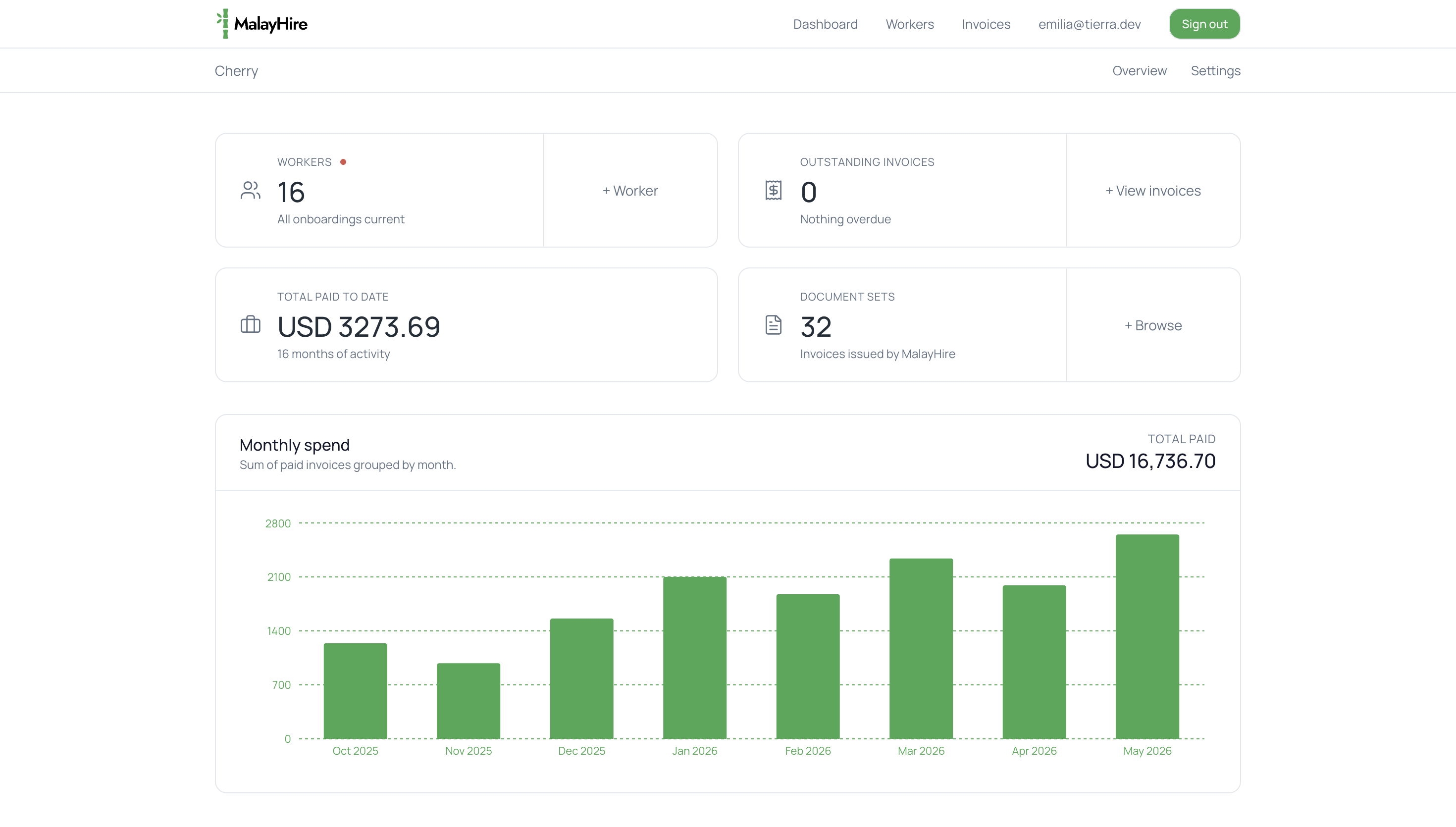
Manage your Malaysian team, payroll & EOR compliance in one place.