
Malaysia Foreign Investment: A Step-by-Step Guide to Simulating Payroll Compliance Before You Hire


Malaysia Foreign Investment: A Step-by-Step Guide to Simulating Payroll Compliance Before You Hire

Key Takeaways
- Testing Malaysia’s statutory contributions in a sandbox lets you validate payroll before real investment risk.
- EPF, SOCSO, EIS, HRDF, and PCB each have unique rates and triggers that generic global sandboxes may miss.
- A compliance sandbox is a fully isolated, no-consequence environment—no real payments, no legal contracts.
- Setting up a simulation involves configuring employee demographics, salary bands, and statutory schedules.
- A Malaysia-dedicated EOR sandbox, like MalayHire’s 48-hour onboarding playground, reflects actual local labour law nuances.
- Common pitfalls include misclassifying EPF categories and overlooking industry-specific HRDF levies.
- Verifying calculations against official government tables before go-live saves you from costly compliance gaps.
- Foreign investors who simulate payroll first demonstrate operational readiness to local partners and regulators.

Why Malaysia Foreign Investment Demands Compliance Readiness
When foreign investors start looking at Malaysia, the conversation often begins with market size, export routes, or tax incentives. What rarely gets talked about at the boardroom stage is the web of statutory contributions—EPF, SOCSO, EIS, HRDF, PCB—that kicks in the moment you hire your first local employee. Yet those same contributions can trip up an otherwise promising market entry. A single misstep in payroll deductions or levy payments can generate penalties, damage your employer brand, and distract leadership from the real work of growing the business.
This is where a compliance sandbox comes in. Think of it as a flight simulator for your Malaysian payroll. You can model different employee profiles, run mock pay cycles, and see exactly how much you’ll owe each statutory body—all without moving real money or creating binding contracts. For foreign investment decisions, that kind of rehearsal is priceless. It shifts compliance from an abstract worry to a known quantity, giving your finance and HR teams the confidence to tell management, “Yes, we’ve tested this. Here are the actual numbers.”
Decoding Malaysia’s Mandatory Statutory Contributions
Before you can test anything in a sandbox, you need to know what you’re testing for. Malaysia’s payroll isn’t just about salary and tax; it’s a layered system of mandatory contributions designed to protect employees and fund national development. Understanding these obligations is the foundation of any simulation. Below are the main components you’ll configure inside an EOR sandbox.
EPF: The Backbone of Retirement Savings
The Employees Provident Fund is Malaysia’s national retirement scheme. Both employer and employee contribute a percentage of monthly wages. Rates depend on the employee’s age and whether they are a Malaysian citizen or permanent resident. For most employees, the employer share is 12–13% while the employee portion is 11%. Anyone simulating payroll must account for tiered contribution scales—above age 60 the rates drop, and for employees earning under RM5,000 there are sliding scales. A sandbox that doesn’t auto-adjust these tiers will give you inaccurate projections.
SOCSO and EIS: The Social Safety Nett
The Social Security Organization (SOCSO) administers two schemes: the Employment Injury Scheme and the Invalidity Scheme, now lumped together under a single contribution rate. An additional Employment Insurance System (EIS) contribution provides financial aid to retrenched workers. Employer and employee each pay a tiny fraction of monthly salary, capped at a specific insurable wage ceiling. While the sums look small, the compliance risk isn’t—missed contributions can trigger audits. Your sandbox simulations should test both standard and overtime scenarios, because SOCSO ceilings apply to total insurable earnings.
PCB: Monthly Tax Deductions at Source
Potongan Cukai Bulanan (PCB) is Malaysia’s version of pay-as-you-earn tax withholding. Employers deduct income tax from employees’ salaries each month and remit it to the Inland Revenue Board. The amount is calculated using the official PCB schedule, which factors in the employee’s marital status, number of children, and other reliefs. In a sandbox, you’ll input various employee profiles to see tax deductions fluctuate. If you’re bringing in foreign talent or transferring expatriate staff, you must test PCB for non-resident tax rates—something a global sandbox might not default to for Malaysian entities.
HRDF: The Often-Overlooked Industry Levy
The Human Resource Development Fund (HRDF) levy applies to specific industry sectors. Employers in manufacturing, services, and selected other fields must pay a levy of 1% of monthly wages for each employee, subject to a minimum and maximum. Not every new foreign investor realises this levy exists. In a simulation, you want to flag which employee roles trigger the levy and confirm the correct percentage. Some sectors are exempt; some have reduced rates. A Malaysia-dedicated sandbox will include HRDF toggles by industry classification code, letting you see true total cost per employee.
The Compliance Sandbox: Why Simulation Matters Before You Invest
In software development, a sandbox lets you experiment without breaking anything. The same principle applies to payroll compliance. A compliance sandbox is an isolated environment—often API-driven—where you can create employee records, set up salary structures, run dummy payroll cycles, and generate mock statutory contribution reports. According to Deel’s developer documentation, their Sandbox is “a completely isolated testing environment” that doesn’t trigger real payments or create legal contracts. It’s pre-populated with sample data, so you can start experimenting immediately.
For a foreign company evaluating Malaysia as an investment destination, the sandbox answers a very practical question: “What will employing someone here actually cost and what administrative burden does it create?” You can model minimum wage scenarios in Kuala Lumpur versus Penang, see how SOCSO contributions change when you add a risky job role, or test whether an expatriate’s salary structure triggers PCB surprises. The difference between a generic global EOR sandbox and one purpose-built for Malaysia is subtle but significant. A local simulation mirrors actual EPF contribution schedules, automatically applies the latest minimum wage adjustments, and flags HRDF applicability based on the real Malaysian Standard Industrial Classification (MSIC) code of your business activity.
Step-by-Step: Running Your First Malaysia Payroll Simulation
Whether you’re using a global platform’s sandbox or a Malaysia-specific EOR environment, the simulation workflow follows a logical pattern. Here’s how to go from zero to a fully verified payroll run that mirrors your intended workforce.
Step 1: Choose Your Sandbox and Obtain API Access
Start by selecting the environment you’ll use. If you go with a global provider like Deel, you’ll authenticate via an API token or OAuth2, as described in their authentication guide. All requests must be sent over HTTPS with the token in the Authorization header. The base URL points to their test API, and sample data is immediately available. For a Malaysia-dedicated experience, a local EOR like MalayHire provides a sandbox that doesn’t require lengthy setup calls; you can get in within 48 hours and see real-time statutory calculations that reflect the exact EPF, SOCSO, and PCB tables.
- Pick a sandbox that replicates Malaysian statutory tables, not just generic payroll maths.
- Generate API keys with the minimum scopes needed: read payroll, write employee, read reports.
- Verify that the environment supports the exact statutory bodies you need—some global sandboxes omit HRDF.
Step 2: Configure Employee Profiles and Statutory Rates
Now create test employee records that mirror the diversity you expect in your actual team. Input Malaysian and non-Malaysian nationals, different age groups, varying salary bands, and distinct employment statuses (permanent, contract, part-time). Attach the appropriate EPF category, SOCSO class, and EIS eligibility. If your business falls under an HRDF-registered sector, flag it. This step is critical: a simulation that only tests a single “plain vanilla” employee misses the edge cases—like a 61-year-old driver whose EPF employer rate drops to 4% and SOCSO Class changes from I to II.
- Enter at least five distinct employee profiles covering age brackets, citizenship, and industries.
- Set salary figures above and below the RM4,000 SOCSO wage ceiling to observe cap effects.
- Activate PCB calculations with both single and married statuses to see tax variation.
- Check if the sandbox auto-applies the current minimum wage (RM1,500 as of mid-2024) or allows manual override.
Step 3: Run a Payroll Cycle and Calculate Contributions
Execute a full payroll run for a chosen month. The sandbox should compute gross-to-nett pay, total employer contributions, employee deductions, and net salary. Then generate a report that itemises each statutory payment: EPF employer share, EPF employee portion, SOCSO employer, SOCSO employee, EIS both sides, PCB, and HRDF levy where applicable. Pay attention to decimal rounding—Malaysian regulations specify rounding to the nearest sen for certain deductions. If your global sandbox rounds differently, you’ll see discrepancies that could translate into real audit risks later.
- Produce a payroll journal that shows each line item by statutory body.
- Compare employer total cost against employee net take-home to assess true headcount expense.
- Log any discrepancies between expected contributions (from official tables) and sandbox outputs.
Step 4: Validate Outputs Against Official Guidelines
Now comes the QA portion. Cross-reference the sandbox outputs with the latest EPF Contribution Table, SOCSO Contribution Rate Schedule, PCB 2024 Schedule, and HRDF Act provisions. If you find mismatches, adjust the configuration—perhaps the employee’s age bracket was set incorrectly or the wage ceiling wasn’t enforced. This is the moment where a localised sandbox really shines: it should already have built-in validation rules that flag anomalies. In a global environment, you might have to manually check everything, which defeats the time-saving purpose.
- Use official EPF, SOCSO, and LHDN tables to verify each contribution amount.
- Document any gaps where the sandbox logic doesn’t match special cases (e.g., probationers, foreign domestic workers).
- If HRDF levy is absent, confirm whether your industry is exempt or the simulation simply missed it.
Global EOR Sandboxes vs. Malaysia-Dedicated Simulations: Spotting the Gaps
Many global Employer of Record platforms offer sandbox environments. Deel’s, for instance, comes pre-populated with contracts, workers, and organizations. Remote, on the other hand, emphasises embedded solutions—a white-label option or a fully custom integration—that could be used to test payroll flows. But when you’re dealing with the specificities of Malaysian labour law, these generalised sandboxes can leave blind spots that a locally-focused simulation fills. Below is where the gaps typically appear.
Coverage of Statutory Bodies
A global sandbox will certainly handle common statutory deductions that exist in many countries—income tax, social security, pension. But Malaysia’s HRDF levy is not universal; it applies only to certain industries and is easy for a multinational tool to overlook. Similarly, the distinction between SOCSO’s two schemes and the Employment Insurance System can get lumped into one generic “social security” line item. When you simulate payroll in a Malaysia-dedicated sandbox, each body appears as a separate, recognisable line with its own calculation method, matching exactly what you’ll see on official bordereau forms.
Handling of Employee Demographic Nuances
EPF rates change at age 60; SOCSO categories depend on employee classification (Class I for those earning above RM4,000, Class II for below); PCB reliefs vary by marital status. A generic sandbox might treat all employees as a single rate, maybe even defaulting to a home-country pension scheme. In practice, the difference between a 28-year-old Malaysian single male and a 55-year-old permanent resident female is significant. A Malaysia-tuned simulation will let you define citizenship status, age, and PCB marital category, then instantly apply the correct statutory matrix—no manual lookups required.
Real-Time Updates on Regulation Changes
Malaysia revises its minimum wage periodically, and EPF contribution rates can change during economic stimulus packages. When the government announced the scheduled EPF employer share reduction during 2020–2021, many foreign employers struggled to keep up. A sandbox that pulls from a centralised, updated rule engine—like the one a dedicated local EOR maintains—automatically reflects the latest announcements. Global platforms may lag because they update rates for dozens of countries, and Malaysia’s micro adjustments don’t always make the top of the queue.
A Finance Team’s Sandbox Verification Checklist for Your First Malaysia Hire
- EPF employer and employee contributions match age-based tier and citizenship (citizen vs. permanent resident).
- SOCSO Class correctly assigned based on insurable wage ceiling and employee’s monthly salary.
- EIS contributions present for all employees below the retirement age of 60.
- PCB deductions align with employee’s marital status, number of children, and latest tax reliefs.
- HRDF levy is activated for positions in registered sectors and calculated at the correct 1.0% rate.
- Minimum wage compliance is verified—no employee record shows a basic salary below the current mandated floor.
- Overtime and bonus payments are factored into SOCSO and EPF contributions where applicable.
- Report outputs itemise each statutory body separately, ready for cross-check against government forms.
- Foreign employees’ PCB rates reflect non-resident tax tables if they haven’t gained resident status.
- The simulation handles mid-month joiners and leavers, prorating contributions correctly.
Common Mistakes When Simulating Malaysia Payroll and How to Avoid Them
Even in a sandbox, it’s easy to walk away with a false sense of security. I’ve seen finance teams make the same errors repeatedly, largely because they treat the exercise as a quick tick-box rather than a genuine dress rehearsal. The most frequent slip-ups centre on misclassifying employees or ignoring industry-specific triggers. Here are the ones to watch for.
- Using a generic employee template that doesn’t account for age-related EPF rate reductions—your over-60 employees will show inflated employer costs.
- Forgetting to enable EIS for employees who are Malaysian citizens or permanent residents, even if SOCSO is active.
- Assuming HRDF applies to all companies; many service sub-sectors are exempt, and your simulation should reflect your actual MSIC code.
- Applying flat PCB percentages instead of the progressive PCB schedule, which can significantly alter take-home pay projections.
- Neglecting to simulate statutory contributions on bonuses and commissions—these are subject to EPF and SOCSO up to certain limits.
- Relying on outdated rates; if your sandbox hasn’t been updated since the last minimum wage adjustment, start over.
- Testing only one monthly salary amount without exploring the SOCSO wage ceiling, missing the cap effect above RM4,000.
From Virtual Sandbox to Real Payroll: Making the Confident Leap
Once your simulations consistently mirror official tables and your finance team has a verified control sheet, you’re ready to move. But the transition from sandbox to live payroll isn’t just about flicking a switch. You’ll need to establish legal entities or engage a registered Employer of Record. A local EOR like MalayHire can take the validated configuration from your sandbox—the employee profiles, the statutory mapping, the payment schedules—and convert it into a fully compliant, active payroll within 48 hours. This means you don’t lose the work you invested in testing; it becomes the foundation of your real operations.
The key is to treat the sandbox output as a living document. Export the contribution schedules, file the validation notes, and share them with the EOR provider so there’s zero ambiguity. By the time you onboard your first Malaysian employee, your payroll run will feel like the natural next step, not an experiment. Foreign investors who follow this path often find that local regulators and banking partners perceive them as more prepared—which can smooth everything from bank account openings to immigration approvals.
Expert Insights for Long-Term Foreign Investment Success
Foreign investment in Malaysia isn’t just about capital; it’s about demonstrating operational competence. The companies that succeed here are the ones that respect local institutions—and the statutory contribution system is one of the most visible ways you show that respect. A thorough sandbox simulation signals to your local team, your board, and the authorities that you’ve done your homework. It also gives you hard data on employment costs, which directly feeds into your financial modelling for the Malaysian entity.
Looking ahead, consider running compliance simulations not just at entry but annually or whenever a major regulatory change looms. Budget announcements, labour law amendments, and minimum wage revisions will all affect your payroll. With a Malaysia-dedicated sandbox, you can replay those scenarios and adjust ahead of time. For a foreign investor, that proactive stance turns compliance from a defensive cost into a strategic advantage—a way to show clients and partners that you’re rooted in the local reality, not just passing through.
Frequently Asked Questions
How do I verify that my payroll simulation for Malaysia is accurate before hiring my first employee?
You verify accuracy by cross-referencing your simulation against official KWSP, SOCSO, and EIS contribution tables from their respective websites. Then systematically run your calculation through the finance team's sandbox verification checklist, ensuring each statutory deduction matches the latest employee wage ceiling and contribution rates for your foreign hire's salary tier.
What are the mandatory statutory contributions for foreign employees in Malaysia that I must include in my payroll simulation?
Foreign employees in Malaysia require mandatory contributions to SOCSO, EIS, and the Employment Pass levy, while KWSP contributions are optional for foreign workers. Your simulation must also account for monthly income tax deductions via PCB, as foreign employees are generally subject to Malaysian tax on income sourced within the country from their first day of employment.
Can I use a global Employer of Record sandbox to simulate Malaysia-specific payroll compliance, or do I need a dedicated tool?
A global EOR sandbox may lack critical Malaysia-specific compliance rules, such as the exact SOCSO contribution tiers for foreign workers or the Employment Pass levy calculation. Using a dedicated Malaysia payroll simulation tool or manually configuring your sandbox with local statutory tables is essential to avoid costly errors in contributions and filing deadlines.
What is the most common mistake foreign investors make when simulating Malaysia payroll for the first time?
The most common mistake is failing to update simulation contribution rates to the latest annual revisions, which can change every February. Another frequent error is treating foreign employees the same as local hires by incorrectly assuming mandatory KWSP contributions, when in fact only SOCSO, EIS, and PCB are compulsory for foreigners.
How does the Employment Pass levy affect my payroll simulation for a foreign hire in Malaysia?
The Employment Pass levy is a monthly fixed cost per foreign employee, which varies by sector and pass type, and it must be included as an employer cost in your simulation. This levy is not a deduction from the employee's salary but an additional payroll expense your company must budget for when calculating total employment cost in the sandbox environment.
What payroll compliance deadlines should I validate in my simulation before making my first real hire in Malaysia?
You must validate that your simulation correctly schedules monthly SOCSO and EIS contributions by the 15th of the following month, and KWSP contributions by the 15th if you opt in. Additionally, confirm your income tax PCB deductions are remitted by the 10th of the next month, and the Employment Pass levy is paid before the pass expires to avoid penalties.
How do I ensure my payroll simulation handles the difference between foreign and local employee contribution rates correctly?
You ensure this by explicitly setting the employee type to 'foreign' in your simulation, which automatically applies the correct SOCSO contribution table covering Classes 1 through 5 for Category 2 employees. The simulation should also exclude mandatory KWSP deductions for foreigners, and instead apply the correct PCB tax table for non-resident or resident foreign employees based on their stay duration.
What steps do I take to transition from a successful Malaysia payroll simulation to running real payroll for my first foreign hire?
First, export your verified simulation data and register with KWSP, SOCSO, and the Inland Revenue Board to obtain your employer account numbers. Then run a parallel test by entering your first real employee's details into the same simulation environment, compare the outputs to your manual calculations, and only after confirming zero discrepancies should you proceed to live payroll processing.
MalayHire is your most cost-effective Employer of Record (EOR) in Malaysia
Hire full-time employees in Malaysia and save costs by avoiding hefty contractor fees. MalayHire handles payroll, employment contracts, statutory compliance (EPF, SOCSO, EIS), and HR admin. Start onboarding your Malaysian hire now, with MalayHire.
Trusted by global companies hiring in Malaysia





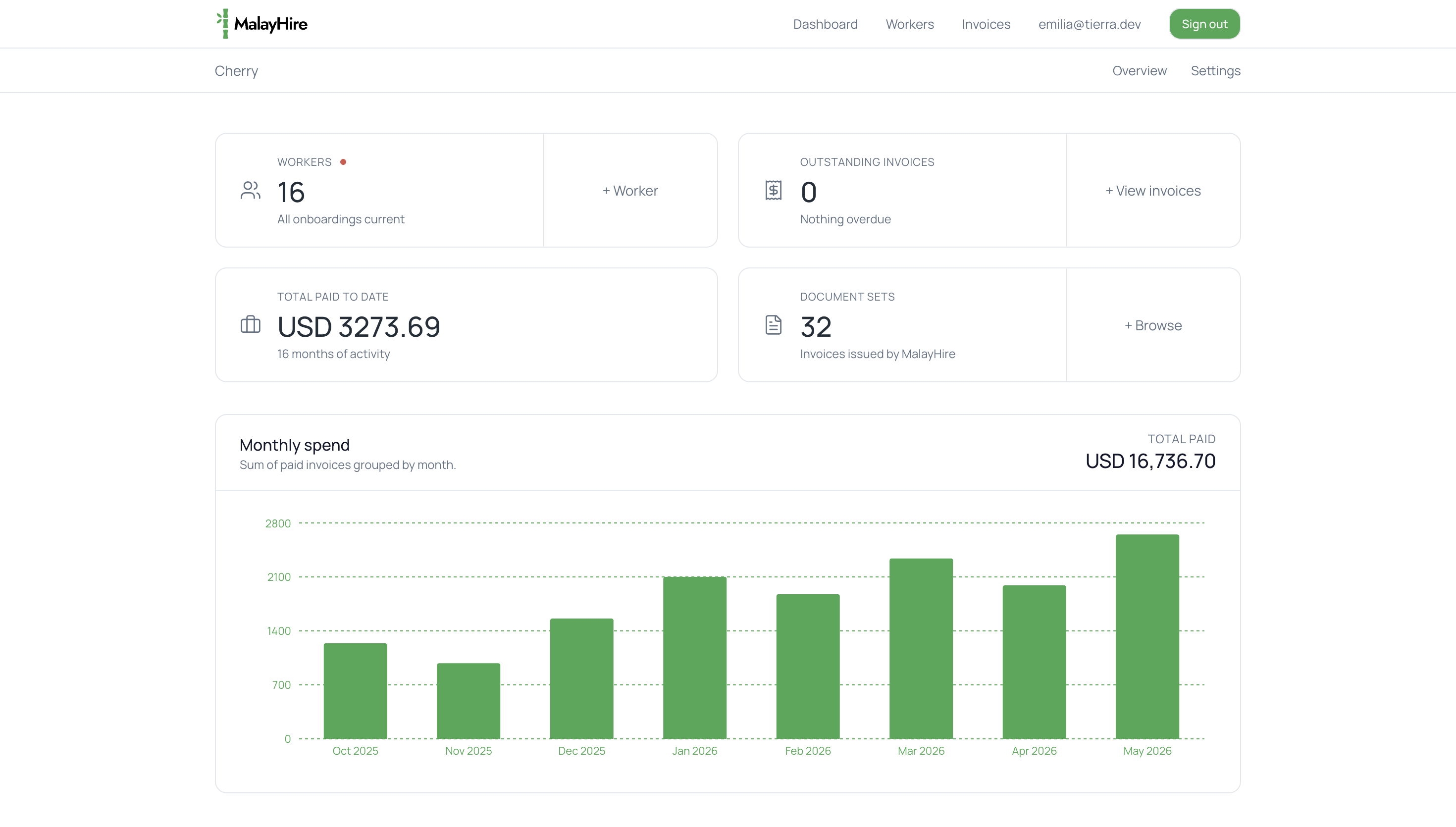
Manage your Malaysian team, payroll & EOR compliance in one place.