
Malaysia Gig Economy Workforce Trends: What Global Employers Need to Know in 2025


Malaysia Gig Economy Workforce Trends: What Global Employers Need to Know in 2025

Key Takeaways
- Malaysia’s gig economy is expanding beyond e-hailing and delivery into freelance tech, creative, and professional services.
- The line between independent contractor and employee is the single biggest compliance risk for foreign employers.
- Platform workers in Malaysia currently sit in a regulatory gray zone, with social protection reform under active discussion.
- Payment rails like DuitNow, FPX, and e-wallet transfers have made same-day gig payouts the norm, not the exception.
- An EOR platform can manage both contractor payments and full-time employee onboarding without setting up a local entity.
- Fast onboarding (under 48 hours) matters because gig projects often start and stop on short timelines.
- Misclassification can trigger backdated EPF, SOCSO, and EIS liabilities, plus penalties for the employer.
- Foreign employers should audit their worker classification before scaling any gig-based hiring model in Malaysia.

Why Malaysia’s Gig Economy Workforce Trends Are Different
Malaysia gig economy workforce trends look different from what you might see in Silicon Valley or London. This isn't just about freelancers on Upwork. It's a blend of platform-driven e-hailing and delivery work, a growing cohort of independent tech professionals, and a regulatory environment that hasn't yet caught up with how people actually earn a living. If you're a foreign employer hiring Malaysian talent, you can't just copy-paste your contractor playbook from another market and assume it works.
The local gig workforce has matured fast. Riders on Grab, food delivery couriers, freelance developers, designers, and virtual assistants now make up a significant slice of the labor market. But the rules governing them remain fragmented. Some gig workers are treated as genuine independent contractors, some are misclassified employees, and an emerging third category — platform workers — is slowly being recognized by policymakers. That fragmentation creates both opportunity and risk. The opportunity is access to agile, high-skill talent without long hiring cycles. The risk is stumbling into statutory obligations you never planned for, like EPF, SOCSO, and EIS, because your so-called contractor looks a lot like an employee under Malaysian law.
The Classification Spectrum: Gig Workforce Trends Malaysia Employers Must Understand
Here's the uncomfortable truth: "gig worker" is not a legal category in Malaysia. You won't find it in the Employment Act 1955 or the Income Tax Act. What you will find are three practical buckets that every foreign employer needs to understand before onboarding anyone. Get the bucket wrong, and you could be on the hook for backdated statutory contributions, unpaid leave, and penalties.
The distinction matters because Malaysia's employment laws are designed around a binary — employee or independent contractor — but the gig economy has forced a messy third category into existence. Let's break down each one.
Employees Under the Employment Act
If a worker is classed as an employee, they're entitled to the full suite of Malaysian labor protections: EPF and SOCSO contributions, EIS coverage, annual leave, sick leave, maternity leave, overtime pay, and termination notice periods. Their employer must deduct contributions monthly and file with the relevant authorities.
Here's the catch: many "gig" arrangements are actually employment relationships in disguise. If a foreign company gives a Malaysian worker a regular monthly retainer, directs their daily tasks, provides tools, and prohibits working for others, that worker is probably an employee — even if the contract says "independent contractor." The label doesn't matter; the working reality does.
Genuine Independent Contractors
A true independent contractor in Malaysia controls how they deliver the work, uses their own tools, sets their own hours, can work for multiple clients, and invoices for deliverables rather than time. They're responsible for their own income tax and are not covered by statutory employment protections.
For foreign employers, this is the lightest-touch arrangement — but only if the independence is real. A short-term freelance developer who works remotely, sets their own schedule, and delivers code against a project milestone is likely a contractor. A "contractor" who must be online from 9 to 6, report to a manager, and use company software under close supervision is not.
The Emerging Platform Worker Category
Malaysia is actively discussing a third category for platform workers — people who earn through e-hailing, delivery, and other app-based services. These workers don't fit neatly into either existing bucket. They have some independence but operate under platform algorithms that control their work.
Regulators are exploring ways to extend social security protections (like accident insurance and possibly SOCSO contributions) to these workers without making them full employees. Nothing is final yet, but the direction is clear: gig work in Malaysia is becoming more regulated, not less. Foreign employers who rely heavily on platform-based talent should monitor these changes closely.
What’s Driving Malaysia’s Gig Economy Workforce Trends
The shift toward gig work in Malaysia didn't happen by accident. Several forces have converged over the last few years, and they're still pushing the market in the same direction. Understanding these drivers helps you see where the workforce is heading — and why the old employment models are cracking.
For global employers, the practical takeaway is simple: Malaysian professionals increasingly expect flexibility, and the infrastructure to support that flexibility is already in place. The companies that adapt quickly will win the best talent.
- Post-pandemic preference for flexibility among Malaysian professionals, especially in tech, design, and content roles.
- Cost-sensitive startups using contractors to test roles before committing to full-time hires with statutory obligations.
- Digital payment infrastructure like DuitNow and e-wallets removing friction from freelance payouts.
- Government push toward a digital economy and remote work ecosystems that normalize project-based work.
- Platform companies expanding beyond ride-hailing into logistics, professional services, and on-demand talent.
The Payment Rails Behind Malaysia’s Gig Payments
Foreign employers often assume that paying Malaysian gig workers means a SWIFT bank transfer from overseas, a PayPal payment, or some clunky workaround. But Malaysia has built a set of local payment rails that make domestic transfers fast, cheap, and nearly instant. If you're hiring gig workers in Malaysia, you should know how these rails work — because your workers already do.
Using the right rail isn't just about speed. It's also about compliance and cost. A cross-border SWIFT transfer can take days and eat into the worker's earnings with intermediary bank fees. A local rail handled through an EOR or local partner can settle in seconds at a fraction of the cost.
- DuitNow: Bank-agnostic instant transfer using a mobile number or NRIC; ideal for one-off gig payouts.
- FPX: Online banking payment gateway that lets you schedule payouts directly from a bank account; commonly used for contractor invoices.
- MEPS Interbank GIRO: Slower (one to two business days) but very cheap for batch payroll runs.
- Touch 'n Go eWallet, GrabPay, and Boost: Popular with gig workers who want instant access to funds without needing a bank account.
- Direct SWIFT transfers from abroad: Expensive and slow; a local EOR can batch domestic transfers instead, turning a three-day wait into a same-day credit.
Where EOR Platforms Fit Into Malaysia’s Gig Economy Workforce Trends
An Employer of Record (EOR) sits neatly between the two extremes of setting up a Malaysian entity and trying to run everything from overseas. For gig economy hiring, an EOR can handle two very different jobs at once: paying genuine independent contractors as a local paymaster, and onboarding full-time employees when a gig relationship converts into something more permanent.
This matters because gig work in Malaysia is rarely static. A project might start with two freelance developers, grow into a six-month engagement, and end with one of them being offered a full-time role. Without a local entity, you'd struggle to manage that transition smoothly. A Malaysia-focused EOR like MalayHire EOR does it with fixed monthly pricing starting at $165 per employee and a 48-hour onboarding process that skips the usual sales-call-and-paperwork dance.
Handling Contractor Payments Without a Local Entity
A foreign company can pay Malaysian gig workers through an EOR's local payment rails without opening a Malaysian bank account or registering a branch. The EOR handles currency conversion, local tax reporting for contractor payments, and ensures the worker receives funds via DuitNow or bank transfer.
This removes the biggest operational headache for small startups: getting money to a Malaysian freelancer quickly and legally. Instead of waiting for overseas transfers, workers get paid on local timelines — which is a major retention advantage in a competitive gig market.
Smoothing the Employee-to-Contractor Transition
When a gig relationship matures into a full-time role, the EOR already has the worker's details, bank information, and compliance profile. Converting them from contractor to employee means triggering EPF, SOCSO, and EIS contributions — something the EOR handles entirely.
This transition is where many foreign employers stumble. They hire a contractor for a month, then realize they want them full-time, but have no infrastructure to make that happen compliantly. An EOR designed for rapid onboarding can do it without missing a payroll cycle.
Why Fast Onboarding Matters for Gig Projects
Gig work runs on short timelines. A startup might get a client project with a two-week deadline and need two developers to start immediately. If onboarding takes two weeks of paperwork, you've already lost the project. If it takes 48 hours, you're competitive.
MalayHire EOR's 48-hour onboarding is built for exactly this scenario. There's no sales call to schedule, no PDF forms to print and scan. Everything is digital, which mirrors how Malaysian gig workers themselves expect to work. Speed isn't just a convenience — it's a hiring advantage.
Five Misconceptions Foreign Employers Have About Malaysian Gig Workers
The biggest mistakes in Malaysia's gig economy don't come from malicious intent. They come from outdated assumptions. Foreign employers transfer their home-market understanding of gig work to Malaysia and end up with compliance exposure, unhappy workers, or both. Let's clear up the most common ones.
- Misconception: All gig workers prefer independent contractor status. In reality, many Malaysian professionals want the social security and stability that come with employee classification.
- Misconception: No statutory contributions means no compliance risk. The risk is misclassification, which can trigger backdated EPF, SOCSO, and EIS liabilities.
- Misconception: A written independent contractor agreement is enough to avoid employee status. Malaysian authorities look at the actual working relationship, not just the contract label.
- Misconception: Gig workers don't need contracts. A clear scope of work, payment terms, and IP ownership clause protect both sides, even for short projects.
- Misconception: Paying via PayPal or foreign transfer is fine. Malaysian gig workers often prefer local instant rails and may face conversion delays or hidden fees with foreign payment methods.
- Misconception: You can hire a gig worker through a global platform and ignore Malaysian labor law. If the worker is physically based in Malaysia, local rules still apply to the engagement.
The Next Five Years: Malaysia Gig Economy Workforce Trends to Watch
If you're planning to hire Malaysian gig workers in 2025 and beyond, don't build your strategy around today's rules alone. The regulatory landscape is shifting, and the workers themselves are becoming more organized. Here are two trends that will reshape the market.
Greater Platform Worker Protections
Expect Malaysia to follow the global trend of extending social protections to gig and platform workers. This could mean mandatory SOCSO-style contributions for e-hailing drivers, delivery riders, and possibly freelance professionals who work through digital platforms. It might also include accident insurance requirements and minimum earnings guarantees.
For employers, this doesn't mean gig work goes away. It means the cost and compliance burden of hiring gig workers will likely increase. An EOR that already manages statutory contributions can absorb much of this complexity.
The Rise of Hybrid Employment Models
More companies will adopt a blended model: a core team of full-time employees and a flexible ring of contractors for project spikes. Malaysia is well-suited to this because its talent pool is highly adaptable and digital-native.
The challenge is managing two different compliance regimes at once. An EOR that handles both contractor payments and employee payroll becomes a single point of control. Without it, foreign employers juggle two separate processes, two payment rails, and two sets of tax obligations — a recipe for errors.
Making the Right Call for Your Hiring Model
Malaysia's gig economy is a genuine opportunity for global employers who understand the rules. The talent is there, the payment rails are modern, and the culture embraces flexibility. But the compliance landscape is not static, and the line between contractor and employee is thinner than most foreign companies realize.
Before you scale any gig-based hiring in Malaysia, do three things. First, audit your current worker classifications against the practical tests of control, exclusivity, and integration. Second, adopt local payment rails so your workers get paid fast and you avoid cross-border friction. Third, decide whether you need an EOR partner that can handle both contract workers and full-time employees — because your gig workforce today might become your core team tomorrow. The companies that treat Malaysia's gig economy as a strategic opportunity, not a cost-cutting shortcut, are the ones that will build durable teams in one of Southeast Asia's most dynamic labor markets.
Frequently Asked Questions
How does Malaysian labor law classify gig workers compared to full-time employees?
Malaysian labor law does not uniformly classify gig workers, leaving them in a gray zone between employees and independent contractors. The standard test examines factors like control, integration, and economic dependency, but consistent case law remains absent. Employers must navigate this ambiguity carefully, especially after recent legal updates.
What is the difference between an independent contractor and a subcontractor in Malaysia?
An independent contractor in Malaysia works directly for a client under a contract for services, controlling their own work methods. A subcontractor is hired by a main contractor to perform part of a larger contract, often within a specific trade or industry. Tax and insurance obligations differ significantly between these classifications.
What is the minimum wage for Malaysian gig workers?
Malaysian gig workers do not have a statutory minimum wage since they fall outside the Employment Act's definition of employees. The minimum wage of RM1,700 applies to formal employees in Peninsular Malaysia, but gig platforms set their own pay rates. Actual gig earnings often exceed this threshold, though without guaranteed hours.
Are Malaysian gig workers entitled to EPF and SOCSO contributions?
Malaysian gig workers are not automatically entitled to EPF and SOCSO contributions because they are not classified as employees under current laws. Voluntary contributions are possible, and the government has introduced schemes to encourage gig worker savings. However, platform companies have no legal obligation to contribute on their behalf.
What is the best way to hire gig workers in Malaysia legally?
The best way to hire gig workers in Malaysia legally is to classify them correctly as independent contractors and draft comprehensive service agreements. You should avoid exercising control over their working hours or methods, and clearly define deliverables. Engaging an EOR platform can mitigate misclassification risks when hiring across borders.
Do Malaysian gig workers have rights to paid leave and public holidays?
Malaysian gig workers have no statutory right to paid annual leave, sick leave, or public holiday pay because they are not employees. Their entitlements depend entirely on their contracts and platform policies, which often provide no paid time off. Some platforms offer limited benefits voluntarily, but these are not legally mandated.
How do Malaysian gig economy payments work regarding PAYE tax withholding?
Malaysian gig platforms do not withhold PAYE tax on worker payments because gig workers are treated as independent contractors, not employees. The workers are responsible for declaring their income and paying income tax themselves. Foreign employers must ensure proper invoicing and tax documentation to avoid penalties.
What Malaysia gig workforce trends should foreign employers watch by 2030?
Foreign employers should watch for legal reforms expanding gig worker protections, including potential social security coverage and clearer classification rules by 2030. Platform consolidation and increased use of AI for matching workers are likely trends. Rising worker demands for benefits will push platforms to adopt hybrid models that blend contract and employment features.
MalayHire is your most cost-effective Employer of Record (EOR) in Malaysia
Hire full-time employees in Malaysia and save costs by avoiding hefty contractor fees. MalayHire handles payroll, employment contracts, statutory compliance (EPF, SOCSO, EIS), and HR admin. Start onboarding your Malaysian hire now, with MalayHire.
Trusted by global companies hiring in Malaysia





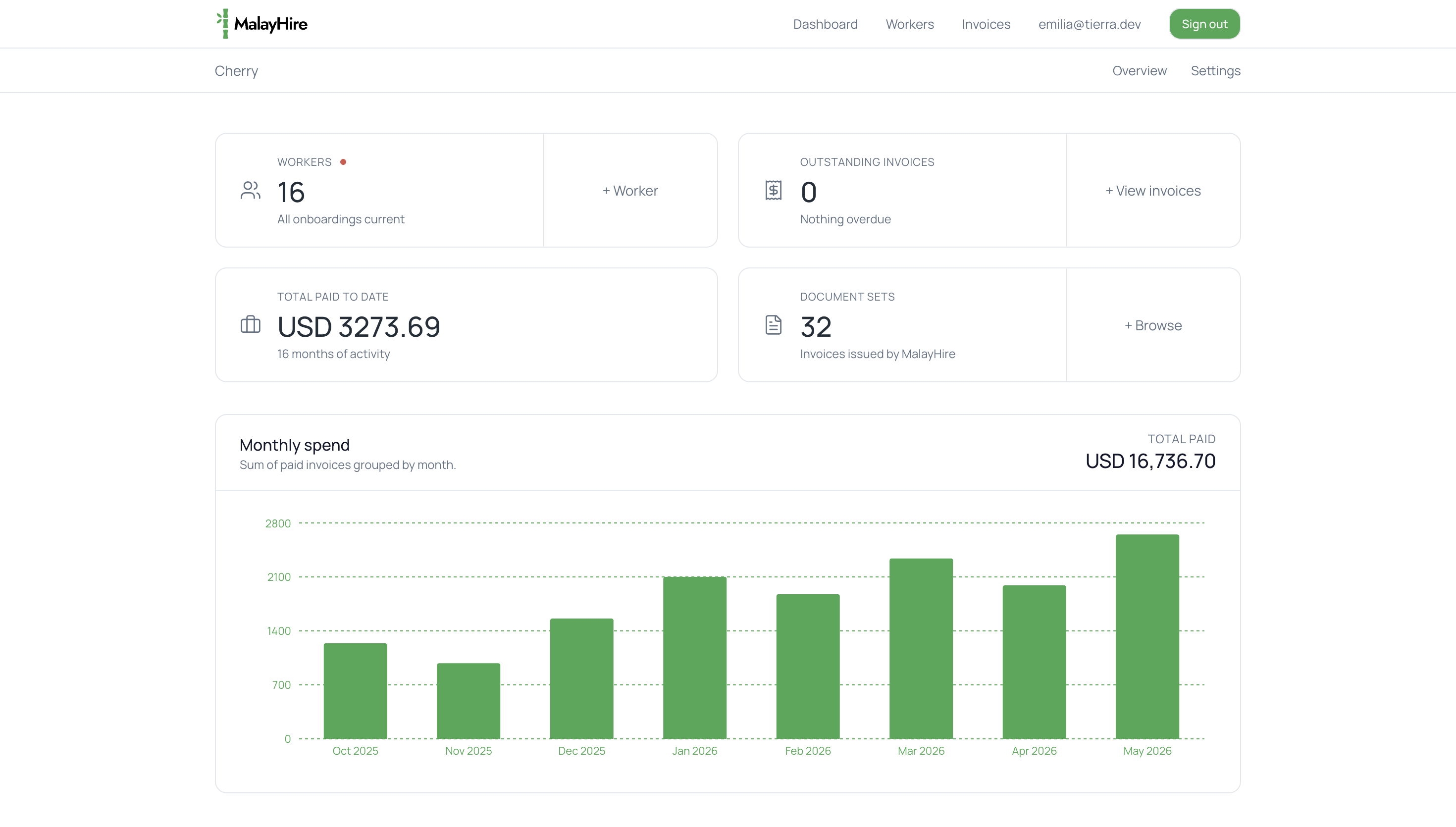
Manage your Malaysian team, payroll & EOR compliance in one place.