
Malaysia Jobs Market: The Hidden Compliance Pitfalls That Trap Foreign Employers


Malaysia Jobs Market: The Hidden Compliance Pitfalls That Trap Foreign Employers

Key Takeaways
- Malaysia’s jobs market is booming, but its labour laws—rooted in the Employment Act 1955—can blindside foreign employers who assume global templates will suffice.
- Misclassifying a full-time hire as an independent contractor is the single most expensive mistake, leading to backpay, penalties, and potential court action.
- Statutory contributions like EPF, SOCSO, and EIS aren’t optional perks—they are mandatory percentages that must be paid on time, and miscalculating them torpedoes budgets.
- The 48-hour onboarding window that local EOR platforms offer is not a luxury; in a competitive talent market, a slow hiring process means losing candidates to faster-moving competitors.
- Termination isn’t as straightforward as giving notice—severance, retrenchment benefits, and rigid notice periods under Malaysian law catch many first-time employers off guard.
- Fixed-price EOR models remove the guesswork from budgeting, starting as low as $165 per employee per month, and bundle contract management, payroll, and statutory filings.
- Simulating compliance through an API sandbox—like those offered by Deel and others—before making your first hire gives you a risk-free preview of the entire payroll flow.
- Choosing between an EOR and a traditional PEO comes down to speed, liability, and local depth; in Malaysia, a locally focused EOR often provides faster resolution when labour offices come calling.

Why the Malaysian Job Market Is Suddenly on Every Foreign Employer’s Radar
Walk through any co-working space in Kuala Lumpur or Penang and you’ll hear a mix of English, Mandarin, and Malay—often in the same conversation. That linguistic ease is just one reason Malaysia’s jobs market has become a magnet for foreign companies. The country churns out thousands of tech-savvy graduates each year, wages remain competitive compared to Singapore or Hong Kong, and government agencies like MIDA actively court foreign direct investment.
But here’s what nobody tells you at the investment seminars: the same Employment Act that protects workers also creates a minefield for international employers who assume Malaysia follows the same at-will employment logic they’re used to back home. The talent pool is deep, but accessing it without a local legal entity means navigating a web of statutory contributions, rigid termination rules, and fast-changing compliance requirements. Get it right and you’ll have a loyal, skilled team. Get it wrong and your first hire could come with a demand letter from the Labour Department.
The Compliance Pitfalls That Sink Even the Savviest Foreign Employers
If you’ve hired successfully in the US or the UK, Malaysia can lull you into a false sense of familiarity. The legal framework is English common-law based, contracts look recognizable, and business culture feels straightforward. But beneath that surface, five specific pitfalls catch almost every first-time foreign employer. I’ve seen them play out across startups, mid-market firms, and even Fortune 500s that thought a generic global HR policy would be enough.
Pitfall 1: Treating Every Worker as a Contractor
The most common trap is also the most expensive. A company finds a talented Malaysian developer, signs an independent contractor agreement, and assumes they’re off the hook for EPF, SOCSO, and EIS—and for termination protection. But Malaysian law doesn’t care what you call the relationship. If the worker has fixed hours, reports to a manager, uses company equipment, and has no other clients, they are an employee in the eyes of the Labour Court. Remote.com highlights similar misclassification risks in India, noting that companies face fines and penalties for getting this wrong. Malaysia is no different. An audit from the EPF or SOCSO can trigger backdated contributions for years, plus compounding interest. In the worst cases, the employer also owes statutory notice pay and retrenchment benefits they never budgeted for.
Pitfall 2: Underestimating the True Cost of Statutory Contributions
Many foreign employers budget base salary and forget that statutory contributions add roughly 14%–16% on top for every employee. Here’s how the math breaks down for a private-sector employee earning RM 5,000 per month:
- EPF (Employees Provident Fund): Employer contributes 13% (or 12% for some brackets) – RM 650 - SOCSO (Social Security Organization): Employer pays 1.75% – RM 87.50 - EIS (Employment Insurance System): Employer contributes 0.2% – RM 10 - The employee also has deductions (11% EPF, 0.5% SOCSO, 0.2% EIS), but the employer’s share must be factored into total cost-to-company.
Overlook these and your carefully planned budget suddenly looks 15% light. Worse, if you miss payments, late contribution interest runs at 0.5% per day for EPF and similar regimes for SOCSO. Suddenly a small oversight compounds into a serious liability.
- EPF: employer share typically 13% for employees earning above RM 5,000; late payment interest is charged daily.
- SOCSO: employer rate 1.75% (capped at an insurable wage ceiling); covers workplace injury and invalidity.
- EIS: 0.2% each from employer and employee; funds employment insurance and re-employment programs.
- PCB (Potongan Cukai Bulanan): monthly tax deduction on employee salary, based on LHDN tables; not an employer cost but requires precise calculation and remittance.
Pitfall 3: Forgetting That Termination Is Not at Will
In many markets, you can let someone go with two weeks’ notice and a handshake. Malaysian employment law is far more structured. The Employment Act prescribes minimum notice periods based on length of service—typically 4 weeks for employees with less than 2 years’ service, 6 weeks for 2–5 years, and 8 weeks for 5 years and above. And that’s just the beginning. Termination without just cause or excuse triggers dismissal claims. If the Labour Court finds the dismissal without valid grounds, it can order reinstatement—a remedy that terrifies foreign employers. On top of that, retrenchment benefits under collective agreements or the Employment (Termination and Lay-Off Benefits) Regulations can require payment of 10–20 days’ wages per year of service. I’ve spoken with HR managers who only discovered these rules when a disgruntled former employee filed a complaint, turning a quiet exit into a months-long tribunal ordeal.
- Minimum notice periods are statutory and cannot be waived by contract alone.
- Dismissal without just cause can result in reinstatement or compensation in lieu.
- Retrenchment benefits require payment based on length of service, often unexpected by employers used to at-will regimes.
- Constructive dismissal claims are common if an employer unilaterally changes terms of employment.
Pitfall 4: Slow Onboarding That Loses Top Talent
The Malaysian talent market moves fast. A skilled software engineer or digital marketer might entertain multiple offers at once. If your onboarding process drags on for weeks while you figure out how to register for EPF and set up payroll, the candidate will accept another offer. In the current jobs market Malaysia, speed is a compliance issue in its own right. I’ve seen companies lose perfect candidates simply because they couldn’t issue a formal employment contract within a few days. The best candidates want the security of knowing their statutory contributions are being handled from day one. When you hesitate, a local competitor or a more agile foreign outfit steps in.
Pitfall 5: Assuming Global Platforms Understand Local Nuances Without Gap Analysis
Some employers lean on global HR platforms that claim to cover 150+ countries. The problem is that Malaysia has quirks that a generic country guide might miss. For example, SOCSO’s contribution ceiling has been raised over time, and EIS was introduced relatively recently. Moreover, a foreign employer without a local entity cannot directly register for EPF and SOCSO—you must either set up a subsidiary (slow and expensive) or work through a registered employer. Platforms like Deel provide sandbox environments where you can test payroll calculations before hiring real people, which is invaluable. But even that simulation is only as good as the local tax logic behind it. Without someone who actually understands the Malaysian Labour Office’s interpretation of the rules, you’re still exposed.
How an Employer of Record Strips Out the Complexity
All of these pitfalls share a common root: foreign companies trying to act as direct employers without a local entity. An Employer of Record (EOR) plugs that gap. The EOR becomes the legal employer of your Malaysian staff—handling contracts, statutory registrations, payroll, and terminations—while you retain day-to-day control of their work. In the Malaysian context, this model is particularly powerful because it separates compliance infrastructure from your own corporate liability.
Rather than a theoretical solution, here’s what a localised EOR approach actually looks like in practice. Malayhire EOR, for example, structures its service around a 48-hour onboarding process. You identify the candidate, they handle everything from offer letter generation to EPF and SOCSO registration within two business days. Because they operate on a fixed monthly fee starting at $165 per employee, there’s no ambiguity about what you’re paying for. That cost includes local payroll processing, statutory contribution filings, tax remittance, and year-end tax forms—the exact areas where foreign employers bleed money when they go it alone.
Speed Without Sacrificing Compliance
When an EOR has pre-built infrastructure—bank accounts, registered employer numbers with KWAP, PERKESO, and LHDN—what takes a foreign company weeks can happen in hours. Contract templates are already vetted against the Employment Act. Payroll calculations are automated with the latest contribution rates. The 48-hour timeline isn’t a marketing gimmick; it’s the natural result of having all the pieces in place before you even make an offer. For an SME or startup, this speed means you can close a candidate on Friday and have them legally employed by Tuesday.
Termination and Severance Become Predictable
Since the EOR is the legal employer, they manage the end of the employment relationship as well. That means you aren’t left to decode retrenchment benefit formulas on your own. The EOR calculates the statutory payments, prepares the termination letter in compliance with local law, and handles any communication with the Labour Department if needed. This turns a high-risk process into a predictable administrative event with a known cost.
A Practical Compliance Checklist for Hiring in Malaysia
- Verify the worker’s employment status under Malaysian law—not just your contract’s label. Apply the ‘control test’ and ‘economic reality test’ honestly.
- Calculate total employer statutory contributions (EPF 13%, SOCSO 1.75%, EIS 0.2%) on top of base salary before finalizing your budget.
- Set up EPF, SOCSO, and EIS registrations as an employer BEFORE the employee’s first day. This requires a local entity or an EOR.
- Prepare a bilingual employment contract (English and Bahasa Malaysia) containing the mandatory particulars under Section 10 of the Employment Act.
- Establish a payroll schedule that aligns with statutory payment deadlines—EPF contributions are due by the 15th of the following month; late payments incur daily interest.
- For termination, document performance issues meticulously. Without a paper trail, even a legitimate dismissal can look unjustified to the Labour Court.
- Include PCB deductions from the first month. Use the latest LHDN tax tables and ensure the employee’s TP1/TP3 forms are filed.
- If using contractors, strictly avoid providing benefits like annual leave, medical coverage, or training that are typical of employment relationships.
- Review all labour law updates at least quarterly. EIS coverage, SOCSO salary ceilings, and minimum wage adjustments happen with little fanfare but big compliance impact.
EOR vs. PEO: Why the Difference Matters in the Malaysian Talent Landscape
You might hear the terms EOR and PEO used interchangeably, but in Malaysia the distinction has real consequences. A Professional Employer Organization (PEO) typically co-employs your staff alongside your own local entity. You still need a Malaysian-registered company to engage a PEO. An EOR, on the other hand, acts as the sole legal employer, meaning you can hire without any corporate footprint in Malaysia. For a foreign startup testing the market or hiring a small remote team, an EOR is the only feasible option. But beyond that, EOR providers often have deeper local expertise because they carry the full compliance risk. If a social security inspection happens, the EOR’s name is on the file, not yours. That risk transfer is what makes the model stick.
- PEO: Requires you to have a local entity; splits employer responsibilities; compliance burden partly remains with you.
- EOR: No local entity needed; provider assumes full legal employer responsibilities; typical for foreign companies with no Malaysian presence.
- In Malaysia, many PEOs focus on large enterprises, while EORs are increasingly tailored for startups and mid-market companies entering the market quickly.
- Cost structures differ: PEOs often charge a percentage of payroll; EORs like Malayhire EOR tend toward fixed monthly fees per employee, which simplifies budgeting.
Expert Tip: Test the Waters with a Compliance Simulation Before Your First Real Hire
Even if you’re sold on the EOR route, committing to a real employment relationship can feel like a leap. This is where modern payroll APIs earn their keep. The Deel Developer Center, for instance, lets you set up a sandbox environment with sample contracts, workers, and organisations. You can run a complete payroll simulation—statutory deductions included—without moving real money or compromising any personal data. In the context of Malaysia’s jobs market, this means you can model the all-in cost for an employee, verify that EPF and SOCSO contributions are being calculated against the correct ceilings, and even test termination scenarios, all in a safe isolated environment. Once you’re confident the numbers stack up, you flip the switch to production. It’s the closest thing to a dress rehearsal for compliance, and I always recommend it to companies making their first foray into the country.
What a Sandbox Simulation Should Cover
A useful simulation isn’t just about running a pay slip. For Malaysia, set up a sample worker with a realistic salary, trigger monthly payroll runs, and then verify that the resulting EPF, SOCSO, EIS, and PCB figures match your own calculations. Test what happens when a mid-month termination is entered—does the system pro-rate contributions correctly? Can you generate EA forms for year-end tax reporting? The goal is to surface edge cases before they involve a real person and a real filing deadline. Platforms like Deel’s sandbox separate test data from production, so even if you make a mistake in the simulation, there’s zero legal exposure.
Next Steps: Building a Resilient Hiring Strategy for the Malaysian Market
Malaysia’s jobs market will continue to attract foreign employers because the fundamentals—talent, language, cost—are too good to ignore. But the companies that thrive are the ones that treat local labour law as a strategic priority from day one, not an afterthought when a compliance letter arrives. Whether you choose to partner with an EOR, run a sandbox simulation, or immerse yourself in the Employment Act, the key is to stop viewing compliance as a blocker and start seeing it as the operating system for stable, scalable growth.
From expensive contractor misclassification to last-minute termination disputes, every major pitfall in this article has a common cure: local expertise paired with the right infrastructure. If you’re ready to move from analysis to action, a fixed-price Malaysian EOR can take you from offer letter to fully compliant employee in 48 hours, complete with EPF, SOCSO, and EIS registration—no local entity required. The market is ready. The question is whether your hiring process is.
Frequently Asked Questions
What are the legal consequences of non-compliance with Malaysian labor laws for foreign employers?
Foreign employers face significant penalties including fines up to RM 50,000 per violation and potential imprisonment for responsible officers. The Department of Labour actively audits foreign companies and can revoke work permits. Non-compliance also risks deportation of foreign workers and blacklisting the employer from future hiring in Malaysia.
How do I differentiate between an Employer of Record and a Professional Employer Organization in Malaysia?
An Employer of Record in Malaysia acts as the legal employer, taking full responsibility for payroll, tax, and compliance while you manage the employee's daily work. A Professional Employer Organization shares employer responsibilities but typically does not assume complete legal liability for employment contracts and regulatory filings.
What specific documents are required to comply with Malaysian employment regulations for foreign hires?
Required documents include a valid employment contract compliant with the Employment Act 1955, work permit approval from the Immigration Department, Foreign Workers Compensation Scheme insurance, and proof of EPF, SOCSO, and EIS contributions. Employers must also maintain detailed payroll records for seven years.
Can I hire foreign employees in Malaysia without setting up a local entity?
Yes, you can hire foreign employees without establishing a local entity by using an Employer of Record service. The EOR legally employs your workers in Malaysia, handling all compliant payroll and regulatory requirements. This approach avoids the cost and time of incorporating a subsidiary while ensuring full adherence to Malaysian labor laws.
What is a compliance simulation audit and how does it help foreign employers in Malaysia?
A compliance simulation audit is a proactive review of your hiring processes against Malaysian regulations before actual hiring begins. It identifies gaps in employment contracts, work permit applications, and mandatory insurance coverage. This practice prevents costly penalties by ensuring your documentation and procedures meet Department of Labour standards upfront.
How quickly can I obtain a work permit for a foreign employee in Malaysia?
Work permit processing typically takes between 30 to 90 days depending on the employee's nationality and role. The process involves approval from the Immigration Department and Expatriate Services Division. Using an Employer of Record can expedite this timeline by managing all submissions and leveraging established relationships with regulatory bodies.
What ongoing compliance obligations do foreign employers have after hiring in Malaysia?
Foreign employers must submit monthly EPF, SOCSO, and EIS contributions by the 15th of each month, file annual tax returns, and maintain up-to-date employee records. They also need to report any changes in employment terms to the Immigration Department and renew work permits annually. Non-compliance on any of these obligations triggers immediate penalties.
Are there specific industries in Malaysia with stricter compliance requirements for foreign hires?
Yes, industries like manufacturing, construction, and plantation often have additional compliance layers including mandatory Foreign Workers Medical Insurance. Critical sectors such as banking and education require sector-specific approvals from regulators like Bank Negara or the Ministry of Education. These industries also enforce higher minimum salary thresholds for foreign employees.
MalayHire is your most cost-effective Employer of Record (EOR) in Malaysia
Hire full-time employees in Malaysia and save costs by avoiding hefty contractor fees. MalayHire handles payroll, employment contracts, statutory compliance (EPF, SOCSO, EIS), and HR admin. Start onboarding your Malaysian hire now, with MalayHire.
Trusted by global companies hiring in Malaysia





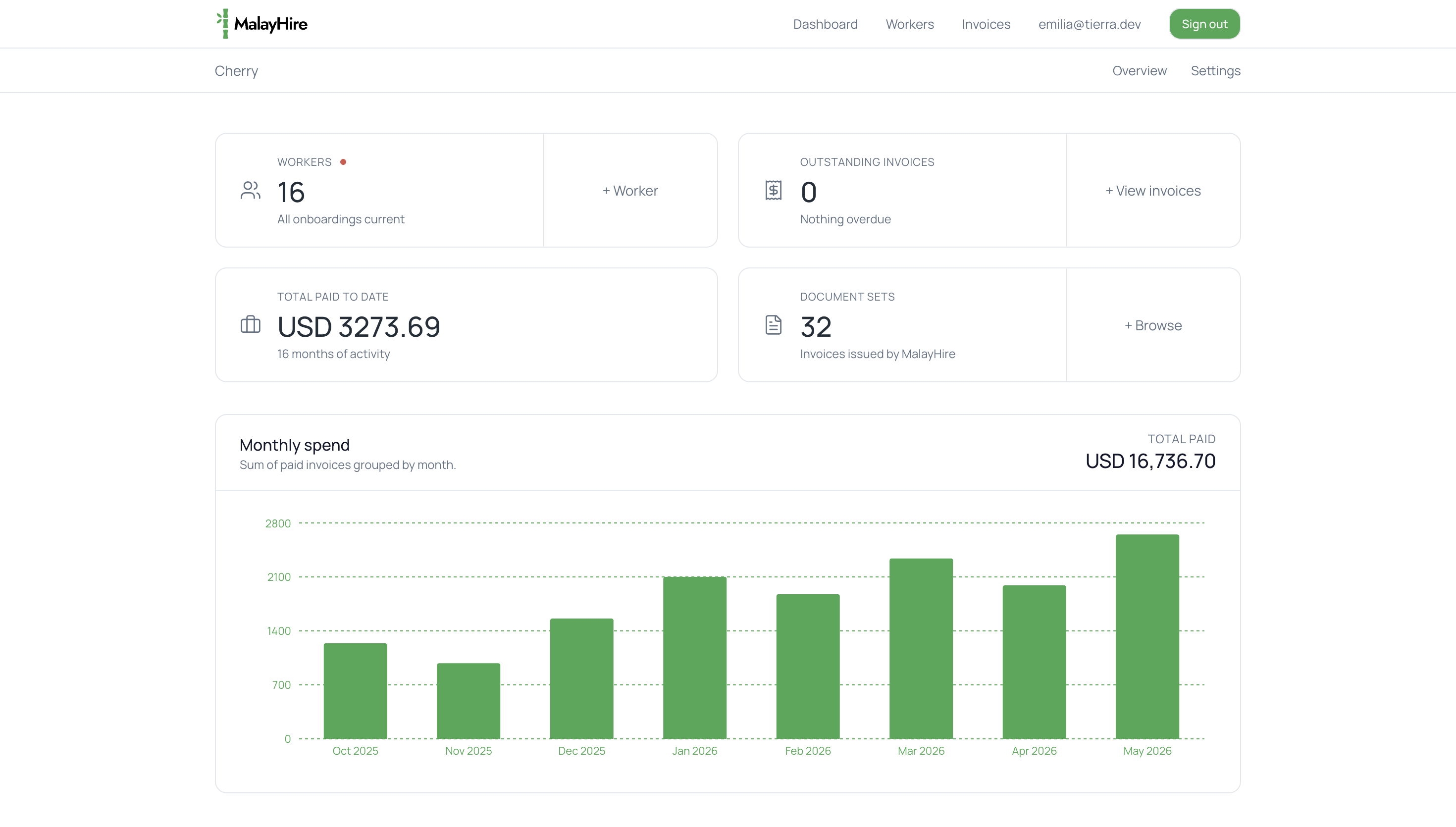
Manage your Malaysian team, payroll & EOR compliance in one place.