
Malaysia Payroll Tax Filing Deadlines 2026: The Complete Calendar for Foreign Employers


Malaysia Payroll Tax Filing Deadlines 2026: The Complete Calendar for Foreign Employers
Key Takeaways
- EPF contributions are due by the 15th of the following month, for both employer and employee portions.
- SOCSO and EIS deadlines follow the same 15th-of-the-month pattern but require separate reporting.
- Monthly PCB (income tax) remittance is also due by the 15th, with an additional annual reconciliation due by 31 March.
- Late payments attract a minimum penalty of RM200 and escalating interest, plus the real risk of a full audit.
- Foreign employers using an EOR can delegate every deadline, eliminating the need for an in-house payroll team in Malaysia.
- Simulating your compliance processes in a sandbox before your first hire uncovers gaps that could lead to late filings.
- The 2026 tax year may see updated SOCSO salary ceilings and new PCB tables — all of which affect calculations but not the statutory cut-off dates.
- HRDF levy deadlines mirror the same 15th cycle for registered employers, adding another layer to monthly compliance.

Why Missing a Payroll Tax Deadline in Malaysia Could Cost You More Than You Think
When you're running a business across borders, it's tempting to imagine that a few days' delay on a Malaysia payroll tax filing won't raise any eyebrows. After all, you're already juggling multiple jurisdictions, and surely the authorities give some leeway. Not in Malaysia. The Lembaga Hasil Dalam Negeri (LHDN), PERKESO, and KWSP operate with a precision that doesn't leave room for grace periods. Miss the 15th of the month — even by a single day — and the penalty clock starts ticking immediately. I've seen otherwise well-run global companies rack up thousands of ringgit in fines simply because their payroll provider didn't understand Malaysia's statutory timetable.
This isn't just about money; it's about business continuity. A late filing can trigger an automatic flag in the system, which often leads to a deeper compliance review of your entire Malaysia employee taxes record. For a foreign employer with no local legal entity, that kind of scrutiny can jeopardise your ability to operate here. The deadlines are not arbitrary suggestions — they are the framework that keeps Malaysia's social security and tax systems running. Treating them as an afterthought is the fastest way to burn through your operational budget on penalties that are entirely avoidable.
Understanding the full landscape of malaysia payroll tax filing deadlines 2026, from EPF to SOCSO to PCB, means you can plan your cash flow and HR processes around dates that never shift. The 15th might fall on a weekend or public holiday? The deadline moves to the next working day — but that's the only flexibility you'll get. If you're a foreign HR manager or a founder building a remote team in Kuala Lumpur, getting these dates right from day one is not optional. It's the price of admission to the Malaysian talent market.
The 2026 Payroll Tax Calendar: Month-by-Month Filing Deadlines for EPF, SOCSO, PCB, and More
Malaysia's entire statutory payment framework runs on a simple premise: everything is due by the 15th of the month following the salary payment. Whether you're remitting EPF contributions, SOCSO and EIS dues, or monthly income tax deductions (PCB), the cut-off date doesn't change. For a foreign employer, the real challenge isn't remembering the 15th — it's knowing which forms go where, what happens when a public holiday lands on a weekend, and how the deadlines interact with year-end reconciliations.
The table below maps every salary month in 2026 to its statutory payment due date. Use it as a pin-up reference for your payroll team, and never assume that 'someone else' will remind you. The authorities certainly won't.
- January 2026 salary → contributions and PCB due by 16 February 2026 (15th falls on a Sunday, deadline moves to Monday).
- February 2026 → due 16 March 2026 (15th is Sunday).
- March 2026 → due 15 April 2026.
- April 2026 → due 15 May 2026.
- May 2026 → due 15 June 2026.
- June 2026 → due 15 July 2026.
- July 2026 → due 17 August 2026 (15th is Saturday, deadline moves to Monday).
- August 2026 → due 15 September 2026.
- September 2026 → due 15 October 2026.
- October 2026 → due 16 November 2026 (15th is Sunday).
- November 2026 → due 15 December 2026.
- December 2026 → due 15 January 2027.
EPF (KWSP) Deadlines: No Excuses for Late Submission
The Employees Provident Fund operates under the EPF Act 1991, and the 15th deadline is hard-coded into law. You must submit your contribution file — along with payment — through the i-Akaun employer portal. Even a technical glitch is not considered a valid reason for delay. If you're a foreign employer, you'll need a valid employer reference number, which your EOR can secure during onboarding. Without it, you can't even log into the system, let alone file on time. The forms you'll deal with are Form A (monthly contribution statement) and the corresponding payment. Keep in mind that employer and employee shares must be paid together; partial payments are not accepted.
- Contribution month reported in i-Akaun must match salary month exactly.
- Payment reference number generated online must be used for bank transfer or JomPAY.
- Even RM1 underpaid will flag a non-compliance notice and attract late payment charges.
SOCSO and EIS Deadlines: Two Separate Payments, One Due Date
SOCSO and the Employment Insurance System are administered by PERKESO, but they appear as separate liabilities on your monthly statement. Both share the 15th deadline. The ASSIST portal is where you'll upload your monthly contribution details and generate the payment slip. Foreign employers often trip up here by assuming that one lump sum covers everything. It doesn't. You must split employer and employee portions for both schemes, and the portal will reject any submission that doesn't balance. EIS is compulsory for all local employees, so there's no opting out even if the amounts seem small.
Monthly Tax Deduction (PCB) Remittance: Form CP39 and the 15th Rule
The PCB system requires you to deduct income tax from employees' salaries every month based on the MTD (Monthly Tax Deduction) tables published by LHDN. The deducted amount must be remitted using Form CP39, accompanied by full payment, by the 15th of the following month. There's no partial filing. If you have zero deduction for a particular month (e.g., all employees fall below the taxable threshold), you'll still need to file a nil return. I've seen small tech startups skip the nil return, thinking it's unnecessary, only to receive a penalty letter months later. Don't make that mistake.
HRDF Levy: When It Applies and When It's Due
If you employ 10 or more Malaysian workers, you're required to register with the Human Resource Development Corporation and pay a monthly levy of 1% of total wages (or 0.5% for certain manufacturing companies). The levy follows the same 15th-of-the-next-month schedule. HRDF uses an online portal for declarations, and late registration can attract backdated assessments. Even if you're a foreign employer using an EOR, the EOR's client account will group your employees for this count, so don't assume a small remote team exempts you.
Year-End and Bonus Season: Deadlines for EA Forms, CP8D Submissions, and Final PCB Payments
The 15th rhythm gets interrupted by annual obligations that catch many foreign employers off guard. First, you must provide each employee with an EA form (statement of annual remuneration) by 28 February 2027 for the 2026 income year. That's non-negotiable. The EA form gives employees everything they need to file their personal income tax returns. Simultaneously, as an employer, you must submit Form E (the employer's annual return) to LHDN by 31 March 2027. This form summarises total employee earnings and PCB remitted during the year.
Bonus season adds its own twist. When you pay year-end bonuses in December 2026, the PCB deduction must use the 'additional remuneration' formula from the MTD schedule. The resulting PCB amount must be remitted alongside the regular salary PCB by 15 January 2027. Some employers mistakenly use the standard monthly table for bonus payments, leading to under-remittance. Come audit time, that's an easy catch for LHDN. Plan your cash flow knowing that January 2027 will require a heftier single remittance that combines December salary PCB and the bonus PCB.
What Happens When You File Late: Penalties, Interest, and Audits
The penalty structure for Malaysia payroll tax deadlines isn't a gentle nudge — it's designed to hurt enough that you won't forget again. Here's what you're really risking when that 15th passes without payment:
- EPF late payment: Interest of 5% per annum calculated on a daily basis from the due date, plus a compound penalty for persistent default.
- SOCSO and EIS: Late payment interest at 6% per year, and PERKESO can impose a court fine of up to RM10,000 if the matter escalates.
- PCB remittance: A 10% penalty on the unpaid amount is added immediately. If it remains unpaid after 60 days, an additional 5% applies, and LHDN may issue a notice of assessment for the shortfall.
- Beyond the financial hit, any late filing lights up your compliance record. LHDN and PERKESO share data, so a delay in one area can prompt a multi-agency field audit that examines every aspect of your employment taxes.
- For foreign employers without a local bank guarantee, repeated late filings can lead to a freeze on work permit approvals, effectively blocking new hires until the matter is resolved.
Simulating Payroll Deadline Compliance in a Sandbox Before Your First Hire
If you've never run a Malaysian payroll before, the safest way to avoid deadline disasters is to test your entire workflow in a sandbox environment before any real employee receives a single ringgit. Global EOR platforms have recognised this need. The Deel API Sandbox, for instance, is an isolated testing environment that mirrors production functionality with pre-populated sample data, allowing testing without real money, contracts, or legal implications. You can create sample workers, simulate a monthly pay run, and check whether your system would actually trigger the EPF and PCB payments by the 15th cut-off.
But here's the catch: a generic global sandbox won't have Malaysia-specific statutory calendars pre-built. You'll need to manually configure the 2026 deadlines, the MTD tax tables, and the SOCSO contribution tiers yourself. This is where a local EOR like MalayHire EOR shifts the equation. A platform designed exclusively for the Malaysian market has these deadlines embedded at the architecture level — the system simply won't let you run a pay period without scheduling the statutory remittances for the correct due dates. Before you go live, you can walk through a full simulation in that localised environment and verify that every Form A, ASSIST declaration, and CP39 filing would happen on time, every time. That kind of sandbox testing, combined with a provider who knows exactly what LHDN and KWSP expect, transforms deadline anxiety into a mechanical, no-surprises process.
How a Specialised EOR Keeps You Ahead of Every Malaysian Payroll Deadline
At a certain point, you have to ask yourself: is managing this calendar in-house the best use of your team's energy, or would a dedicated Malaysia payroll provider do it faster, cheaper, and without the late-night panic? MalayHire EOR handles the entire statutory compliance chain — from registration for EPF, SOCSO, and tax accounts to the actual filing and remittance — as part of a fixed monthly service starting at $165 per employee. The platform's 48-hour onboarding process means you don't have to wait weeks to get an employer reference number. You get a fully digital workflow that respects every deadline on the calendar we've just walked through.
For foreign HR managers who don't want to memorise MTD schedules or worry about the 15th falling on a weekend, this is the kind of local expertise that replaces clipboard checklists with automated certainty. The EOR ensures that year-end EA forms go out, Form E reaches LHDN by 31 March, and that bonus payrolls trigger the additional PCB formula automatically. It's not just about avoiding penalties — it's about presenting a professional, fully compliant posture to your Malaysian employees, who can compare their payslips against statutory requirements and see that everything is in order. When you remove deadline risk from the equation, you stop treating Malaysia payroll tax as a quarterly headache and start treating it as a solved, background process.
What Changes for 2026: Adjustments to Ceilings, Rates, and Filing Processes You Should Watch
While the 15th deadline itself is etched in stone, the calculations behind it can shift from one fiscal year to the next. For 2026, anyone handling malaysia payroll needs to pay attention to a few moving parts. PERKESO has historically increased the insurable earnings ceiling periodically — it rose from RM4,000 to RM5,000 in recent years — and further adjustments aren't out of the question for 2026. Even if the ceiling stays put, contribution rates for the newly expanded coverage might be fine-tuned, affecting your monthly SOCSO bill.
On the PCB side, LHDN releases fresh MTD schedules each year, usually effective 1 January. The 2026 tables could incorporate revised personal reliefs or tax brackets announced in the national budget. That means the amount you deduct from employees in January 2026 could differ from the December 2025 deduction, even if salaries remain the same. You'll need to update your payroll engine accordingly, and your EOR provider should handle this automatically. EPF contribution rates are unlikely to see dramatic swings, but the employee statutory rate (currently 11% for most) can be adjusted by government policy — something that happened during the pandemic. Keep an eye on any announcements from KWSP in late 2025. The bottom line: the filing deadlines don't change, but the numbers you file can, and it's your responsibility to ensure your payroll system reflects the latest legal requirements before that first 2026 pay cycle kicks in.
Frequently Asked Questions
How do I calculate the late payment penalty for EPF in Malaysia in 2026?
The late payment penalty for EPF in Malaysia is 10 percent per annum on the outstanding contribution amount calculated from the due date until full payment is made. You must compute the penalty daily for any delay beyond the 15th of the following month. Late fees compound if you fail to settle before the next filing cycle begins, increasing your total liability significantly.
What is the maximum amount I can claim for PCB relief in Malaysia for 2026?
For 2026, the maximum PCB relief amount in Malaysia depends on your individual taxpayer category and eligible deductions like medical expenses and lifestyle purchases. The standard personal relief remains at RM9,000, with additional reliefs capped at RM8,000 for education fees and RM6,000 for medical insurance. You should refer to the latest Finance Act for exact limits, as thresholds may increase from 2025 levels.
Can I submit SOCSO contributions manually if my company has no employees yet in Malaysia?
Yes, you can submit SOCSO contributions manually using the Form 8A even if your company has no active employees, but this is rarely needed for a zero employee scenario. You must register your business with SOCSO first using Form 1, then file a nil return each month by the 15th. A specialised EOR like AscentHR can automate this process to avoid manual paper submissions and potential penalties for missed deadlines.
How do I file EA forms for part-time employees who worked less than 12 months in Malaysia?
You must file EA forms for part-time employees who worked any duration in the year, even if less than 12 months, using the same Form EA format. Report their total gross income, PCB deductions, and EPF contributions from the period they were employed. Submit the EA form to LHDN by April 30, 2026, along with a CP8D for foreign workers if applicable. No proration of thresholds is required.
What happens if I pay PCB through the wrong bank account after the deadline in Malaysia?
Paying PCB through the wrong bank account after the deadline in Malaysia is treated as a late payment because the funds do not reach LHDN on time. This triggers a penalty of 10 percent per annum on the unpaid PCB amount from the due date until corrected payment clears. You must immediately request a refund or redirect the payment via LHDN's online portal to avoid additional interest charges and potential audit triggers.
Are Malaysian employers required to show EPF contributions in the employee's pay slip for 2026?
Yes, Malaysian employers are legally required to show both employee and employer EPF contributions separately on each pay slip under the Employment Act 1955 and EPF Act 1991 for 2026. The pay slip must display the contribution amount, the contribution month, and the employee's EPF account number. Missing this disclosure can result in a notice from the Department of Labour and potential fines of up to RM10,000 per violation.
How do I update my company's payroll system for the 2026 SOCSO ceiling changes in Malaysia?
To update your payroll system for the 2026 SOCSO ceiling changes in Malaysia, first obtain the official ceiling amount from the SOCSO website or your EOR provider. Then adjust the contribution calculation formula in your payroll software to cap monthly wages at the new limit before applying the contribution rate. Test the change using a sandbox environment to verify accuracy before the first payroll run of 2026.
What are the deadlines for filing HRDF contributions in Malaysia for 2026?
For 2026, HRDF contributions in Malaysia must be filed and paid by the 15th of each month following the pay period. This deadline aligns with EPF and SOCSO due dates, so you can submit all three contributions together. Late filing incurs a penalty of 10 percent per annum on overdue amounts, similar to EPF, and repeated delays may lead to suspension of your levy exemption status.
MalayHire is your most cost-effective Employer of Record (EOR) in Malaysia
Hire full-time employees in Malaysia and save costs by avoiding hefty contractor fees. MalayHire handles payroll, employment contracts, statutory compliance (EPF, SOCSO, EIS), and HR admin. Start onboarding your Malaysian hire now, with MalayHire.
Trusted by global companies hiring in Malaysia





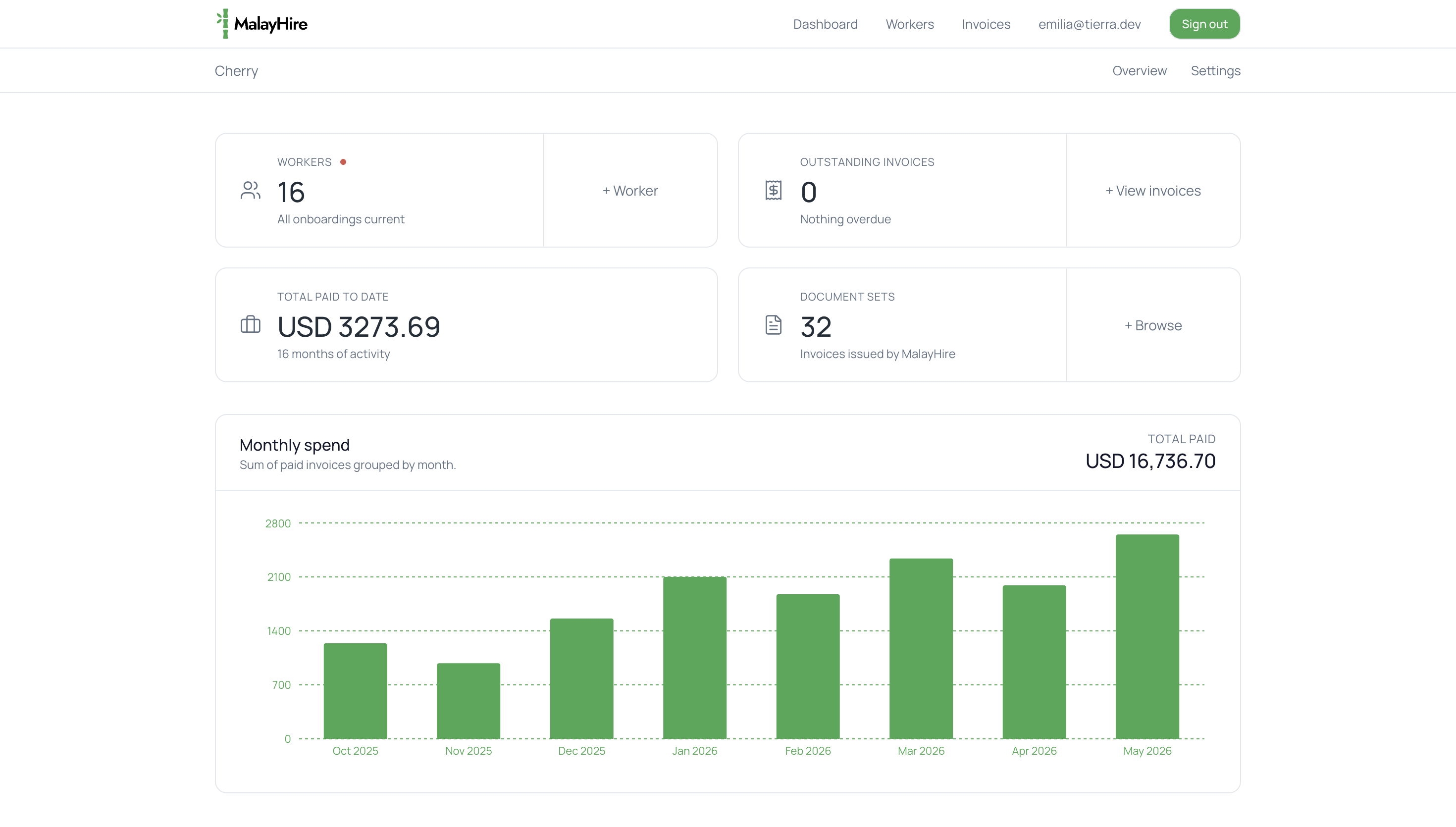
Manage your Malaysian team, payroll & EOR compliance in one place.