
Malaysia Remote Work Tax Implications: What Foreign Employers Actually Owe


Malaysia Remote Work Tax Implications: What Foreign Employers Actually Owe

Key Takeaways
- Remote work status does not remove Malaysian payroll tax obligations for a locally resident employee.
- A foreign company with no Malaysian entity still faces EPF, SOCSO, EIS, PCB, and HRD Corp duties when the relationship is employment, not contracting.
- Using an Employer of Record shifts those statutory obligations to the EOR while the employee keeps working remotely from Malaysia.
- Malaysian tax residency generally triggers once an employee spends 182 days or more in Malaysia during a calendar year.
- Real production webhook events expose contribution triggers and payroll cutoffs that simulated sandbox events often do not surface.
- Statutory deadlines are tied to contribution periods and payment windows, not the date the remote worker accepts an offer.
- A compliant 48-hour onboarding sequence depends on contract signing, statutory registration, and payroll cutoff happening in the right order.

Malaysia Remote Work Tax Implications Start with Presence, Not Entity
When a Singaporean SaaS company hires a Malaysian product designer who works from a rented desk in Petaling Jaya, the arrangement feels borderless. The designer sends Figma links, not timesheets. The company pays an invoice from a contractor. But Malaysian remote work tax implications start the moment that relationship stops looking like genuine freelancing and starts looking like employment. Physical presence in Malaysia, not the employer's registered address, drives most of the obligations.
Many foreign founders assume that because they have no Malaysian branch, they have no Malaysian payroll exposure. That assumption breaks quickly. If the worker is a Malaysian tax resident, income earned for work performed in Malaysia is subject to Malaysian income tax. If the worker is an employee, the employer or an appointed local entity must handle monthly tax deductions and statutory contributions. Remote work changes where the laptop sits, but it does not change where the tax event happens.
The practical implication is that hiring remotely in Malaysia is more like hiring locally than it looks. You need someone who understands EPF, SOCSO, EIS, and PCB, not just a signed contract and a bank transfer.
What Actually Triggers Malaysian Payroll Tax for a Remote Hire
Three conditions tend to flip the switch from no obligation to full obligation. The first is tax residency. The second is whether the arrangement is employment or independent contracting. The third is who bears legal responsibility for withholding and remittance. When all three line up, a foreign employer is effectively running Malaysian payroll even if the employee works from home and the company has never visited Kuala Lumpur.
The cleanest way to understand this is to separate the employee-side tax from the employer-side contributions. The employee owes income tax on Malaysian-sourced employment income. The employer owes statutory contributions that are calculated on top of wages. Both have filing deadlines, both have payment deadlines, and both can trigger penalties when missed. Remote work does not create a special exemption; it only changes the communication channel and the location of the worker.
Tax Residency and the 182-Day Rule
A Malaysian tax resident is generally someone who has been in Malaysia for 182 days or more in a calendar year. Remote workers who live in Malaysia usually hit this threshold quickly. Once they do, their Malaysian-sourced employment income becomes taxable at resident rates, and monthly PCB deductions follow. Employers cannot wait until year-end to sort this out. The obligation starts with the first salary payment after the employment relationship is established.
Permanent Establishment Risk Without an EOR
Foreign companies sometimes worry that hiring a remote employee in Malaysia creates a permanent establishment, which could make the company itself taxable in Malaysia. The risk is real but often overstated for a single remote employee. The more immediate problem is payroll compliance: without a local entity, a foreign company cannot register for EPF, SOCSO, EIS, or PCB in its own name. An Employer of Record closes that gap by acting as the legal employer of record in Malaysia while the foreign company directs the work.
Employee Income Tax vs Employer Statutory Contributions
Employee income tax, deducted through PCB, comes out of the worker's salary. Employer contributions to EPF, SOCSO, EIS, and HRD Corp are separate costs on top of salary. Mixing these up leads to under-budgeting. A remote hire with a RM10,000 base salary costs more than RM10,000 to the employer. The remote nature of the job does not reduce the employer's contribution burden. It just makes the paperwork less visible when nobody is sitting in a Malaysian office.
Malaysia Remote Work Tax Implications: Mandatory Contributions You Cannot Ignore
The moment you treat a Malaysian remote worker as an employee, a fixed set of statutory deductions and employer contributions becomes part of every payroll run. These are not optional add-ons that can be negotiated away in an employment contract. They are set by Malaysian law and enforced by separate agencies. Remote work does not change the rates, the caps, or the deadlines.
A common planning error is to compare base salary between Malaysia and another country without adding the employer-side statutory load. That load is modest compared with many European countries, but it still matters for a startup CFO modelling headcount costs. The list below covers the core obligations you will see on a standard Malaysian payroll run for a remote employee.
- EPF: employee contribution is 11% of wages; employer contribution is 12% or 13% depending on the wage band.
- SOCSO: employee contributes 0.5% and the employer contributes 1.75% for employment injury and invalidity coverage.
- EIS: employee and employer each contribute 0.2% of covered wages.
- HRD Corp levy: 1% of monthly wages for covered employers, with registration requirements based on industry and headcount.
- PCB: monthly income tax deductions based on the LHDN MTD schedule, adjusted for the employee's residency status and any prior deductions.
Deel's Simulated Webhooks vs. Real Malaysian Payroll Events
Global EOR platforms expose developer tools that let you test payroll workflows before a real employee is added. Deel's developer documentation is explicit about what those simulations do. According to Deel's webhook simulation page, you can test without triggering real business processes or affecting production data. Simulated events use the same infrastructure as production events but are clearly marked for different handling. That is useful for validating a URL, checking signature verification, and making sure your HRIS can parse the payload.
The limitation is not technical; it is contextual. A simulated event can show you the shape of a webhook. It cannot show you whether an EPF registration was accepted, whether the SOCSO wage ceiling was applied correctly on a given month, or whether the PCB amount matches LHDN's actual MTD table for a married employee with one child. Those details live in real production events and in the local filings that follow them.
What Deel's Simulation Environment Actually Shows
Deel's quickstart describes a three-step process: create an account, set up an API sandbox, and make the first API call. The sandbox is a separate testing environment where API calls can be tested without affecting real data. For HR teams, this means you can simulate a webhook for an employee record change or a payroll event and see the payload before going live. The documentation highlights use cases like validating configuration, testing integration logic, reproducing error conditions, and training team members on real payload structures.
Where Simulation Falls Short for EPF, SOCSO, and PCB
Simulated webhooks do not carry the production identifiers that Malaysian payroll requires. A real EPF submission references an employer number and employee provident fund number. A real PCB deduction references an income tax file number and a specific MTD schedule version. Simulated events may mark themselves as test data, but the absence of those local identifiers means your integration can pass a simulation and still fail in production when the actual statutory registration data is missing. That gap matters more in Malaysia than in countries with fewer separate contribution schemes.
Why Real Webhook Payloads Change How You Build Integrations
When you integrate with a Malaysia-focused EOR, the webhook should reflect the actual triggers that matter locally: contract activated, statutory registrations completed, payroll cutoff passed, contribution amounts calculated, and remittance files generated. Unlike a generic simulation, these events are tied to real registration numbers and real payroll runs. That allows a technical integrator to map each compliance event to a specific webhook payload instead of relying on a sample that only proves the endpoint works.
Malaysia Remote Work Tax Implications in Practice: A 48-Hour Onboarding Walkthrough
Here is what a compliant first hire looks like when a foreign company uses an Employer of Record with local Malaysian operations. A UK-based SaaS startup wants to hire a senior support engineer who will work remotely from Kuala Lumpur. The company has no Malaysian entity and no desire to open one for a single hire. MalayHire EOR steps in as the legal employer of record. The onboarding window is roughly 48 hours, but only because each step is sequenced around statutory registration and payroll cutoff.
The first day focuses on contract execution and employee data collection. The second day handles registrations and the first payroll run setup. The webhook events that fire during this window are real, not simulated. The foreign company's HRIS receives a contract_signed event, then a statutory_registration_completed event, then a payroll_cutoff_reached event. Each one tells the integration when to create records in the company's own system.
- Hour 1: employee signs the Malaysian employment contract and submits identity, tax file, and banking details through a digital portal.
- Hour 4: the EOR validates the worker's tax residency status and determines the correct PCB category.
- Hour 12: EPF, SOCSO, and EIS registrations are submitted under the EOR's existing Malaysian employer accounts.
- Hour 24: the payroll run is configured with base salary, statutory employer contributions, and the first month's PCB deduction.
- Hour 36: the payroll cutoff passes and the EOR generates a remittance file showing exactly what will be paid to each statutory body.
- Hour 48: the foreign company receives a real webhook payload confirming the payroll event and the amounts that will be deducted from its invoice.
Common Missteps Foreign Employers Make with Remote Malaysian Workers
The mistakes are rarely about malice. They are usually about treating a Malaysian remote hire like a contractor in another country and hoping the tax problem disappears. It does not. The most expensive errors tend to surface months later, when an employee asks for a payslip, a bank asks for proof of income, or a government agency sends a penalty notice.
Foreign employers also underestimate how quickly a remote worker becomes a tax resident. Someone who starts in March and stays in Malaysia for the rest of the year passes 182 days well before December. By the time the company realizes it should have been deducting PCB, several months of payroll have already gone out without statutory contributions. Backdating those payments is messy and can trigger penalties that outweigh the cost of doing it correctly from the first month.
- Treating a full-time remote worker as an independent contractor to avoid statutory contributions and payroll tax.
- Assuming a remote worker's income is automatically foreign-sourced because the employer is based overseas.
- Waiting until the worker passes the 182-day threshold before setting up PCB deductions.
- Registering for EPF and SOCSO only after the first salary has already been paid.
- Budgeting for base salary without adding employer contributions, which pushes the real cost above the approved headcount budget.
- Relying on simulated webhook tests as proof that Malaysian statutory filings are actually happening in production.
How to Read Real Webhook Payloads for Malaysian Payroll Compliance
If your HRIS consumes webhooks from an EOR, you do not need to become a Malaysian tax accountant. You do need to know which events correspond to real compliance milestones. A real production payload for a Malaysian hire should contain more than an employee ID and a timestamp. It should carry the data your finance team needs to reconcile payroll: statutory registration status, contribution amounts, PCB deducted, and the payroll period the event covers.
A practical way to structure this is to map each Malaysian compliance event to a webhook event name and a set of fields. When the mapping is in place, a failed statutory registration shows up as a missing event or an error payload, not as a surprise penalty three months later. This is where production-grade integration differs from sandbox testing.
Contract Signing vs Statutory Registration
A contract_signed event tells you the employment relationship exists. It does not tell you the worker has an EPF number or that SOCSO registration was accepted. In a real integration, these should be separate events. The gap between them is where onboarding delays happen. If your system only watches for contract_signed, you can think the hire is complete while statutory registration is still pending.
Payroll Cutoff and Contribution Calculation Windows
Malaysian payroll runs on monthly cycles with cutoff dates. A payroll_cutoff_reached event should arrive before the contribution calculation is finalised. After the cutoff, changes to salary or employment status usually land in the next payroll period. Reading the cutoff event correctly prevents finance from approving a payroll that includes an employee who joined after the cutoff or excludes someone who left before it.
Error Payloads That Signal Compliance Gaps
A well-designed EOR integration sends error payloads when a statutory submission fails, not just when an API call times out. For example, an EPF submission can be rejected because the employee's name format does not match the national registration database. A PCB amount can be recalculated because a tax file number was entered incorrectly. Paying attention to these production error events is what keeps a remote hire compliant without a local HR team on the ground.
What This Means for Your Malaysia Hiring Plan
Malaysia remote work tax implications are not a reason to avoid hiring Malaysian talent. They are a reason to stop treating a remote hire as a paperwork-free contractor arrangement. The statutory system is structured, predictable, and manageable once you have a local employer of record or a local entity handling the obligations. The danger is in waiting until after the first salary payment to ask who is handling EPF, SOCSO, EIS, and PCB.
For a foreign founder or an HR systems integrator, the move is to sequence the hire around local payroll events, not around a generic global onboarding checklist. Contract first. Statutory registration second. Payroll cutoff third. First remittance fourth. Real webhook events should mirror that order. If your current provider can only show you simulated payloads, ask what the production payload looks like for an actual Malaysian statutory submission. The answer will tell you whether you are truly covered or just testing an endpoint.
That is the practical difference between a global EOR that treats Malaysia as one country among many and a Malaysia-focused provider that understands the local contribution calendar, the registration quirks, and the payroll cutoff discipline. The remote worker in Kuala Lumpur deserves the same compliance rigor as a desk-bound employee in Singapore or London. Malaysian law certainly expects it.
MalayHire is your most cost-effective Employer of Record (EOR) in Malaysia
Hire full-time employees in Malaysia and save costs by avoiding hefty contractor fees. MalayHire handles payroll, employment contracts, statutory compliance (EPF, SOCSO, EIS), and HR admin. Start onboarding your Malaysian hire now, with MalayHire.
Trusted by global companies hiring in Malaysia





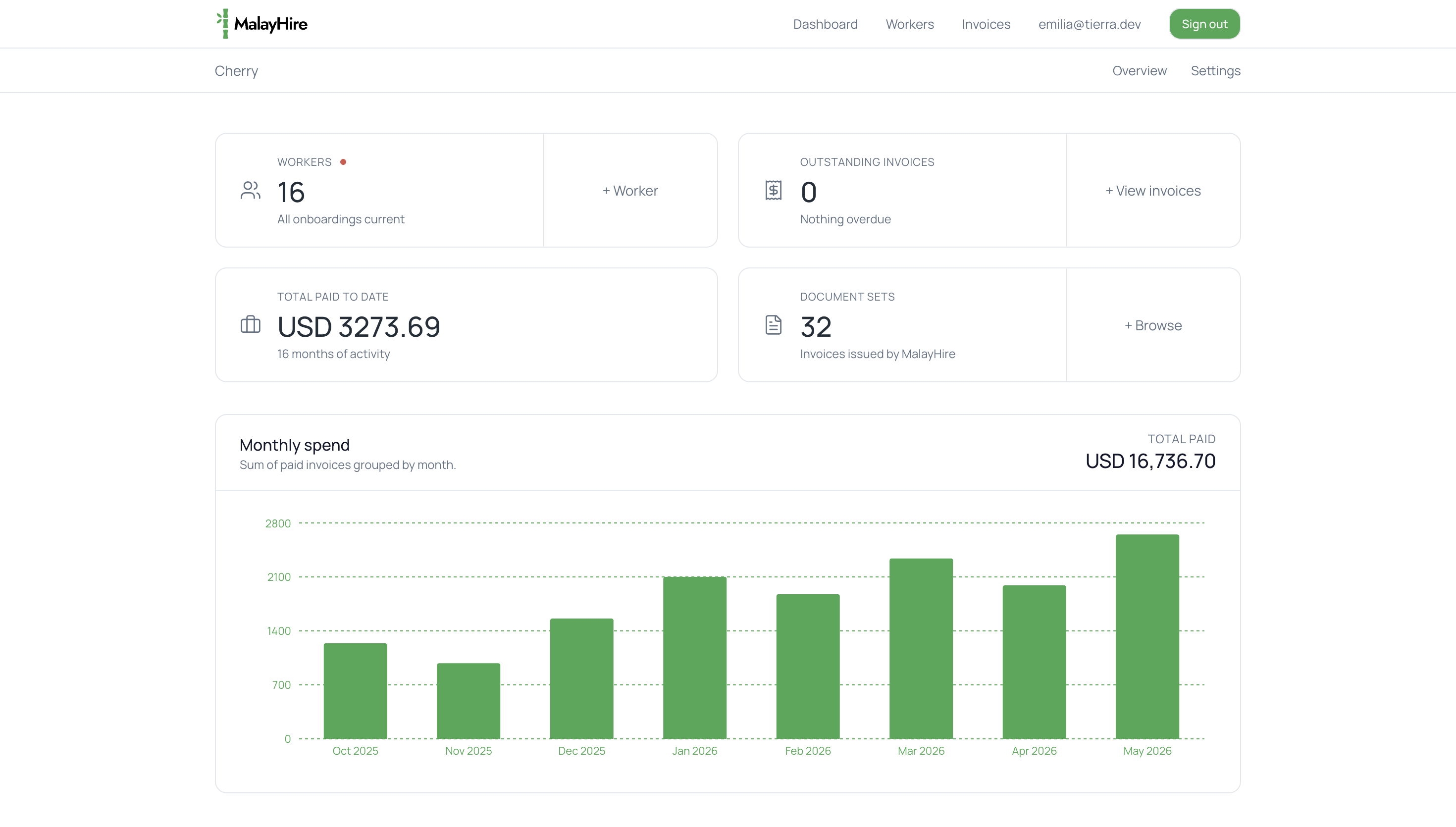
Manage your Malaysian team, payroll & EOR compliance in one place.