
Malaysia Workforce News: The Brazil vs Malaysia Compliance Showdown Global HR Teams Keep Getting Wrong


Malaysia Workforce News: The Brazil vs Malaysia Compliance Showdown Global HR Teams Keep Getting Wrong

Key Takeaways
- Malaysia's employer statutory stack (EPF, SOCSO, EIS, HRDF) typically lands in the mid-teens as a percentage of gross payroll, far below Brazil's 36.58% to 41.08% employer tax burden.
- Payroll cadence differs sharply: Malaysia runs monthly cycles, while Brazil's bi-weekly rhythm doubles annual processing runs and reconciliation work.
- Malaysia's local payment rails (DuitNow, MEPS, FPX) settle fast, but foreign employers need a local entity or an EOR to access them without compliance friction.
- Termination costs in Malaysia are more predictable than Brazil's FGTS-linked severance penalties, but still carry notice period and statutory benefit obligations.
- An API-driven EOR like MalayHire can collapse Malaysia onboarding to 48 hours, while traditional PEOs often take days or weeks just to get paperwork moving.
- Choosing Malaysia versus Brazil is not about picking the cheaper market on paper; it's about operational cadence, time-to-compliance, and exit flexibility.
- The real workforce news from Malaysia is that digital-first hiring infrastructure is outpacing legacy providers in both APAC and LATAM.

The Malaysia vs Brazil Decision You're Actually Making
If you've been tracking Malaysia workforce news lately, you've likely seen the same storylines: digital hiring platforms are shortening onboarding times, statutory contribution rules are being enforced more tightly, and global employers are taking a harder look at APAC as a hedge against LATAM volatility. What you rarely see, though, is a clean line-by-line comparison between Malaysia and Brazil that gets into the operational weeds HR and finance teams actually care about. That's the gap this article fills. We're not going to talk about GDP or population growth. We're going to compare the machinery of workforce payments and compliance: employer tax stacks, payroll cadences, local payment rails, filing deadlines, termination costs, and the role an Employer of Record plays in making the whole thing feel less like a spreadsheet and more like a function. Because when you're deciding where to put your next ten hires, the difference between Kuala Lumpur and São Paulo isn't the timezone. It's how the money moves, who withholds what, and how fast you can undo a bad hire without triggering a compliance audit.
Statutory Costs and Deductions: The Number That Should Kill the Debate
Most global HR teams start by comparing employer taxes. That's reasonable, but the way you read the numbers matters more than the headline percentage. Malaysia and Brazil both use an employer-plus-employee withholding model, but the total burden sits in completely different leagues. And unlike Brazil, where the employer tax stack is largely uniform, Malaysia's contributions shift based on wage bands, employee age, and whether the employer falls under HRD Corp levy obligations. If you model only the headline EPF rate, you'll under-budget. If you assume Malaysia is always cheaper by the same margin for every role, you'll miss the exceptions.
Malaysia's Employer Stack: EPF, SOCSO, EIS, HRDF
Malaysia's employer-side statutory contributions are layered. EPF is the big one: employers typically contribute 12% of monthly wages, though that rises to 13% for employees earning below a certain threshold. SOCSO adds around 1.75% on the employer side, depending on the wage ceiling. EIS is a flat 0.2% from both employer and employee. Then there's HRD Corp, a 1% levy that applies to many private sector employers with ten or more Malaysian workers. Add it all together and most employers land in the 14% to 16% range before income tax withholding. That's not a trivial cost, but it's predictable and well-documented.
Brazil's Employer Stack: FGTS, INSS, and the Rest
According to Papaya Global's Brazil payments data, employer taxes run from 36.58% to 41.08% of payroll, while employee costs sit at 14%. The stack includes the FGTS severance fund (8% employer contribution), INSS social security (around 20% to 22.5% depending on the industry and risk classification), plus education and accident insurance contributions. Unlike Malaysia, where HRD Corp only applies to certain employers, Brazil's social charges apply broadly. The employee side is also heavier: 14% in Brazil compared with around 11% to 12% combined EPF, SOCSO, and EIS in Malaysia. That gap of roughly 20 to 25 percentage points on the employer side is not a rounding error. It's a structural difference.
Payment Rails and Payroll Cadence: Where the Money Actually Moves
Payroll cost is only half the story. The other half is how often you have to run payroll and how the funds actually reach employees. Brazil's bi-weekly payroll frequency, as noted in Papaya Global's own country data, means 24 payroll runs per year. Malaysia's standard is monthly: 12 runs. That difference alone doubles the administrative touchpoints for a Brazilian hire, even before you factor in exchange rates and payment rail speed. For a lean HR team managing both markets, the cadence mismatch can quietly eat several days per quarter.
- Malaysia: 12 payroll runs per year; Brazil: 24 payroll runs per year.
- Malaysia's DuitNow settles in seconds to minutes; Brazil's PIX is also instant, but the more frequent payroll cycle multiplies reconciliation effort.
- Foreign employers in both markets need a local entity or EOR to access domestic payment rails cleanly.
- FPX in Malaysia is designed for high-volume payroll and statutory payments, while Brazil's boleto can take days for some payment types.
Malaysia's Local Payment Infrastructure
Malaysia runs on three main rails. DuitNow is the real-time instant transfer network, MEPS handles interbank transactions, and FPX is the online banking debit system widely used for payroll disbursements and statutory payments. Monthly payroll is the norm, and most banks process salary files same-day if submitted before the morning cut-off. The catch for foreign employers: you cannot simply wire international transfers and expect the employee to receive funds the same way a local employer would. You need a local bank account or an EOR that already has payment rails wired into the system.
Brazil's Payment Landscape
Brazil has its own instant payment system, PIX, plus TED for same-day bank transfers and boleto for slower bill payments. But the operational headache is the bi-weekly payroll frequency. Papaya Global's Brazil data confirms this, and it aligns with the country's long-standing labour practice. Running payroll every two weeks means more cut-off times, more reconciliation cycles, and more opportunities for misalignment with monthly accounting closes. For a finance team used to monthly cycles, Brazil's rhythm feels like a second job.
Tax Filing Timelines and Deadlines: The Hidden Operational Burden
Filing frequency is where the real operational pain lives. Malaysia's monthly rhythm is forgiving compared with Brazil's constant stream of filings. If you are running a lean team and hiring your first few employees in a new market, the number of deadlines you must track can be the difference between a smooth launch and a late-payment penalty.
- Malaysia: one payroll run per month, most statutory deadlines near the 15th.
- Brazil: 24 payroll runs per year, monthly FGTS and INSS payments, plus eSocial events and annual DIRF.
- Late payment penalties for EPF and SOCSO in Malaysia accrue daily; Brazil's penalties can be similarly sharp but with more filing categories to miss.
- An EOR that automates statutory filings can compress Malaysia's monthly compliance work to a single approval step.
Malaysia's Monthly Rhythm
Malaysia's statutory deadlines cluster around the middle of the following month. EPF, SOCSO, and EIS contributions are generally due by the 15th, while income tax (PCB) remittances follow a similar rhythm. HRD Corp levies are typically filed monthly or quarterly depending on the employer's registration. The key advantage is that everything happens on roughly the same cadence. You process payroll once, you file four or five returns, and you're done for the month. It's boring, and boring is good.
Brazil's Filing Lifecycle
Brazil's filing environment is denser. In addition to monthly social security and FGTS payments, employers must submit eSocial events on a continuous basis and file annual DIRF declarations. The bi-weekly payroll frequency means tax withholdings and accruals are being touched every two weeks, not once a month. Papaya Global's data notes Brazil's fiscal year runs January to December, which at least aligns with the calendar year, but the sheer volume of recurring obligations means an employer can spend two to three times more hours on compliance per employee than in Malaysia.
Termination and Severance: What It Costs to Exit
Exit costs are the part of the comparison most finance teams ignore until it's too late. In Malaysia, termination costs are largely driven by the employment contract and the Employment Act, which mandates minimum notice periods and, in some cases, retrenchment benefits for employees with long service. There is no automatic statutory severance fund the way Brazil has. In Brazil, the FGTS fund acts as a forced savings account, and an employer who terminates without cause must pay a 40% penalty on the balance. That single clause can add a month and a half of salary to every involuntary departure.
- Malaysia: notice periods typically 1 to 3 months depending on contract and length of service; statutory retrenchment benefits may apply only in specific scenarios.
- Brazil: FGTS penalty of 40% on the employee's accumulated fund balance for termination without cause, plus any contractual notice.
- Malaysia's exit costs are more predictable for a fixed-term contract or probationary period.
- Brazil's exit costs scale with tenure, making long-tenured hires much more expensive to separate.
- An EOR can structure Malaysian contracts to keep termination exposure clear and pre-agreed, avoiding surprise liabilities.
The EOR Factor: Why Local Infrastructure Changes the Math
Most of the cost and cadence differences above assume you have a local entity already set up. For foreign employers testing the market, that's rarely true. An Employer of Record absorbs the local compliance obligation and lets you hire without incorporating. But not all EORs are built the same. Malaysia's workforce news over the past two years has been dominated by one trend: local EORs moving to fully digital, API-first onboarding, while global legacy providers still route everything through sales calls and PDF forms.
- Traditional PEO: sales call, custom proposal, manual forms, multi-day setup, variable pricing.
- API-driven EOR: self-serve console or API integration, instant pricing, automated document generation, 48-hour onboarding.
- MalayHire's fixed monthly fee of $165 per employee removes the negotiation back-and-forth.
- Local compliance expertise in Kuala Lumpur means statutory issues get resolved same-day, not escalated to a regional hub.
- Digital onboarding also means fewer data-entry errors, which reduces the risk of EPF or SOCSO filing mistakes.
Traditional PEO vs API-Driven EOR in Malaysia
Traditional PEOs in Malaysia often operate like consulting firms: you talk to a sales rep, wait for a proposal, fill out enrolment forms, and wait again. That can stretch onboarding to a week or more. An API-driven EOR like MalayHire flips that model. You integrate once, submit employee data through a secure API, and the platform generates contracts, registers the employee with EPF, SOCSO, and EIS, sets up payroll, and handles tax filing. No sales call needed. Pricing is fixed at $165 per employee per month, with no hidden setup fees. For a startup hiring three developers in Kuala Lumpur, that's the difference between being compliant this week versus next month.
The 48-Hour Onboarding Difference
The specific workforce news angle here is speed. MalayHire advertises a 48-hour onboarding window, and for any global employer who has sat through a traditional PEO's three-week setup, that sounds almost too good. But it works because the compliance layer is pre-built. Contracts are templated and localised. Payroll schedules are already mapped to Malaysia's monthly cycle. EPF and SOCSO registration is handled digitally. The API simply moves employee data from your HR system into the compliant flow. The result: a foreign startup can sign an offer letter on Monday and have the employee on payroll, with statutory contributions filed, by Wednesday.
Common Mistakes Global HR Teams Make When Comparing Malaysia and Brazil
When a finance lead asks whether Malaysia or Brazil is cheaper, the instinct is to pull up a tax table and call it done. That misses the entire operating layer. Here are the most frequent mistakes we see from global HR and finance teams evaluating the two markets side by side.
- Comparing only the employer tax rate without accounting for payroll frequency and number of annual runs.
- Assuming Malaysia's lower statutory cost automatically means lower total employment cost for every role, ignoring seniority and wage-band effects on EPF and SOCSO ceilings.
- Underestimating the administrative time required for Brazil's bi-weekly payroll and continuous eSocial filings.
- Forgetting that termination costs in Brazil can erase the initial savings on a lower salary package due to the FGTS penalty.
- Treating all EORs as interchangeable, when local API-driven providers can dramatically compress onboarding time compared with legacy PEOs.
- Failing to consider payment rail access: an international bank transfer is not the same as settling via DuitNow or PIX.
A Decision Framework for Global HR and Finance Teams
Instead of a simple pros and cons list, use a weighted scoring approach. Assign points for operational fit, compliance predictability, and speed-to-productivity. Malaysia tends to win on cadence and exit flexibility. Brazil wins on market size and raw talent volume. The decision should hinge on which factors your team can tolerate without burning out.
- Score Malaysia on payroll cadence: 12 runs per year versus Brazil's 24.
- Score Brazil on total employer cost: 36.58% to 41.08% versus Malaysia's mid-teens range.
- Score Malaysia on onboarding speed: 48 hours with an API-driven EOR versus days or weeks with traditional providers.
- Score Brazil on termination exposure: FGTS 40% penalty versus Malaysia's contract-driven notice periods.
- Weight termination cost higher if you anticipate high employee turnover.
Scoring Operational Fit
Score each market from 1 to 5 on four dimensions: payroll cadence burden, statutory filing volume, termination cost predictability, and payment rail accessibility for foreign employers. Malaysia typically scores 4 or 5 on cadence and termination, while Brazil scores 2 or 3 on cadence but may score higher on payment rail maturity if you have a local entity already. Weight these scores by how many employees you expect to hire in the first 12 months.
When Malaysia Wins vs When Brazil Wins
Malaysia wins when you need speed, a lean HR team, and predictable monthly compliance. If you are hiring 5 to 20 developers or support staff and want them productive within days, Malaysia's EOR ecosystem and monthly rhythm are a clear advantage. Brazil wins when you need massive scale, accept higher employer costs as the price of a large domestic market, and already have or plan to build a dedicated local HR function. There is no universal right answer, but the data should drive you, not the headlines.
What This Means for Your Expansion Roadmap
The Malaysia workforce news you should be reading between the lines is that the market's hiring infrastructure is maturing faster than most global HR teams realise. The country is not just a lower-cost alternative to Singapore or a stopover for regional talent. It is now a market where an employer can go from signed offer letter to fully compliant payroll in 48 hours, with statutory contributions handled digitally and payment rails that settle in seconds. Brazil, for all its scale, still carries a heavier operational tax: more frequent payroll, a larger employer contribution stack, and exit costs that can surprise you. That does not make Brazil a bad choice; it makes it a different kind of commitment. If your roadmap values speed, predictability, and a lean operations team, Malaysia is the clearer path. If you need a massive domestic consumer market and can absorb the compliance overhead, Brazil may still be the play. Either way, the decision should be made with your finance team in the room, your HR tools integrated, and your EOR partner already answering questions before you sign.
Frequently Asked Questions
How does the total cost of employing someone in Malaysia compare to Brazil for a global company?
Malaysia is significantly more cost-effective than Brazil for global employers, with statutory contributions near 13% of salary versus Brazil's roughly 30% to 40% burden. The real difference emerges in payroll taxes, mandatory benefits, and termination costs, which add substantial operational expenses in Brazil. Total employment costs in Malaysia often run 20% to 30% lower than comparable roles in Brazil, making Malaysia attractive for cost-sensitive expansion.
What are the mandatory statutory contributions an employer must pay in Malaysia versus Brazil?
In Malaysia, employers contribute to the Employees Provident Fund, SOCSO, and the Employment Insurance System, totaling roughly 12% to 13% of an employee's salary. Meanwhile, Brazil requires employers to fund INSS social security and FGTS severance, combined with other levies that reach approximately 30% of payroll. These percentages exclude additional costs like mandatory thirteenth salary and vacation pay in Brazil, which significantly increase the actual employer burden.
Can a global company use an EOR to hire in both Malaysia and Brazil without setting up local entities?
Yes, an Employer of Record can legally employ staff on your behalf in Malaysia and Brazil, but the operational experience differs vastly between the two countries. An EOR in Malaysia handles straightforward statutory contributions and a simpler labor framework, while Brazil's complex labor code, union agreements, and monthly tax filings demand deeper local expertise. The EOR cost in Brazil often doubles Malaysia's due to the administrative burden and compliance risks involved.
How do the payroll cycles and payment rails differ operationally between Malaysia and Brazil?
Malaysia typically runs monthly payroll with straightforward bank transfers, leveraging efficient payment rails and few mandatory supplemental payments. Brazil requires a monthly payroll cycle alongside a mandatory thirteenth salary, vacation bonuses, and complex profit-sharing calculations that disrupt cash flow timing. Payment rails in Brazil also involve additional banking layers and tax withholding steps, making each payroll run slower and more error-prone than in Malaysia.
What are the key tax filing deadlines a global HR team must track in Malaysia versus Brazil?
Malaysia requires employers to file monthly tax deductions and annual Form E by March 31, with a straightforward digital process. Brazil imposes a monthly obligation to file multiple tax declarations, including DCTFWeb and eSocial, alongside an annual DIRF submitted by the end of February. Missing any Brazilian deadline triggers heavy fines, while Malaysia's simpler timeline reduces administrative strain for global teams.
How does termination and severance cost differ for an employee in Malaysia versus Brazil?
Terminating an employee in Malaysia generally involves notice pay and modest statutory severance that grows only after two years of service. Brazil mandates a complex severance calculation, including 40% FGTS penalty, notice indemnity, and proportional thirteenth salary and vacation pay. Consequently, a mid-level Brazilian employee's exit cost can exceed three months' salary, while Malaysia's comparable figure often remains under one month's pay.
What common mistakes do global HR teams make when they assume Brazil and Malaysia are similar labor markets?
Global HR teams frequently underestimate Brazil's labor code complexity and overestimate Malaysia's compliance burden, leading to flawed cost projections. They often ignore that Brazil's "thirteenth salary" and union fees add hidden costs, while Malaysia's labor flexibility reduces exit risks. Another mistake is applying a single payroll calendar to both countries, which inevitably causes filing misses in Brazil and unnecessary administrative work in Malaysia.
Which country should a global company choose for its first Southeast Asia or Latin America expansion based on labor compliance?
Malaysia is generally the better first choice for companies prioritizing lower compliance risk and a faster setup in Asia, since its labor laws favor employers and statutory costs stay predictable. Brazil suits expansion only if your market needs justify its heavier compliance burden and higher employment costs. Your decision should hinge on revenue potential, not just labor ease, but Malaysia offers a smoother operational entry point.
MalayHire is your most cost-effective Employer of Record (EOR) in Malaysia
Hire full-time employees in Malaysia and save costs by avoiding hefty contractor fees. MalayHire handles payroll, employment contracts, statutory compliance (EPF, SOCSO, EIS), and HR admin. Start onboarding your Malaysian hire now, with MalayHire.
Trusted by global companies hiring in Malaysia





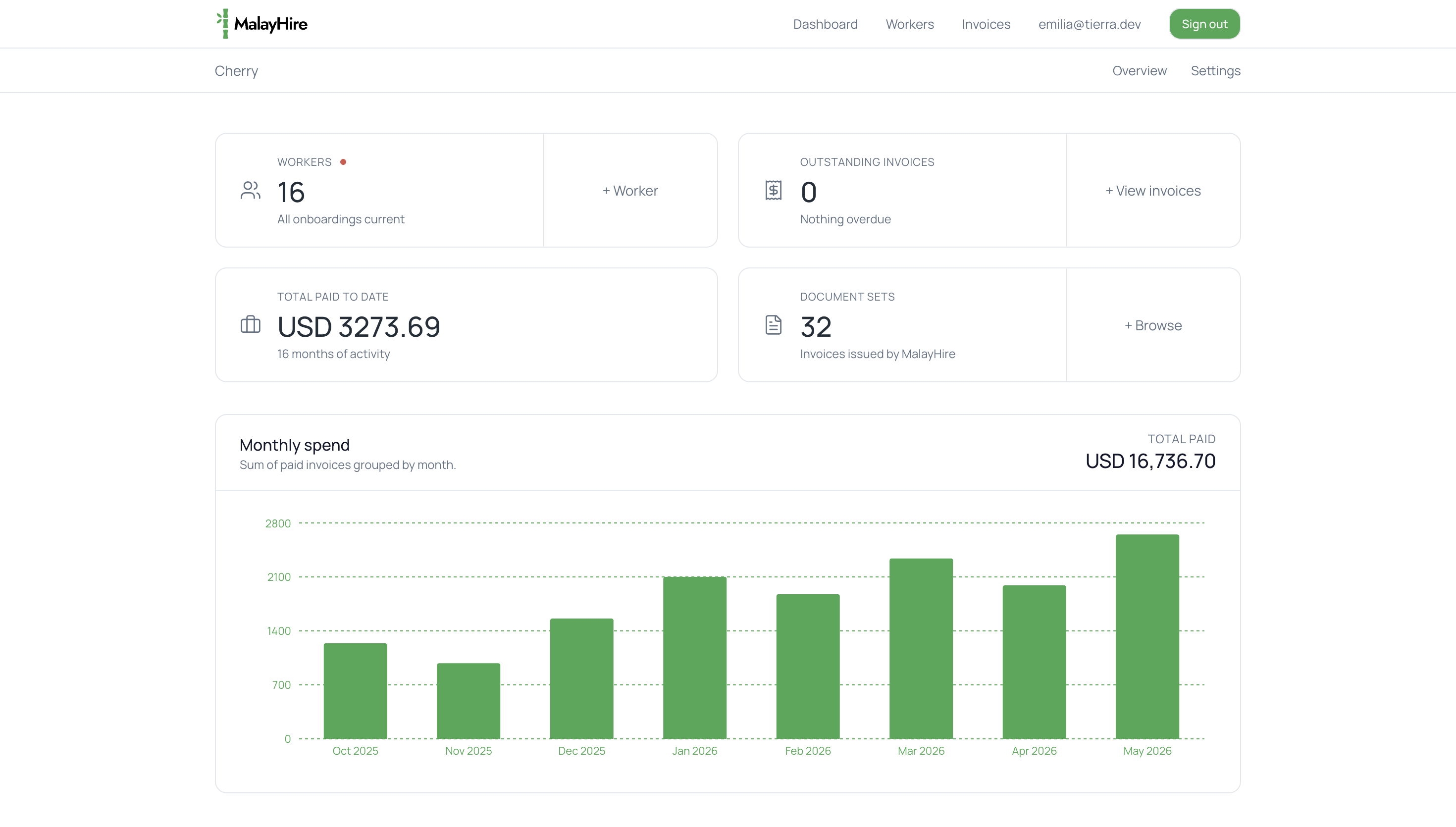
Manage your Malaysian team, payroll & EOR compliance in one place.