
Malaysia Workforce Trends: The Finance Team’s Checklist for Verifying Payroll and Statutory Contributions in an EOR Sandbox Before the First Hire


Malaysia Workforce Trends: The Finance Team’s Checklist for Verifying Payroll and Statutory Contributions in an EOR Sandbox Before the First Hire

Key Takeaways
- Malaysia’s statutory payroll contributions — EPF, SOCSO, EIS, HRDF, and PCB — each come with their own calculation rules, caps, and timelines that a standard global EOR sandbox rarely simulates in full.
- A sandbox that mirrors only core product logic often misses local nuances like tiered EPF rates, the SOCSO salary ceiling, and monthly PCB recalibration based on cumulative annual income.
- Global platforms like Deel provide an isolated testing environment, but verifying Malaysia-specific compliance requires deep injection of local tax tables, contribution schedules, and regulatory change windows.
- Finance teams should not trust a sandbox run until they have manually tested edge cases: employer EPF contributions exceeding RM5,000 per month, prorated SOCSO for mid-month starters, and HRDF levy applicability.
- The most critical list of verifications includes cross-checking MTD/PCB calculations against the LHDN monthly schedule, validating EPF division between employer and employee accounts, and simulating EIS payment routing.
- A dedicated Malaysia EOR sandbox, as opposed to a generic global wrapper, will pre-load EPF contribution rates by age and wage bracket, SOCSO class codes, and HRDF registration status — all within a 48-hour test window.
- Without proper sandbox rehearsal, finance teams risk statutory underpayment, late payment penalties, and compliance audit triggers in the first quarter of hiring.
- Building a repeatable verification process around these checklists ensures that every new Malaysian employee is onboarded with zero payroll defects, reinforcing workforce stability and employer reputation.

Why Sandbox Testing Has Become a Mainstay in Malaysia Workforce Trends
Not long ago, expanding into Malaysia meant flying in a local accountant, getting a crash course on EPF tiers, and praying the first payroll run didn’t miss a deduction. That’s changed. The conversation around Malaysia workforce trends now revolves around pre-emptive compliance testing. More companies are using Employer of Record sandboxes to simulate statutory contributions and payroll workflows weeks before an actual hire comes on board.
Here’s what’s driving this shift. The Malaysian government has tightened enforcement around EPF, SOCSO, EIS, and HRDF, and penalties for late or incorrect contributions are no longer a slap on the wrist. At the same time, global EORs have matured, offering sandbox environments that claim to replicate production. But there’s a catch. Many of these environments are product mirrors — ideal for testing API calls and contract generation, yet surprisingly thin when it comes to simulating the messy reality of local payroll tax tables, monthly PCB adjustments, and tiered contribution rates.
The trend, then, is not just using a sandbox. It’s demanding a sandbox that truly speaks the language of Malaysian labor law. For finance teams at foreign companies, that means moving beyond surface-level testing and creating a systematic verification checklist that covers every statutory contribution down to the last sen. This article provides exactly that: a detailed, room-by-room inspection of what an EOR sandbox must prove before you can sign off on payroll for your first Malaysian employee.
What a Global EOR Sandbox Typically Delivers — And Where It Falls Short on Malaysian Compliance
If you’ve explored platforms like Deel or Remote, you’ve probably seen the sandbox pitch. According to Deel’s API documentation, their Sandbox is a "completely isolated testing environment" pre-populated with sample contracts, workers, and organizations. It prevents real payments and legal agreements — ideal for safe tinkering. Remote Embedded offers a plug-and-play white-label solution with access to an API framework for embedding EOR functions. These are powerful tools for integration flow tests.
But a finance team looking to verify Malaysian statutory deductions will quickly hit walls. The populated sample data doesn’t adapt to EPF’s complex age- and wage-based contribution categories. The SOCSO tables that decide an employee’s contribution class — based on monthly salary capped at RM5,000 — aren’t natively simulated. The critical HRDF levy, which applies differently to companies registered under the PSMB Act, rarely appears in default sandbox scenarios. And the monthly PCB calculation, which relies on cumulative yearly income and personal reliefs, can’t be tested end-to-end when the sandbox resets or operates on static data.
What this tells you is that a global sandbox is a staging environment for API calls, not a compliance rehearsal room. To truly verify that your first Malaysian employee’s payslip will be correct, you need a sandbox that starts with local contribution logic, not just product features.
A Head-to-Head Look: Global Sandbox Simplicity vs. Malaysia-Dedicated Sandbox Depth
To make the gap concrete, let’s compare what a typical global sandbox offers against the capabilities finance teams actually need when verifying Malaysia payroll. This isn’t about criticizing any platform; it’s about understanding where your own testing responsibility begins.
Sample Data Realism
Global sandboxes pre-load generic worker profiles and organizations. A Malaysia-dedicated sandbox, on the other hand, will offer sample employees with realistic NRIC numbers, EPF registration statuses, SOCSO category codes, and even pre-filled PCB registration details. This matters because a generic employee profile won’t trigger EPF age-tier rules or show how the system handles a foreign worker levy exemption.
- Global: Static sample workers with no Malaysian personal identifiers or scheme registrations.
- Malaysia-dedicated: Test accounts segmented by citizenship, age bracket (below 60, above 60, foreign workers), and HRDF levy applicability.
Contribution Calculation Engine
The heart of any payroll sandbox is the math. Global environments may let you input arbitrary deduction amounts, but they rarely calculate EPF employer and employee shares based on the current statutory rate table. A Malaysia-focused sandbox will allow you to change an employee’s monthly salary and immediately see the correct EPF, SOCSO, and EIS deductions appear — including employer portions that don’t show on the payslip but must be paid to KWAP, SOCSO, and SIP.
- Global: Deductions are often configurable, not automated to Malaysian tables.
- Malaysia-dedicated: Auto-populates EPF at 11% (employee) and 12%/13% (employer) based on wage bracket, SOCSO contributions capped at RM5,000 salary, and EIS at 0.2% each for employer and employee.
Statutory Filing Simulation
Testing payroll isn’t complete without seeing how the sandbox generates statutory filing outputs — the Borang A for EPF, Form 8A for SOCSO, and CP39 for PCB. Global sandboxes almost never touch these. A local sandbox can produce mock filing files and help you verify that totals match what you’d submit via i-Akaun, ASSIST, or e-PCB systems.
- Global: No simulated filing forms.
- Malaysia-dedicated: Produces dummy Borang A (EPF), Form 8A (SOCSO), and CP39 (PCB) with correct totals, letting you cross-check directly.
The Finance Team’s Ultimate Sandbox Verification Checklist for Malaysian Statutory Contributions
Now we get to the practical heart of the matter. Whether you’re using a global EOR sandbox or a Malaysia-native one, your finance team should run through this checklist before green-lighting the first real hire. Each bullet below represents a non-negotiable verification point. A single miss can cascade into compliance debt that follows you for months.
- EPF Employee Contribution: Verify that the sandbox auto-calculates 11% of monthly salary for Malaysian employees below 60, not exceeding RM7,350 monthly salary ceiling. Test with a salary of RM4,000 — the employee share should be exactly RM440.
- EPF Employer Contribution: Confirm that the employer portion appears at the correct tier (12% for salaries ≤RM5,000; 13% for >RM5,000) and is not simply a configurable field. Run a test employee with RM6,500 salary and expect employer EPF of RM845 (13%).
- SOCSO Contribution: Check that the system applies the correct class (First or Second) based on monthly salary and caps contributions at RM5,000 salary ceiling. For a salary of RM3,000, employer share should be 1.75% (RM52.50) and employee share 0.5% (RM15.00).
- EIS (Employment Insurance System): Validate that both employer and employee are charged 0.2% each on the actual monthly salary, with no cap. A RM2,500 salary should show exactly RM5.00 from both sides.
- HRDF Levy: If your company is liable under the Pembangunan Sumber Manusia Berhad Act, test that a 1% levy on each employee’s monthly wage is generated. Many sandboxes ignore HRDF entirely. Confirm it’s an automated line item, not optional.
- PCB (Monthly Tax Deduction): Inject a cumulative annual salary and personal relief status to see if the sandbox recalculates PCB using LHDN’s Monthly Deduction Table. Test with a single employee earning RM8,000/month, no bonus, single status, and observe the PCB value against the official LHDN calculator. The sandbox must match it exactly.
- Late Payment Simulation: Ask the sandbox to process a contribution one day after the statutory deadline. Check that it flags the late payment and computes the correct penalty — EPF late payment interest is currently calculated daily on the outstanding amount. A Malaysia-dedicated environment will do this automatically.
- Multiple Employee Scenarios: Add three employees with varying salaries, ages, and citizenship statuses in one sandbox batch. Verify that the total employer contribution summary for EPF, SOCSO, EIS, and HRDF reconciles with manual spreadsheet calculations.
Common Traps Finance Teams Fall Into When Testing EPF and SOCSO Calculations
Even with a checklist, certain subtle traps can fool a well-meaning finance team. I’ve seen them surface repeatedly during initial sandbox trials, and they almost always stem from assuming that a global sandbox handles the exceptions the same way a local payroll administrator would.
The first trap is the EPF employer contribution for employees above 60. The rate drops to 4% for the employer and 0% for the employee if the employee is past the statutory retirement age, yet many sandbox setups don’t adjust for this. A second trap is SOCSO category confusion: an employee earning RM4,800 falls under the Second Category with a different contribution table than one earning RM5,200. A generic sandbox might apply a flat rate or miss the ceiling entirely. Another frequent oversight is the EIS applicability for domestic helpers and some self-employed categories — but that rarely applies to EOR hires, so the main risk is misclassifying a foreign worker’s citizenship status and accidentally omitting EIS charges.
Then there’s the HRDF levy trap. Companies with less than 10 Malaysian employees are exempt from the levy. If your sandbox doesn’t track or allow you to toggle the headcount, it may incorrectly apply the levy and inflate employer costs in testing. And finally, the PCB trap: a mid-year join date means the employee’s taxable cumulative income is not full-year, so monthly PCB must be estimated using a specific formula. A sandbox that only looks at monthly salary without cumulative input will spit out the wrong tax deduction every single time.
How to Align Sandbox Testing with Real-World Malaysian Regulatory Change Windows
Malaysia’s workforce trends aren’t static. Minimum wage is adjusted periodically; the government has revised EPF contribution rates during economic crises; SOCSO coverage can shift through Budget announcements. A sandbox that doesn’t reflect upcoming changes is already obsolete.
Finance teams must use the sandbox not just for present-day verification, but for forward-looking simulation. Before a new minimum wage takes effect on May 1st, test what happens to EPF and SOCSO calculations for employees currently at the old floor. If an employer is required to absorb the wage increase, does the sandbox automatically recalculate employer EPF at the new threshold? If SOCSO announces a new salary ceiling, can you toggle a future date and see contribution caps adjust?
A key tactic is to treat the sandbox as a regulatory change rehearsal stage. Once a year, after the Malaysian Budget tabling, run all existing employee profiles through the sandbox with the new parameters. This proactive testing unearths system limitations (like a global platform taking months to update their tax tables) before they affect production payroll. In the context of Malaysia workforce trends, the ability to simulate local fiscal policy changes months ahead is rapidly becoming a baseline expectation for any EOR platform you’d trust with long-term compliance.
Building a Repeatable, Documented Sandbox Verification Process for Every New Hire
You don’t want to reinvent the checklist each time you add an employee. Here’s a lightweight framework to embed into your finance team’s standard operating procedure:
- Create a master sandbox scenario profile: Malaysian male, age 35, salary RM5,500, single, contributing to EPF and SOCSO, HRDF liability yes. Run this every month as a regression test.
- Add variants: a female employee, 28, salary RM3,200, and a foreign worker, salary RM2,500, with levy exemption. These three profiles catch most miscalculations.
- Export the sandbox’s statutory reports (mock Borang A, Form 8A, CP39) into a spreadsheet that re-calculates each contribution using your own formulas. Flag any discrepancy automatically.
- Document the exact steps to trigger EPF age-based rate change, SOCSO ceiling change, and mid-month pro-ration. If the sandbox can’t simulate these out of the box, your team knows the platform has a coverage gap.
- Set a recurring calendar event one week before payroll cutoff to run this verification suite. A 30-minute sweep can catch data drift or platform updates that alter calculation logic.
- If your EOR offers an API, integrate the sandbox test run with a simple script that POSTs employee data and GETs payroll breakdowns, then compares values against expected outputs. Automation reduces human error, especially with PCB.
Interpreting Sandbox Failures and What They Tell You About Your Malaysia Hiring Readiness
When a sandbox test fails, don’t just patch the data and move on. Treat every failure as a signal about your overall compliance posture. A mismatch in EPF employer share for a salary bump from RM4,900 to RM5,100 might reveal that the platform doesn’t recognize the tier boundary correctly. That’s a systemic issue, not a one-time glitch.
Similarly, a failure to generate HRDF levy for a company with 12 employees indicates that the sandbox either lacks HRDF registration simulation or is incorrectly counting headcount. If the platform can’t handle this, what happens when you later hire a 50th employee and the HRDF filing becomes mandatory? The sandbox test has just warned you that your first hire’s compliance may be correct, but the tenth hire’s may not.
Use these signals to ask your EOR provider pointed questions. How often do they update EPF tables? Do they ingest LHDN bulletin changes within days or months? Can they simulate industry-specific SOCSO subclass codes for certain manufacturing roles? These aren’t edge cases anymore; they’re the daily reality of managing a Malaysian workforce. A sandbox that continually reveals its gaps is telling you something important — listen to it.
What This Means for Your Finance Team’s Role in Malaysia Workforce Trends
The Malaysia workforce trends data is clear: more foreign companies are entering the market, and compliance expectations are tightening. Your finance team isn’t just a payroll processor anymore — you’re the safety net between the promise of a sleek EOR and the reality of KWAP contribution deadlines. Sandbox verification is your new due diligence language.
So here’s the simple takeaway: never trust a sandbox run until you have personally crossed off every item on a Malaysia-specific statutory checklist. Don’t assume that because a platform can spin up a contract in the sandbox, it can also calculate PCB for a married employee with two children. Test, document, repeat. When you find a gap — and you will — you’ll either have discovered a learning moment for your internal process or identified a platform that wasn’t built for Malaysian hiring depth.
Either way, you’ll be one step closer to what this whole hire should have been from day one: a payroll run where every statutory remittance lands on time, every contribution amount is accurate, and your only surprise is how smoothly it went.
Frequently Asked Questions
How do I verify EPF contributions in an EOR sandbox before hiring in Malaysia?
You verify EPF contributions by inputting an employee’s monthly salary into the sandbox and comparing the calculated employer and employee shares against the official EPF contribution rates for their wage category and citizenship status. Any discrepancy exceeding one ringgit indicates a configuration error, requiring immediate correction before processing live payroll.
What is the difference between global EOR sandbox and Malaysia-dedicated sandbox for SOCSO testing?
A global EOR sandbox typically applies standard SOCSO rates without accounting for the First Schedule wage ceiling changes or the additional Employment Injury Scheme tiers. A Malaysia-dedicated sandbox dynamically updates SOCSO contribution thresholds and automatically applies the correct employee and employer percentages for both the Employment Injury and Invalidity Pension schemes.
Can I test PCB tax deductions in an EOR sandbox before hiring in Malaysia?
Yes, you can test PCB tax deductions by entering the employee’s monthly remuneration, marital status, and number of dependents into the sandbox. The system should apply the correct statutory tax brackets and calculate monthly deductions. Always cross-check the sandbox output against the current LHDN PCB schedule for accuracy.
Why does my EOR sandbox show different SOCSO amounts than the official calculator?
This mismatch usually occurs because the sandbox uses outdated SOCSO contribution tables or fails to apply the correct wage ceiling for the current year. Verify the sandbox is configured with the latest SOCSO rates from the official PERKESO portal, specifically checking the First Schedule wage ceiling update to ensure alignment.
How often should I update my EOR sandbox test data for Malaysian statutory contributions?
You should update your sandbox test data every time the EPF, SOCSO, or LHDN announces a regulatory change, at minimum quarterly. Major changes occur in January with new wage ceilings and in March with budget announcements. Failing to update test data leads to incorrect payroll calculations and compliance risks.
What are the most common errors finance teams make when testing EPF calculations in a sandbox?
The most common errors include using the wrong wage ceiling for non-citizen employees, forgetting to apply the correct EPF contribution rate for employees earning below RM5,000, and failing to test prorated contributions for mid-month hires. These mistakes cause underpayment of contributions and potential penalties from KWSP.
How do I interpret a sandbox failure for Malaysian payroll compliance?
A sandbox failure indicates your EOR or payroll system is misaligned with current Malaysian statutory requirements. Identify which contribution type failed by comparing the sandbox output to official rates. Document the discrepancy, update the system configuration, retest, and escalate any persistent failures to your provider for compliance readiness assessment.
What should I include in a documented sandbox verification process for new Malaysia hires?
Include a step-by-step checklist covering employee data input validation, EPF and SOCSO rate confirmation against current laws, PCB tax bracket verification, and contribution totals cross-check with official calculators. Every test cycle should be timestamped and signed off by a finance team member to ensure repeatability and audit readiness.
MalayHire is your most cost-effective Employer of Record (EOR) in Malaysia
Hire full-time employees in Malaysia and save costs by avoiding hefty contractor fees. MalayHire handles payroll, employment contracts, statutory compliance (EPF, SOCSO, EIS), and HR admin. Start onboarding your Malaysian hire now, with MalayHire.
Trusted by global companies hiring in Malaysia





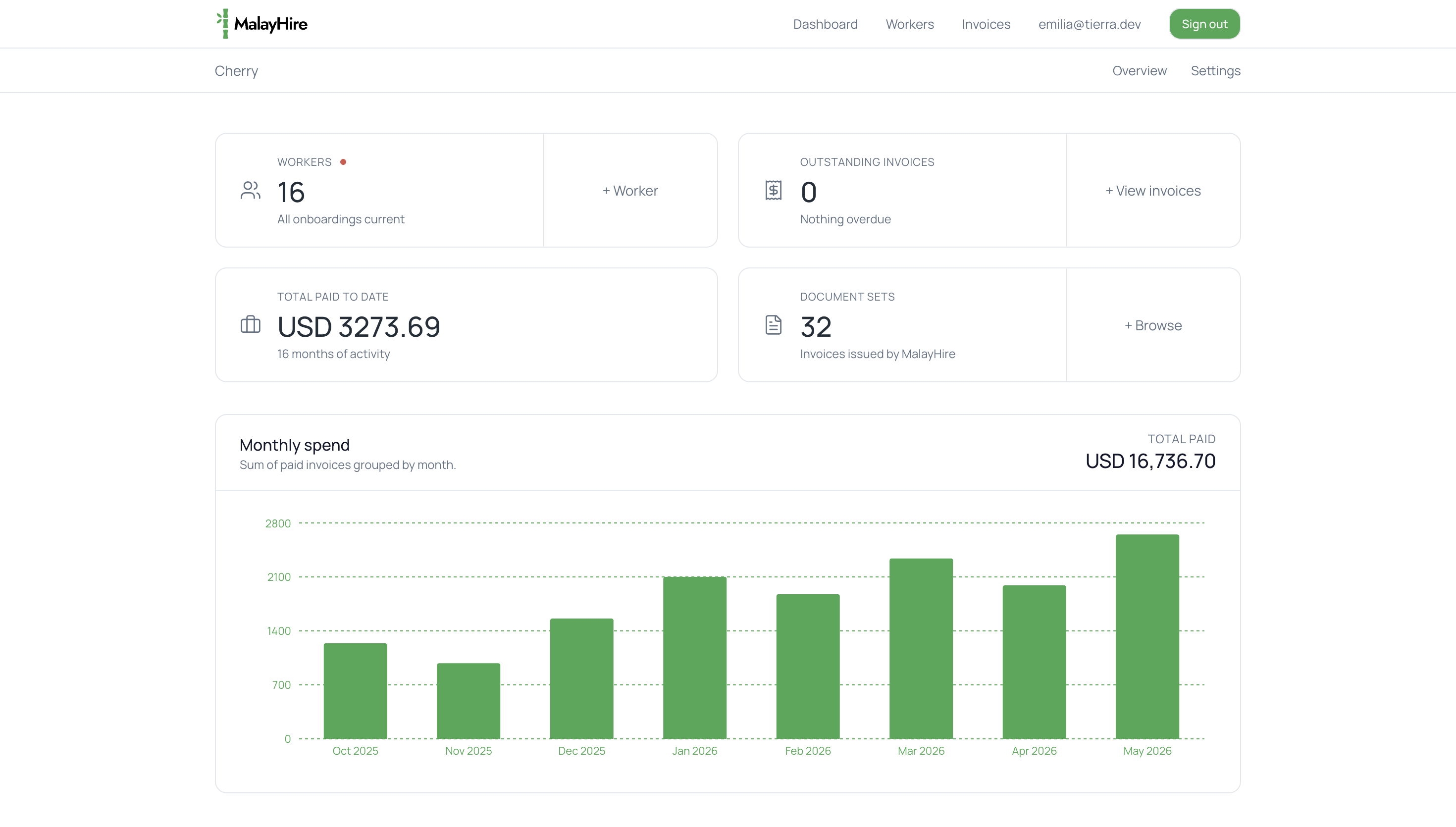
Manage your Malaysian team, payroll & EOR compliance in one place.