
Navigating Malaysia Tech Talent: A Global Employer’s Guide to Hiring and Onboarding the Country’s Next Wave of Developers


Navigating Malaysia Tech Talent: A Global Employer’s Guide to Hiring and Onboarding the Country’s Next Wave of Developers

Key Takeaways
- Malaysia’s tech talent pool is expanding rapidly, fueled by strong STEM education, government digital initiatives, and an increasingly mature startup ecosystem.
- English proficiency, competitive salary expectations, and a multicultural work environment make Malaysian developers particularly attractive to global companies.
- Hiring tech talent in Malaysia demands meticulous attention to statutory contributions—EPF, SOCSO, PCB, and HRDF—from day one, with no room for trial-and-error.
- Rapid onboarding (as fast as 48 hours) is achievable when you work with a Malaysia-focused Employer of Record that pre-configures local compliance workflows.
- The most common mistakes involve misclassifying contractors, overlooking probation rules, and underestimating the importance of culturally intelligent interview processes.
- Sandbox environments that replicate real Malaysian payroll and contract scenarios let you simulate hires, test contribution calculations, and catch compliance gaps before committing.
- A localized EOR approach transforms compliance from a bottleneck into a strategic lever, allowing you to secure top tech talent faster than competitors relying on generic global platforms.
- Understanding where to source talent—from community-driven meetups to niche job boards—is as critical as understanding legal obligations.

Malaysia’s Tech Moment Has Arrived
Walk into any co-working space in Kuala Lumpur, Penang, or Johor Bahru and you’ll feel it: a quiet hum of ambition that’s far louder than the decibel meter suggests. Malaysia’s tech talent isn’t an emerging story anymore—it’s already here, building fintech platforms that handle millions of ringgit a day, crafting AI models for regional logistics giants, and shipping code for startups that have gone from idea to Series A in under two years. Yet for global employers, this talent pool can feel like a black box. You know the engineers exist, you’ve heard the numbers, but the path from “we should hire in Malaysia” to “our developer submitted their first pull request” is littered with compliance hurdles and cultural unknowns.
This guide isn’t a broad overview of the Malaysian economy or a generic pitch for why you should expand into Southeast Asia. Instead, we’re going deep on one thing: how to actually understand, hire, and onboard Malaysia tech talent in a way that’s fast, compliant, and utterly practical. We’ll talk about what the talent pool looks like right now, the hidden compliance traps that trip up even seasoned HR teams, and how a modern, Malaysia-focused Employer of Record can turn the country’s most exciting developers into productive team members in less time than you’d expect. If you’re a CTO, a people ops lead, or a founder staring at a hiring funnel that needs real technical muscle without the headache of setting up a local entity, you’re in the right place.
The Shape of Malaysia Tech Talent in 2025
To hire well, you need to know what you’re dealing with. The Malaysian tech workforce is not a monolith—it’s a layered ecosystem that spans deep enterprise developers who’ve spent a decade building banking systems, fresh graduates who cut their teeth on cloud-native projects during university, and a growing freelance community comfortable working async for companies they’ll never visit in person.
Education and Skills Pipeline
Malaysia’s public and private universities produce over 40,000 IT-related graduates each year. Institutions like Multimedia University, Universiti Malaya, and the Asia Pacific University of Technology & Innovation have actively updated their curricula to include data science, cybersecurity, and cloud architecture. Government programs such as MDEC’s Premier Digital Tech Institution initiative also tie academic output directly to industry needs, meaning graduates aren’t just theoretically sound—they’ve often completed internships with local tech firms before they even walk across the stage. The result is a steady stream of talent that understands both legacy systems and modern stacks like Python, React, and Kubernetes. You’ll find a particularly strong concentration of JavaScript/TypeScript, .NET, and mobile development skills, with AI and ML capabilities gaining ground fast.
Language and Adaptability
English is the primary language of business and technical communication in Malaysia. Code reviews, design docs, and sprint planning happen in English by default in most tech companies. This fluency removes a friction point that plagues global teams hiring in other regional markets. Beyond language, Malaysian developers tend to be culturally adaptable—comfortable switching between formal client-facing communication and casual Slack banter with international colleagues. That adaptability is a byproduct of a genuinely multi-ethnic society where daily life involves code-switching between Malay, English, Mandarin, and Tamil. For a global team, it means you’re not just hiring a coder; you’re gaining a team member who can bridge communication gaps across markets.
Cost Versus Quality Equation
Let’s address the elephant in the room. Global companies don’t look at Malaysia purely for altruistic reasons—the math has to work. A senior full-stack developer in Kuala Lumpur might earn significantly less than a similarly skilled engineer in Singapore, London, or San Francisco, yet the code quality and work ethic are often indistinguishable. But here’s where the conversation gets nuanced: the best Malaysian tech talent knows their worth. If you approach hiring with a budget-only mindset, you’ll attract candidates who are already looking elsewhere. Pair competitive pay with compelling work, ownership, and career growth, and you’ll tap into a pool that’s loyal and immensely productive. Think of it as a fair-value proposition rather than cheap labour, and you’ll build a team that stays.
The Compliance Reality: What Tech Hires Don’t Tell You
A tech hire is still an employee, and Malaysian employment law doesn’t care how elegant your codebase is. The moment you onboard someone in Malaysia, you’re bound by a web of statutory obligations that must be executed flawlessly from the first salary run. Many foreign companies learn this the hard way—treating their first Malaysian developer as a contractor, missing contributions, and later facing back payments plus penalties. Here’s what you need to get right.
EPF and SOCSO: The Non-Negotiables
The Employees Provident Fund (EPF) and Social Security Organization (SOCSO) contributions are the twin pillars of Malaysian employment. Employers must contribute 12-13% of an employee’s monthly salary to EPF (with a portion from the employee as well), while SOCSO contributions cover workplace injury and invalidity benefits. These aren’t optional perks; they’re legal requirements that kick in the moment an employment contract takes effect. Even a single missed month can trigger audit flags and erode trust with your new hire. For tech roles where salaries often sit above the median, the absolute ringgit amounts are substantial, so payroll precision matters doubly.
Income Tax (PCB) and HRDF Contributions
Monthly tax deductions, known as Potongan Cukai Bulanan (PCB), must be calculated based on the employee’s expected annual income and remitted to the Inland Revenue Board. For tech companies, the Human Resources Development Fund (HRDF) levy also often applies, especially if you’re hiring for roles that involve training. The levy is a small percentage of payroll, but registration and monthly filings are mandatory for covered employers. Overlooking HRDF registration can seem like a minor oversight until you realize it’s a compliance checkpoint during audits. An EOR that generates these calculations automatically in a sandbox environment allows you to verify every ringgit before it leaves your account.
The Risk of Misclassification
Malaysia’s courts and labour department look at substance over form. Calling someone an independent contractor when you set their working hours, provide equipment, and require them to attend stand-ups creates a classic misclassification scenario. Tech talent might prefer the flexibility of freelancing, but if the role looks like employment, you’re on the hook for all statutory contributions retroactively plus fines. The safe path—and the one that earns genuine goodwill from local hires—is to bring them on as full-time employees through an EOR that assumes the legal employer responsibilities. It removes ambiguity and lets your developer focus on code without lurking tax anxiety.
Speed as a Strategic Advantage: 48-Hour Onboarding for Tech Roles
Great developers don’t stay available for long. When you’ve identified the right candidate, the weeks it typically takes to set up a local entity, draft bespoke contracts, register for tax numbers, and run initial payroll feel like an eternity. I’ve seen companies lose a perfect hire to a competitor simply because the administrative machinery moved too slowly.
This is where a Malaysia-specialist EOR rewrites the timeline. Instead of treating onboarding as a sequential process where legal, HR, and finance hand tasks back and forth, the entire workflow is pre-configured. Employment contracts are vetted against Malaysian labour law, EPF and SOCSO IDs are registered digitally, and payroll calculations are pre-loaded with the latest statutory rates. Some providers, like MalayHire, even commit to a 48-hour onboarding window—from offer acceptance to a fully compliant, payroll-ready employee. For a startup that just closed a round and needs to ship a feature fast, that speed isn’t a nice-to-have; it’s the difference between hitting a launch deadline and watching it slip.
That speed rests on deep local integration. Generic global EORs often take longer because they’re adapting a one-size-fits-all framework to Malaysia’s specific requirements—think manual overrides and back-and-forth emails with a local partner. A dedicated Malaysia EOR bakes those local rules into the core system, making the 48-hour sprint feel almost effortless from your side.
Where to Actually Find Strong Malaysia Tech Talent
Posting a job on a global platform and waiting for applications is the slow lane. The best Malaysia tech talent often moves through less visible channels. Here’s where to focus your sourcing energy.
Beyond Job Portals: Communities and Events
Malaysia’s tech community thrives on meetups, hackathons, and Slack groups. Events run by groups like Women Who Code Kuala Lumpur, the Malaysia Linux User Group, and ReactJS Kuala Lumpur attract practitioners who are already sharpening their skills outside work hours. Attending—or even sponsoring—these gatherings puts you directly in front of passive candidates who might not be actively browsing job boards. Similarly, the annual Penang Tech Fest and regional hackathons organized by MDEC are talent magnets. When you show up as a genuine contributor, not just a recruiter, conversations turn into hires.
Tap into the Remote Work Wave
A significant slice of Malaysia’s tech talent now expects remote or hybrid work as a baseline. Platforms like MauKerja, Hiredly, and even LinkedIn have strong local penetration, but niche remote-work communities—both local and global—are where you’ll find developers already comfortable with distributed collaboration tools and async workflows. Look for talent that’s been contributing to open-source projects or has a track record of delivering in distributed teams; their GitHub profiles often speak louder than a CV. Emphasizing your company’s remote infrastructure and async culture in job descriptions will pull these candidates out of the woodwork.
Leverage EOR Networks
Leading Malaysia-focused EORs don’t just handle compliance—they sit at the intersection of dozens of hiring companies and the local talent market. Their teams know which developers are looking for new challenges, and they can often make warm introductions before a job requisition even goes public. While you shouldn’t treat an EOR as a recruitment agency, the network effect is real. When an EOR has helped place and onboard hundreds of tech workers, they develop an intimate sense of who’s available and who’s a strong fit for a given tech stack and team culture.
Common Pitfalls When Hiring Malaysia Tech Talent
Even well-intentioned hiring managers stumble on these. They’re rarely documented in official guides because they sit at the messy intersection of culture, labour law, and tech industry norms.
- Overlooking notice periods: Many Malaysian employment contracts specify 1-3 months’ notice. Assuming a developer can start in two weeks because that’s the norm in your home market blindsides both you and the candidate.
- Ignoring cultural nuance in interviews: Direct, rapid-fire technical questioning can be perceived as aggressive in a culture that values harmony and face-saving. Balance rigour with relationship-building to avoid losing candidates who are technically strong but conflict-averse.
- Assuming one-size-fits-all benefits: Private medical insurance, internet allowances, and upskilling budgets are increasingly expected by senior tech talent. Failing to articulate these as part of total compensation—even if the base salary feels generous—can tip a candidate toward a competing offer.
- Skipping probation period structure: Malaysian law allows probationary periods (typically 3-6 months) with different termination requirements. Clear probation terms must be in the contract, and failing to document performance reviews during this window can complicate later decisions.
- Neglecting public holidays and local leave conventions: Malaysia has a mix of national and state-level public holidays. Developers in Penang may observe different holidays than those in KL. An EOR automatically manages this, but if you’re trying to do it manually, mismapped leave calendars cause resentment fast.
Testing the Waters: Simulating Payroll Before the First Hire
The smartest global teams I’ve worked with don’t wait until an employee is already lodged in their payroll system to discover a calculation error. They simulate the entire payroll and compliance workflow first. This is exactly what a well-built sandbox environment offers—a complete, isolated replica of the production payroll system where you can test EPF, SOCSO, and PCB contributions with dummy employee data without triggering real payments or legal contracts.
What a Malaysia-Specific Sandbox Should Include
A generic global sandbox (like Deel’s API sandbox, which accurately mirrors production functionality without affecting real data, triggering actual payments, or creating legal contracts) is useful for understanding API mechanics. But for Malaysia-specific compliance, you need more. The sandbox should be pre-populated with a sample worker who has a realistic EPF/SOCSO registration number, a Malaysian bank account structure, and local contract templates that include statutory language. You should be able to run a mock payroll cycle—complete with employer and employee contributions—and verify that the final takings match your own calculations. If the sandbox doesn’t include Malaysia-specific taxation rules, you’re still flying blind on the most critical part of the hire.
How It Prevents Costly Errors
I’ve seen a European startup use a Malaysia EOR sandbox to model the entire onboarding of their first Kuala Lumpur-based machine learning engineer. They uploaded a dummy employment contract, ran a simulated payroll with the forecasted salary, and immediately caught a misconfiguration in HRDF contribution rates that would have resulted in underpayment. Because they caught it in the sandbox, the correction took minutes instead of weeks of rectification with the actual tax authorities. This kind of proactive validation is not a luxury; it’s a risk-management baseline when statutory compliance has legal teeth. Before you commit to a provider, ask whether their sandbox includes real-world Malaysian identity structures and tax scenarios. If it doesn’t, you’re getting a demo, not a rehearsal.
What the Future Holds for Malaysia’s Tech Workforce
The next five years look remarkably bright. The government’s MyDigital blueprint and the continued expansion of the tech hub in Cyberjaya are creating a flywheel: more investment feeds better infrastructure, which attracts more companies, which drives demand for talent, which in turn motivates more students to pursue tech careers. Emerging specializations like blockchain engineering, green-tech software, and AI ethics are already finding footholds in local research clusters.
For global employers, this means the window of opportunity is wide open but also competitive. Companies that treat Malaysia as a second-tier outsourcing destination will lose out to those that recognize it as a strategic talent hub and offer genuine career paths. The EOR model supports this beautifully: it enables you to build a local reputation as a solid employer without the overhead of a subsidiary, letting you scale your tech team in tandem with market opportunities.
What This Means for Your Global Team
Malaysia tech talent deserves to be understood as a sophisticated, high-value resource that requires precise handling—not a low-cost commodity you can plug in with minimal attention. The developers you hire here will write production code, own critical features, and influence your technical direction just like any other team member. So give them the same level of structural support you’d give an employee in your home country, but tailored to Malaysian law and culture.
That means having a trusted, locally knowledgeable partner who can handle the statutory machinery while you focus on building an engineering culture that spans continents. Whether you’re hiring your first Malaysian developer or your fiftieth, the combination of deep local compliance expertise and the ability to simulate and verify every step of the payroll process in a sandbox will save you from sleepless nights. Get the compliance right, move fast, and you’ll discover that Malaysia isn’t just a cost-effective option—it’s a genuine engineering hub that can shift the trajectory of your product.
Frequently Asked Questions
How do I verify the qualifications of Malaysia tech talent before hiring?
You verify qualifications by requesting official transcripts from the Malaysian Qualifications Agency or recognized universities for independent confirmation. Conduct structured technical assessments through platforms like HackerRank or Codility alongside portfolio reviews during the interview process. This dual verification ensures candidates possess the exact skills required for your tech roles.
What is the typical salary range for senior software developers in Malaysia in 2025?
Senior software developers in Malaysia earn between RM 12,000 and RM 20,000 per month in 2025, with top talents commanding higher compensation for specialized skills like AI or cybersecurity. Salaries vary by location with Kuala Lumpur offering the highest range due to cost of living differences. Consider total benefits including bonuses and stock options when comparing offers to attract the best candidates.
Can I hire Malaysia tech talent as independent contractors instead of full-time employees?
You can hire Malaysia tech talent as independent contractors, but you must carefully structure the engagement to avoid misclassification under Malaysian labor laws. Independent contractors require clear contracts specifying deliverables and no employee benefits such as EPF contributions or annual leave. Misclassification risks include back payment of statutory contributions and legal penalties from the Industrial Relations Department.
How long does it take to obtain a work permit for foreign tech employees in Malaysia?
A work permit for foreign tech employees in Malaysia takes 30 to 60 working days for processing through the Expatriate Services Division after submitting a complete application. Accelerated processing is available for companies with approved status under the Malaysia Digital Economy Corporation for qualified roles. Begin the application process at least three months before the intended start date to ensure timely approvals.
What are the mandatory benefits I must provide for tech employees in Malaysia?
Mandatory benefits for tech employees in Malaysia include contributions to the Employees Provident Fund of 12 percent from your side and Social Security Organization coverage for work-related injuries. You must also provide paid annual leave of at least eight days per year and public holidays matching the Employment Act 1955 requirements. These statutory obligations apply to all full-time Malaysian employees regardless of your company size.
How do I handle payroll and taxes for remote tech hires in Malaysia?
You handle payroll and taxes by registering with the Inland Revenue Board Malaysia and remitting monthly tax deductions through the CP 39 reporting system for all local hires. Work with a licensed payroll provider familiar with Malaysian tax brackets and EPF calculations to ensure compliance with statutory deadlines. For non-resident hires, apply the correct flat tax rate of 30 percent on gross income unless a tax treaty reduces this obligation.
What common cultural differences should I expect when managing Malaysia tech teams?
When managing Malaysia tech teams, expect a respectful communication style where direct criticism is softened to maintain group harmony, requiring feedback delivered privately and constructively. Malaysian employees often value clear hierarchical structures and may wait for explicit instructions rather than taking initiative without guidance from leadership. Building trust through regular one-on-one meetings and acknowledging local festivals fosters stronger collaboration across your global team.
How can I test payroll compliance before hiring my first tech employee in Malaysia?
You can test payroll compliance by simulating payroll runs using a professional employer organization or payroll calculator specifically designed for Malaysian regulations before making any actual hires. This simulation process allows you to calculate correct EPF, SOCSO, and tax withholdings based on different salary scenarios without risking legal penalties. Many employers use this approach to validate their setup and avoid costly errors during the first real payroll cycle.
MalayHire is your most cost-effective Employer of Record (EOR) in Malaysia
Hire full-time employees in Malaysia and save costs by avoiding hefty contractor fees. MalayHire handles payroll, employment contracts, statutory compliance (EPF, SOCSO, EIS), and HR admin. Start onboarding your Malaysian hire now, with MalayHire.
Trusted by global companies hiring in Malaysia





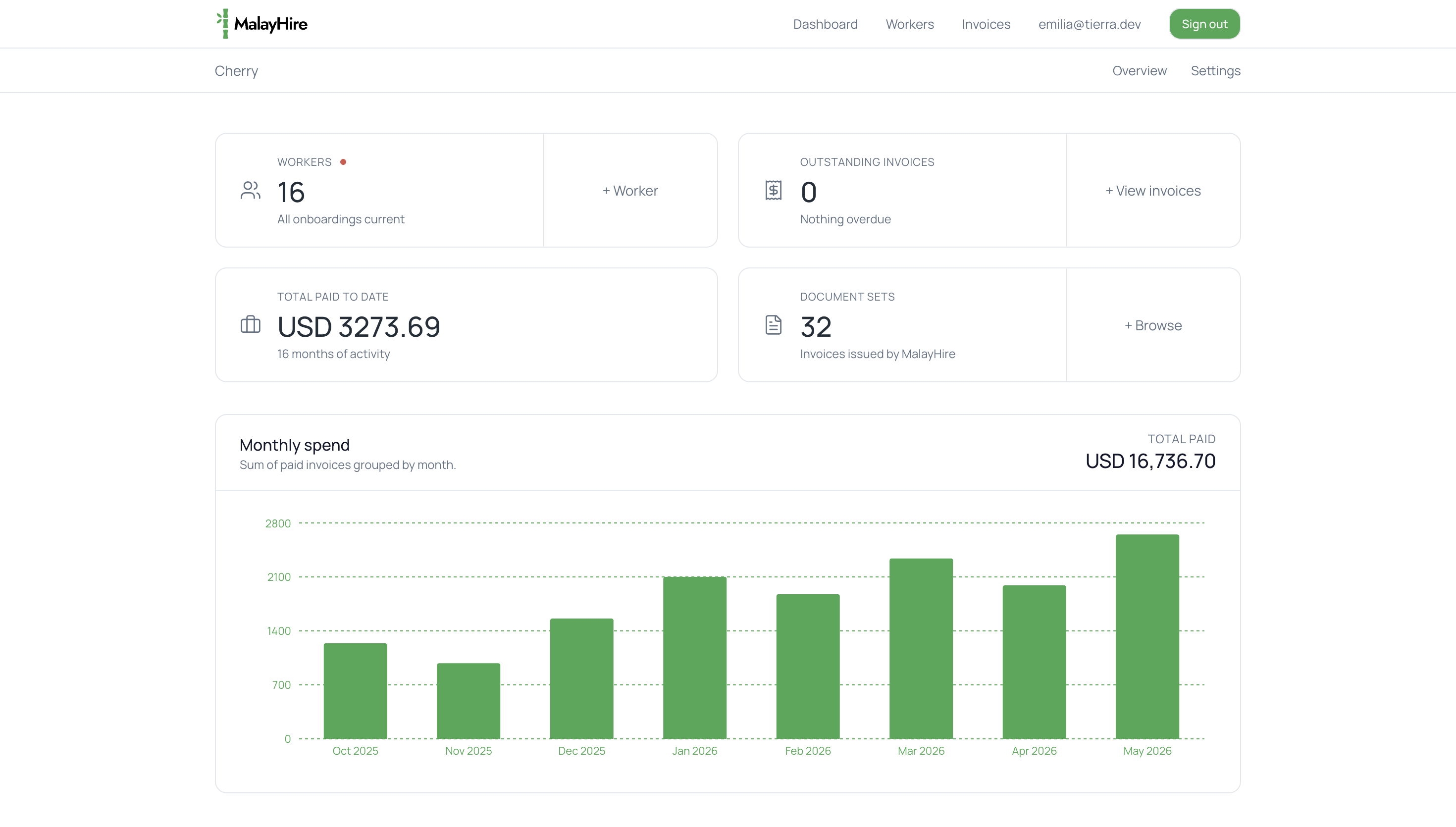
Manage your Malaysian team, payroll & EOR compliance in one place.