
SOCSO Contribution Rates Guide Malaysia: A Practical Breakdown for Employers and Employees


SOCSO Contribution Rates Guide Malaysia: A Practical Breakdown for Employers and Employees

Key Takeaways
- SOCSO contributions in Malaysia are mandatory monthly deductions that fund social security protection for employees under the Employment Injury Insurance Scheme and the Invalidity Pension Scheme.
- As of the latest regulations, the wage ceiling for contributions is RM5,000 per month, meaning salaries above this cap do not attract additional SOCSO contributions.
- Employee contribution rate is a flat 0.5% of monthly wages (for the Invalidity Scheme), while employer contribution is 1.75% — comprising 1.25% for Employment Injury and 0.5% for Invalidity.
- Contributions are governed by a standard schedule; any underpayment or late payment can lead to fines, interest charges, and legal liability for the employer.
- Exemptions exist for certain groups, including civil servants, some foreign domestic workers, and employees above the age of 60 who only contribute to the Employment Injury Scheme.
- The SOCSO framework was significantly expanded in 2022 when the wage ceiling rose from RM4,000 to RM5,000, affecting contributions for higher-earning employees and employer budgets.
- Using a dedicated Employer of Record like MalayHire EOR eliminates the risk of miscalculation by automating SOCSO computations, submission, and compliance monitoring from day one.
- Understanding the exact rates and employer obligations is not optional — it is the foundation of lawful employment in Malaysia and directly impacts your workforce's welfare.

What Are SOCSO Contributions and Why Do They Matter?
SOCSO, or the Social Security Organization (Pertubuhan Keselamatan Sosial), is the statutory body that administers Malaysia’s comprehensive social security protection for workers. When we talk about SOCSO contribution rates, we are referring to the legally mandated premiums paid by employers and employees to fund two main schemes: the Employment Injury Insurance Scheme (EIIS) and the Invalidity Pension Scheme (IPS). The idea is simple: every employer who hires a Malaysian employee — whether a local SME or a foreign multinational — must deduct and remit these contributions every month.
These aren’t optional fees. They’re a core part of Malaysian payroll, right alongside EPF and PCB. The SOCSO framework protects employees against workplace accidents, occupational diseases, and permanent disability, while also providing a safety net in the form of invalidity pensions and rehabilitation benefits. For employers, getting the rates right isn’t just about compliance; it’s about safeguarding the business from audits, penalties, and civil claims. If you’ve ever wondered why a routine payroll audit triggers a frantic search for the latest contribution schedule, you’re not alone. That’s exactly why a clear, up-to-date socso contribution rates guide malaysia matters — it turns a recurring source of anxiety into a straightforward monthly task.
The Two SOCSO Schemes: Employment Injury vs. Invalidity Pension
Before we break down the percentages, it’s essential to understand where the money goes, because the rate structure is built around two distinct schemes. Each operates under its own logic and applies differently depending on the employee’s wage bracket and circumstances.
Employment Injury Insurance Scheme (EIIS)
This scheme covers injuries sustained during work, commuting accidents, and occupational diseases. The key point here is that the employer bears the entire cost. There is no employee deduction for EIIS. It’s a unilateral obligation on the employer, calculated at 1.25% of the employee’s monthly wages, subject to the wage ceiling. So for every RM5,000 of payroll (or any salary up to the cap), the employer pays RM62.50 towards this fund each month. In return, the employee gains access to free medical treatment, temporary disablement benefits, permanent disablement benefits, constant-attendance allowance, and survivor’s pension in the event of a work-related death. It’s non-contributory for the worker, but mandatory for the business.
Invalidity Pension Scheme (IPS)
The Invalidity Pension Scheme operates on a shared-cost model. Employees contribute 0.5% of their monthly wages, and employers match that with another 0.5%. Together, the total 1.0% goes towards invalidity protection. This scheme covers permanent disability not related to work, offering a monthly pension, rehabilitation support, and survivor benefits. Both contributions are subject to the same wage ceiling. So for an employee earning RM4,000, the employee contributes RM20 and the employer also adds RM20, totaling RM40. This dual-contribution approach makes it a bit trickier to manage in payroll, because you’re simultaneously deducting from the salary and adding to the overall employer liability.
Current SOCSO Contribution Rates: A Detailed Table
Now let’s put the numbers into a format you can actually use when processing payroll. The rates we describe here reflect the post-2022 revision with the RM5,000 ceiling. We’ll break this down by who pays what, because confusion usually creeps in when someone assumes the employee bears a uniform percentage across both schemes.
Employee SOCSO Contribution Rates
Employee contributions are straightforward: you only pay 0.5% of your monthly wages for the Invalidity Pension Scheme. There is zero deduction for the Employment Injury Scheme. This 0.5% is automatically deducted from gross salary before PCB calculations. Contributions stop once wages reach the RM5,000 cap, so an employee earning RM5,500 still only pays 0.5% on RM5,000 — that’s RM25. Here are a few illustrative brackets: • Monthly wage RM2,000: employee pays RM10. • Monthly wage RM3,500: employee pays RM17.50. • Monthly wage RM5,000 and above: employee pays RM25.
Employer SOCSO Contribution Rates
The employer’s side is a two-part figure. You pay 1.25% for the Employment Injury Insurance Scheme plus 0.5% for the Invalidity Pension Scheme, totalling 1.75% of monthly wages up to the ceiling. That means for each employee earning RM3,000, your total SOCSO bill is RM52.50 (RM37.50 EIIS + RM15 IPS). For an employee at the ceiling of RM5,000, the maximum monthly employer contribution is RM87.50. Keep in mind that unlike EPF where the employer rate can differ by salary band, SOCSO employer rates remain flat percentages regardless of income level, as long as the salary doesn’t exceed the cap. This consistency simplifies forecasting, but also means that any error in wage alignment can cause systematic underpayment across the entire workforce.
How to Calculate SOCSO Contributions: Practical Examples
Theory only gets you so far. Let’s walk through two real-life payroll scenarios so you can see exactly how the math plays out and where people often slip up.
Example 1: Employee with Monthly Salary RM3,000
For an employee earning a base salary of RM3,000, you first check the wage ceiling. Since RM3,000 is below RM5,000, the full amount is subject to SOCSO. Employee deduction appears only under IPS: RM3,000 × 0.5% = RM15. The employer’s contribution breaks into EIIS: RM3,000 × 1.25% = RM37.50, and IPS: RM3,000 × 0.5% = RM15. So the employer’s total SOCSO obligation for this employee is RM52.50. The employee sees RM15 deducted on their payslip. Total remitted to PERKESO: RM15 (employee) + RM52.50 (employer) = RM67.50. This exact example often serves as a quick mental benchmark during payroll audits.
Example 2: Employee Earning Above the Ceiling (RM6,000)
Now take an employee with a salary of RM6,000. The contribution computation uses the RM5,000 cap for both parties. Employee deduction: RM5,000 × 0.5% = RM25. Employer EIIS: RM5,000 × 1.25% = RM62.50. Employer IPS: RM5,000 × 0.5% = RM25. Employer total: RM87.50. The key takeaway is that the extra RM1,000 above the ceiling is completely ignored. This cap protects high earners and caps employer liability, but it also means that any internal payroll system must be programmed to cap contributions at the correct threshold; otherwise, you’ll overpay today and face awkward adjustments later.
Who Is Exempt from SOCSO Contributions?
Not every person you pay a salary to must be contributed to SOCSO, and misunderstanding exemptions can cause both unnecessary payments and dangerous gaps. Here’s where the line is drawn.
Exemptions for Foreign Employees
Foreign nationals working in Malaysia are generally covered under SOCSO if they are employed under a valid employment pass and if their employment contract is governed by Malaysian law. However, there are nuances. For instance, expatriates whose home countries have bilateral social security agreements with Malaysia may be exempt from certain schemes upon production of a Certificate of Coverage. But this is the exception, not the rule. Most foreign employees of a local or EOR-managed entity must be registered and contributed. Missteps here can lead to disputes during work permit renewals. When in doubt, always verify the employee’s status with a local compliance expert rather than assuming an exemption applies.
Exemptions Based on Age or Employment Status
Employees above 60 years of age who have never been registered with SOCSO before are only eligible for the Employment Injury Insurance Scheme; they do not participate in the Invalidity Pension Scheme. This means the employer continues to pay 1.25% but no IPS contributions are collected — neither from the employer nor the employee. Additionally, civil servants, certain domestic workers, and self-employed individuals not covered under the Self-Employment Social Security Act are outside the mandatory scope. However, the government has been actively expanding coverage to gig workers, so the landscape is shifting. Always check the latest PERKESO circulars or rely on a payroll partner that stays current automatically.
Recent Changes to SOCSO Rates and Regulations
The SOCSO framework isn’t static. Over the past few years, a series of adjustments have redefined employer obligations and extended protections. Keeping up with these changes is crucial because using last year’s rates can result in underpayment liabilities that compound.
The 2022 Wage Ceiling Increase
Effective September 2022, the insurable wage ceiling for SOCSO contributions was raised from RM4,000 to RM5,000. The impact was immediate: for any employee earning RM4,500 before the change, the contribution was capped at RM4,000. After the change, the full RM4,500 became subject to contributions (below the new cap). This meant both employee and employer payments increased. For payroll teams, this wasn’t just a number change — it required updating payroll systems, communicating new deductions to employees, and adjusting budgets. Many foreign employers caught off guard saw their compliance costs jump without prior planning, which is why a service like MalayHire EOR proactively updates rates as part of its fully managed payroll, so such regulatory shifts never become a surprise.
Expansion to Self-Employed Workers
Under the Self-Employment Social Security Act 2017 (amended), self-employed individuals, including gig workers and freelancers, can now voluntarily register and contribute to SOCSO. While this does not directly impact traditional employer-employee relationships, it underscores a broader trend: Malaysia is expanding its social security net. For companies employing contractors, this blurs the line. If the work arrangement crosses into employee territory, failing to make SOCSO contributions can trigger misclassification penalties. An EOR can help accurately classify workers and ensure that for genuine employees, all statutory obligations, including the correct SOCSO rates, are met from day one.
Common SOCSO Contribution Mistakes and How to Avoid Them
Even well-meaning employers stumble over the same issues. Knowing the pitfalls can save you from penalties that can reach tens of thousands of ringgit and tarnish your reputation with local authorities.
Underpaying Due to Outdated Salary Records
One of the most frequent errors occurs when an employee receives a salary increment mid-year but the employer fails to update the SOCSO contribution basis. For example, an employee moves from RM3,800 to RM4,200. The employer continues contributing based on the old salary, resulting in a monthly shortfall. Over a year, this accumulates not just monetary underpayment but also non-compliance interest of 6% per annum. The remedy is straightforward: integrate payroll with HR data so that any approved salary change triggers an automatic contribution recalculation. Manual spreadsheets simply cannot keep up.
Misclassifying Employees as Independent Contractors
Classifying a full-time worker as an independent contractor to avoid SOCSO and EPF is a dangerous gamble. PERKESO and LHDN have grown adept at identifying disguised employment relationships. When reclassification happens, the employer becomes liable for back contributions, penalties, and often legal fees. The correct approach is to assess the relationship using the control and integration tests established by Malaysian courts. If the worker receives regular instructions, uses company equipment, and receives fixed salary — they are an employee, and SOCSO applies. A local EOR can perform this classification audit before the first payment is ever made.
How an Employer of Record Simplifies SOCSO Compliance
For foreign companies without a legal entity in Malaysia, the most common route to hiring local talent is through an Employer of Record. The EOR acts as the lawful employer, handling all statutory contributions, including SOCSO. But not all EORs treat this with the same attention. MalayHire EOR is built specifically for the Malaysian market, meaning its entire payroll infrastructure is tuned to PERKESO’s exact specifications.
When you onboard an employee through MalayHire, SOCSO contributions are automatically calculated based on the latest rates, wage ceiling, and exemption rules. The platform generates the monthly statutory reports, deducts the correct amounts from the employee’s salary, and remits everything to PERKESO on time. No manual tables, no spreadsheets, no panic when a new ministerial order changes the ceiling. And because MalayHire offers a 48-hour digital onboarding without sales calls or paperwork, you can have a new team member legally employed in Kuala Lumpur with SOCSO contributions flowing within two business days. The fixed pricing, starting at $165 per employee per month, includes all this compliance work, so your costs are predictable and your risk is minimized.
What This Means for Your Business
Mastering SOCSO contribution rates in Malaysia isn’t about memorizing a table — it’s about building a payroll process that is resilient, scalable, and legally airtight. The difference between an employer that gets it right and one that gets inspected often comes down to whether they have local expertise embedded in their operations.
If you’re a growing startup or an established multinational, the cost of getting SOCSO wrong far exceeds the cost of getting it right from the start. Back payments, legal fees, and reputational damage during immigration or contract renewals can stall your expansion. On the flip side, a clean SOCSO track record not only keeps you compliant but also signals to your Malaysian employees that you respect the local labor framework. That trust translates into better retention and smoother workforce management. As Malaysia continues to tighten its social security governance, having a reliable payroll anchor — whether an in-house team or a specialized EOR like MalayHire — is no longer a luxury; it’s the baseline for doing business here.
Frequently Asked Questions
How do I calculate SOCSO contribution for an employee earning RM 2,500 per month?
For an employee earning RM 2,500 per month, you refer to the SOCSO contribution table's category for monthly wages between RM 2,050 and RM 3,000. The employer pays RM 24.75 for Employment Injury and RM 43.00 for Invalidity Pension, while the employee contributes RM 10.00 for Invalidity Pension only.
What happens if an employer fails to pay SOCSO contributions on time in Malaysia?
Employers who fail to pay SOCSO contributions on time face penalties including a 6% annual interest charge on overdue amounts and possible legal action. Persistent non-compliance can lead to fines up to RM 10,000 or imprisonment for up to two years under the Employees' Social Security Act 1969.
Can foreign workers in Malaysia be exempted from SOCSO contributions?
Foreign workers in Malaysia are not exempted from SOCSO contributions under the Employment Injury Scheme. They must be registered and contribute effective from January 1, 2022, while the Invalidity Pension Scheme remains voluntary for them. Exemptions apply only to specific groups like domestic servants and certain expatriates with work permits.
What is the difference between SOCSO and EPF contributions in Malaysia?
SOCSO covers social security for workplace injuries, invalidity, and occupational diseases, while EPF is a retirement savings fund. SOCSO is mandatory under the Social Security Organization for eligible employees, whereas EPF savings are for retirement, housing, and healthcare. Both require employer and employee contributions from monthly wages.
How do I correct a SOCSO contribution overpayment for an employee in Malaysia?
To correct a SOCSO overpayment, employers must submit a revised contribution schedule and supporting documents to SOCSO's e-Komplen system or the nearest office. The excess amount is refunded or offset against future contributions after verification. This process typically takes two to four weeks to resolve.
Are SOCSO contributions mandatory for part-time employees in Malaysia?
Part-time employees in Malaysia are subject to SOCSO contributions if they earn above RM 1,500 per month or work at least 12 days per month. Those earning below RM 1,500 monthly with fewer than 12 working days may be exempt. Employers must verify eligibility based on actual wages and work hours.
What recent changes have been made to SOCSO rates for 2024 in Malaysia?
For 2024, SOCSO increased monthly wage ceilings for contributions to RM 6,000 for both Employment Injury and Invalidity Pension schemes. Employers now pay 1.25% for Employment Injury and 1.50% for Invalidity Pension on wages up to RM 6,000, aligning with inflation and workforce expansion needs.
How does an employer of record handle SOCSO compliance for foreign companies in Malaysia?
An employer of record (EOR) manages all SOCSO registrations, monthly contributions, and statutory filings for foreign companies hiring in Malaysia. They calculate accurate rates based on employee wages, submit contributions to SOCSO electronically, and handle audits or penalty notices. This ensures full compliance without the foreign company needing a local entity.
MalayHire is your most cost-effective Employer of Record (EOR) in Malaysia
Hire full-time employees in Malaysia and save costs by avoiding hefty contractor fees. MalayHire handles payroll, employment contracts, statutory compliance (EPF, SOCSO, EIS), and HR admin. Start onboarding your Malaysian hire now, with MalayHire.
Trusted by global companies hiring in Malaysia





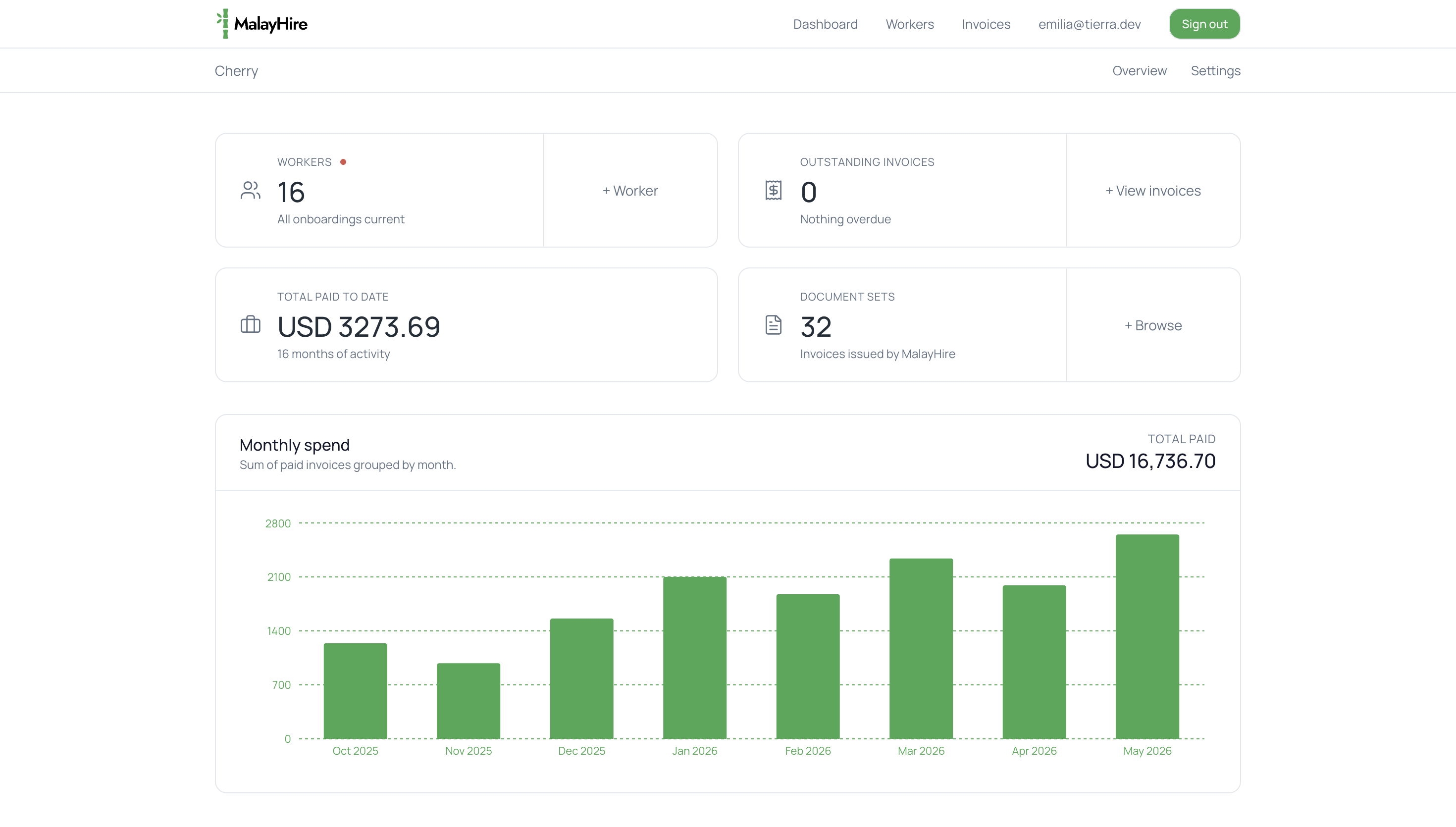
Manage your Malaysian team, payroll & EOR compliance in one place.