
Testing Malaysia Labor Market Compliance: Global vs Local EOR Sandbox Simulation Gaps


Testing Malaysia Labor Market Compliance: Global vs Local EOR Sandbox Simulation Gaps

Key Takeaways
- Malaysia’s labor market demands strict adherence to mandatory statutory contributions like EPF, SOCSO, EIS, HRDF levy, and PCB income tax; a sandbox that doesn’t simulate these precisely exposes foreign employers to penalties and reputational harm.
- Global EOR sandboxes, such as Deel’s, provide useful API authentication and pre-populated sample data but often lack native simulation of Malaysia-specific tiered rates, levy triggers, and monthly tax deduction schedules.
- A Malaysia-dedicated EOR sandbox replicates real-world payroll runs with full statutory granularity—right down to EPF contribution tiers based on employee age and wage, SOCSO category assignments, and PCB calculation rules for residents versus non-residents.
- The biggest compliance gaps in generic sandboxes include misapplied foreign worker levies, missing HRDF contributions for eligible employers, and incorrect overtime or minimum wage adjustments tied to local employment acts.
- Verifying your sandbox against official KWSP, PERKESO, and LHDN tables before a single hire goes live is a non-negotiable step that can save months of back-and-forth with authorities.
- API integration for payroll compliance in Malaysia requires more than a bearer token; a purpose-built local EOR sandbox should deliver scoped access for EPF submission endpoints, SOCSO reporting, and PCB filing—areas where global platforms typically fall silent.
- Relying solely on a global sandbox without local augmentation often leads to ‘simulation blind spots’—scenarios that work fine in the test environment but break catastrophically when you process your first real salary run in Kuala Lumpur.
- A transparent, Malaysia-native sandbox can shrink the time from compliance testing to confident employee onboarding, aligning with expectations for a 48-hour digital setup when you partner with an EOR that knows the local labor landscape firsthand.

The Malaysian Labor Market at a Glance: What Compliance Means for Foreign Employers
Any conversation about the Malaysia labor market has to begin with a simple fact: it’s not just a pool of talented, multilingual workers. It’s a deeply regulated ecosystem where statutory contributions are not extras but your legal baseline. If you’re a foreign company itching to hire in Kuala Lumpur or Penang, you’ll quickly bump into acronyms like EPF (Employees Provident Fund), SOCSO (Social Security Organization), EIS (Employment Insurance System), HRDF (Human Resources Development Fund levy), and PCB (Potongan Cukai Bulanan, or monthly tax deduction). These aren’t optional line items. They’re mandatory, tiered, and adjusted frequently by government circulars.
Employers who treat Malaysia as a carbon copy of their home country’s payroll system often end up with nightmarish audits. The EPF contribution rate, for instance, depends on whether the employee earns less or more than RM5,000 a month, their age, and whether they are a Malaysian citizen or permanent resident. SOCSO splits into different categories based on the nature of work and salary cap. On top of that, there’s the foreign worker levy for companies hiring non-Malaysians, and HRDF kicks in when you have 10 or more local employees. A single misconfiguration in your payroll can cascade into incorrect tax filings, employee grievances, and fines. That’s precisely why simulating the entire compliance workflow in a sandbox before you ever sign a contract is not a luxury—it’s a prerequisite for any sane market entry.
Inside an EOR Sandbox: Simulating Payroll Without Real-Money Consequences
Think of a compliance sandbox as a digital twin of your payroll engine. It mirrors the same logic, statutory tables, and tax rules that would fire in a live run, but the money is fake and every transaction is quarantined. This lets foreign HR teams and compliance officers run endless scenarios—adjusting wages, switching employee categories, adding bonuses—without triggering actual government submissions or bank transfers.
When you start exploring options, you’ll encounter two broad flavours: the global EOR sandbox, built to serve dozens of countries with a unified interface, and the local Malaysia-dedicated sandbox, which exists solely to replicate the nuances of Malaysian labor law. The difference isn’t just about language. A global sandbox might let you create a dummy employee in Malaysia and run a generic payroll, but does it know that PCB calculations for non-resident employees follow a flat rate of 30% while residents use progressive monthly tax tables? Does it flag that SOCSO contributions have a maximum salary ceiling and that the employer’s share changes for the Employment Injury Scheme versus the Invalidity Scheme? These are the details where a generic environment often falls silent.
How Sandboxes Isolate Test Environments
A well-designed compliance sandbox keeps test data completely separate from any production record. According to Deel’s developer documentation, their sandbox offers an isolated environment where test data and actions are partitioned from live systems. That separation is critical because you don’t want a dummy payroll run accidentally triggering a real SOCSO submission. Isolation also means you can push your sandbox to its limits—simulating extreme salary variations, backdated contributions, or mass onboarding—without any real-world fallout. For Malaysian compliance, this concept extends to ensuring that dummy EPF account numbers, fake SOCSO employer codes, and test tax identification numbers never leak into government portals.
The Role of Pre-Populated Sample Data
The Deel sandbox comes with pre-populated sample contracts, workers, and organizations right out of the gate. This is a productivity booster: instead of building everything from scratch, you get a ready-made playground. But here’s the catch. Sample data in a global sandbox often mirrors a generic employee—say, a full-time worker in cyberjaya with a flat salary—rather than the diverse Malaysian workforce reality of apprentices, part-timers, foreign knowledge workers, and statutory-aged employees where EPF rates drop after 60. A local EOR sandbox should ideally seed sample data that reflects these varied profiles, allowing you to test the exact edge cases that will populate your real payroll.
Deel’s Global Sandbox Under the Microscope
Deel’s developer API sandbox is a respected tool in the EOR space, and it’s worth examining its capabilities because they set a certain industry expectation. The platform supports two authentication methods: API Tokens and OAuth2, with tokens used as bearer tokens in the Authorization header. This is standard and developer-friendly. Its sandbox provides an isolated environment, separate from production, and seeds it with sample contracts, workers, and organizations so you can hit the ground running. More recently, Deel has introduced an MCP (Model Context Protocol) server at `https://api.letsdeel.com/mcp`, communicating over HTTP using JSON-RPC 2.0 with Server-Sent Events.
These features make it easy for an engineering team to wire up a test integration and start sending payroll commands. Yet there’s a structural limitation that few API docs explicitly spell out: the sandbox’s statutory logic is abstracted. It knows how to process an employee with a salary and a tax code, but whether that tax code automatically reflects Malaysia’s monthly PCB schedule, with its specific deductible reliefs and chargeable income bands, is a different question. The sample data may not include Malaysia-specific employments like ‘Female Employee on Maternity Leave subject to SOCSO Fund’ or ‘Expiring Foreign Worker Permit triggering levy recalculation’. When you test against such a sandbox, you’re verifying that the API contract works—not that the legal engine is aligned with Malaysian Ministry of Human Resources circulars. That gap is where a local specialist EOR sandbox earns its place.
Authentication Strengths That Still Fall Short Locally
API tokens and OAuth2 are excellent for securing machine-to-machine communication, and the MCP protocol is a forward-looking choice for contextual integrations. But in the Malaysian context, authentication isn’t just about accessing an EOR API; it’s about proving identity to government systems. When an EOR files EPF contributions via the KWSP i-Akaun portal or submits PCB data to LHDN, the authentication layer often involves corporate digital certificates, e-PCB PINs, and employer credentials that aren’t covered by a standard bearer token. A global sandbox that only simulates its own API’s auth flow won’t prepare you for these government-side handshakes. A Malaysia-focused sandbox ideally offers a simulation layer that mimics the expected response codes from statutory portals, so your finance team can build error-handling for things like ‘EPF submission rejected due to mismatched employee IC number’ before the real deadline looms.
Where a Malaysia-Dedicated EOR Sandbox Must Excel
When you’re testing the Malaysia labor market’s compliance machinery, the sandbox needs to be bilingual—not in English and Bahasa Melayu, but in the dual language of Central Bank regulations and local employment acts. A Malaysia-dedicated sandbox must bake in the entire lifecycle of statutory contributions that a foreign employer will face from day one. That includes EPF’s two-tier contribution structure for employees above and below RM5,000 monthly wage, with lower rates for employees aged 60 and above; the wage ceiling of RM20,000 beyond which contributions are optional; SOCSO’s contribution rates split into Employment Injury Scheme and Invalidity Scheme, with separate employer and employee portions and salary caps; EIS contributions applied to every eligible employee at a rate of 0.2% each from employer and employee; and PCB (monthly income tax deduction) that follows the progressive tax schedule published by LHDN, accounting for personal reliefs, SOCSO deductions, EPF life insurance reliefs, and zakat payments for Muslim employees.
Additionally, the HRDF levy—currently 1% of monthly wages for employers with 10 or more Malaysian employees—must trigger automatically in the simulation when that headcount threshold is crossed. For companies hiring foreign workers, the sandbox should incorporate the foreign worker levy, which varies by sector and worker’s nationality. Minimum wage adjustments (the current minimum wage was recently raised to RM1,700 per month as of 2025, but that may evolve) must be reflected, along with overtime calculations prescribed by the Employment Act 1955. A local sandbox from a specialist like MalayHire EOR will surface these elements as configurable templates, not as fields you have to manually code from scratch.
Mandatory Contributions a Local Sandbox Simulates Out of the Box
To be valid, a Malaysia-native EOR sandbox should run through these contributions on every simulated pay run: EPF Tier 2 rates for wages above RM5,000 (12% employer, 11% employee for most; 4% employer for those 60+), SOCSO categories varying from Class I for those earning below RM4,000 to Class IV for those over RM4,000 with a salary cap, EIS at 0.2% for both sides, and PCB using the latest monthly tax deduction tables. HRDF levy for applicable employers and foreign worker levy for non-citizen hires round out the picture. Any sandbox that cannot demo a full remittance statement mirroring LHDN’s CP39 format is essentially incomplete for Malaysian payroll testing.
The Gaps That Can Cost You: EPF, SOCSO, and PCB Misfires
Here’s where theory collides with a real pay slip. Suppose you’re testing with a global sandbox that lets you enter an employee’s gross salary of RM6,000. The API happily accepts it and spits out a net pay. But the sandbox applies a flat employer EPF rate of 12%—which is correct for a Malaysian citizen below 60 earning above RM5,000—except your test employee is a 62-year-old rehired Malaysian director, where the employer rate should drop to 4%. The violation goes unnoticed because the global sandbox didn’t prompt for birth date or trigger the age-based rule. You only discover it when the real KWSP portal rejects your contribution.
Similarly, a generic sandbox might treat SOCSO as a single, undifferentiated line item. In practice, the Invalidity Scheme and Employment Injury Scheme require separate contribution lines, and an employee who reaches the age of 60 ceases to be covered under the Invalidity Scheme. A local sandbox will flag this automatically. Then there’s PCB: monthly tax deductions vary not just with salary but with the employee’s tax resident status. A non-resident foreign worker attracts a flat 30% withholding, while a resident follows the progressive scale. If your sandbox doesn’t distinguish between these two profiles during testing, your first real PCB filing could under-remit by thousands of ringgit, triggering a penalty from LHDN. And let’s not forget the HRDF levy: companies with fewer than 10 employees are exempt, but the moment you scale to 10 local staff, the levy obligation kicks in. A generic sandbox rarely monitors headcount dynamically, so you might miss the moment compliance becomes due.
Practical Steps to Validate Your EOR Sandbox for Malaysian Compliance
Before you commit to a live employee, you need a systematic validation routine. This isn’t just about clicking a button and seeing a green checkmark. It’s about running a parallel payroll calculation using official Malaysian government calculators and comparing results line by line against what the sandbox produces. The following steps form a lightweight assurance framework that finance teams and HR leads can execute within a single week, using nothing more than the sandbox interface, a spreadsheet, and the statutory tables downloaded from KWSP, PERKESO, and LHDN websites.
- Prepare three distinct mock employee profiles: a Malaysian resident below 35 earning RM5,500, a non-resident foreign contractor earning RM10,000, and an employee over 60 earning RM4,200. Run a full monthly payroll cycle for each in the sandbox.
- For every profile, manually compute the EPF employer and employee contributions using the latest KWSP rate table. Cross-check that the sandbox applies the correct tier and age reduction. Verify that contributions stop when the simulated wage exceeds the RM20,000 ceiling.
- Check SOCSO line items: ensure the sandbox splits contributions between the Employment Injury Scheme and Invalidity Scheme (where applicable), and that the salary cap of RM4,000 or RM5,000 (depending on scheme) is respected.
- Validate EIS at a flat 0.2% for both employer and employee, up to the prescribed salary ceiling. The sandbox should automatically include this deduction on every eligible employee.
- Run the sandbox’s PCB output against LHDN’s official PCB calculator for the same monthly salary, taking into account EPF relief and personal relief status if entered. Ensure that for the non-resident employee, the sandbox correctly applies the 30% flat rate rather than progressive tax.
- Trigger an HRDF levy check by creating a batch of 10 or more Malaysian employees in the simulation. Verify that the sandbox flags the employer as liable and calculates a 1% levy on monthly wages for those employees.
- Simulate the onboarding of a foreign worker requiring a levy, such as a manufacturing sector worker from Indonesia. The sandbox must reflect the correct annual levy amount divided into monthly cost projections and include it in the total cost of employment.
- Finally, simulate a minimum wage compliance scenario: set an employee’s base salary at RM1,600 and confirm the sandbox either rejects it or flags a warning if the prevailing minimum wage is RM1,700. Verify that overtime calculations align with the Employment Act’s rate of 1.5x for ordinary overtime hours.
The API Perspective: Authenticating and Interacting with Local Payroll Data
For enterprise developers tasked with integrating EOR payroll into internal HR systems, the API layer is where the rubber meets the road. Deel’s approach—API tokens as bearer tokens, OAuth2 flows, and an MCP server—sets a high bar for developer experience. You can curl an endpoint, authenticate, and pull worker data in minutes. But when you need to push Malaysia-specific contribution data to statutory portals, the API’s scope matters more than its authentication method. A generic global sandbox typically exposes endpoints generic to any country: create worker, define compensation, run payroll. It rarely gives you EPF submission batching, SOCSO category reassignment triggers, or a dedicated endpoint that returns the exact LHDN CP39 data structure.
A Malaysia-focused EOR sandbox, by contrast, will likely have scoped API tokens that grant read and write access to statutory filing simulations. For instance, you might have a token permission for `epf:submit_test` that, in the sandbox, mimics a successful filing to KWSP and returns a transaction reference ID. Another scope might handle `pcb:generate_monthly` to return the formatted text file for e-PCB Plus. This level of granularity is absent from global sandboxes because their API surfaces are designed for a common denominator. If your integration plan includes automating statutory submissions, you need to ask the EOR provider whether their sandbox exposes these Malaysia-specific endpoints and whether the token scopes align with your internal audit controls—something that a simple bearer token won’t resolve on its own.
Token Scopes That Separate a Local EOR from Global Tokens
A global API token might just say ‘payroll:write’ and grant broad access. But for Malaysian compliance, you’d ideally see scopes like `epf:read`, `socso:submit`, `lhdn:pcb_filing`, `hrdf:levy_status`, and `fw_levy:adjust`. These granular permissions not only tighten security but also allow you to restrict which part of the system your integration can touch. In a sandbox environment, these scopes let you test failure modes—for example, deliberately revoking `pcb:submit` and seeing if your system handles the rejection gracefully—before you ever touch live financial data.
A Real-World Scenario: Testing Before Going Live
Imagine a Berlin-based SaaS startup that wants to hire its first Kuala Lumpur sales representative. The founders have read about Malaysia’s talent pool and are eager to move fast. They sign up for a global EOR platform and get access to a sandbox within hours. They punch in a monthly salary of RM7,000 for the prospective hire, run a simulated payroll, and everything looks clean. Net pay is calculated, a standard SOCSO line appears, and the PCB deduction seems reasonable. Satisfied, they proceed to live hiring.
Three months later, the employee flags that her EPF statement shows a lower contribution than expected. Simultaneously, the company receives a letter from LHDN stating that PCB remittances have been underpaid because the employee was mistakenly classified as a non-resident for the first two months. It turns out the global sandbox defaulted to a non-resident tax profile and the startup’s admin didn’t know to switch it manually. Moreover, the HRDF levy was never triggered because the sandbox didn’t track the total number of Malaysian employees—by the time the company hired its 11th employee, the levy obligation was three months overdue. Fixing all this consumed two weeks of back-and-forth with the EOR’s support team, not to mention a cramped timeline for tax appeals.
Now replay that scenario with a dedicated Malaysia compliance sandbox. The platform would have prompted for the employee’s residency status during the dummy setup and automatically selected the progressive PCB schedule. It would have flagged the age-specific EPF tier and reminded the admin to confirm SOCSO categories. And when the headcount silently crossed 10 local staff, the sandbox would have surfaced a warning: ‘HRDF levy now applicable—monthly cost impact RM70 per employee.’ This isn’t a fantasy; it’s the tangible difference between testing in a generic playground and testing in an environment that knows the labor market’s rulebook by heart.
What This Means for Your Malaysia Hiring Timeline
Every hour you spend validation-testing in a sandbox that lacks Malaysian statutory intelligence is an hour that will come back to you later in compliance remediation. The Malaysia labor market rewards employers who treat it with granular respect. For a foreign company, that means selecting an EOR partner whose sandbox mirrors the real thing. That sandbox should fill in EPF forms, generate PCB statements in the correct LHDN format, and handle foreign worker levies as naturally as it calculates gross-to-net pay.
With a purpose-built local sandbox, you can collapse the typical compliance testing window from weeks to days. You’ll onboard your first Malaysian employee knowing that every ringgit of EPF, SOCSO, EIS, and PCB is accounted for exactly as the authorities expect. The downstream effect is not just peace of mind but a faster, more credible market entry—the kind that lets you tell your new team member, ‘Your first payroll is already cleared by the sandbox.’ That’s the velocity a Malaysia-dedicated EOR like MalayHire is engineered to deliver, turning what could be a regulatory quagmire into a simple, 48-hour setup that respects both the employee and the law.
Frequently Asked Questions
How do I test if my EOR sandbox correctly calculates Malaysian EPF contributions?
To test Malaysian EPF contributions in an EOR sandbox, you must input employee wages and verify the system applies the correct statutory 11% employee and 12% to 13% employer contribution rates. Cross-check the sandbox output against the official EPF contribution tables or a local payroll calculator. A misfire here indicates a gap in local compliance logic that requires immediate correction before going live.
What are the common mistakes in SOCSO calculations within an EOR sandbox for Malaysia?
Common mistakes in SOCSO calculations within an EOR sandbox include applying incorrect contribution rates from the wrong category table or failing to cap wages at the statutory ceiling. The sandbox might also miss the separate deduction for the Employment Insurance System. These errors produce inaccurate payroll reports and can lead to regulatory penalties for non-compliance with Malaysian labor law.
Can I use Deel's global sandbox to simulate Malaysian PCB tax deductions accurately?
You can use Deel's global sandbox to simulate Malaysian PCB tax deductions, but it may not handle all local nuances like married relief categories or specific rebates. The simulation might miscalculate the monthly deduction schedule for non-resident employees. Therefore, you should always verify PCB outputs against the LHDN's official MTD schedule to confirm accuracy before processing real payroll.
How does a Malaysia-dedicated EOR sandbox differ from a global one in handling EPF contributions?
A Malaysia-dedicated EOR sandbox is built with the exact EPF contribution tables and statutory updates integrated into its calculation engine, whereas a global sandbox often relies on generic logic that can miss local rate changes or specific wage categories. The dedicated version ensures automatic updates for compliance, reducing risk of penalty from misfiled contributions. This precision gap is critical for foreign employers testing payroll in Malaysia.
What practical steps should I take to validate an EOR sandbox for Malaysian compliance?
Practical steps include running parallel payroll calculations using official EPF, SOCSO, and PCB tables alongside the sandbox output to identify discrepancies. You should also test edge cases like overtime pay, unpaid leave, and termination bonuses to see how the sandbox handles variable compensation. Finally, verify that the sandbox generates compliant submission files for LHDN and SOCSO before any live employment.
How can I authenticate my API interactions with local Malaysian payroll data in an EOR sandbox?
To authenticate API interactions, you must use the correct OAuth 2.0 credentials provided by your EOR platform and ensure the sandbox environment connects to mock endpoints that mimic local payroll systems like EPF i-Akaun or SOCSO's portal. Confirm that the API sends encrypted payloads with your employer registration number. Without proper authentication, the sandbox cannot validate data integrity for real-world submissions to Malaysian authorities.
What happens if my EOR sandbox incorrectly calculates PCB for a foreign employee in Malaysia?
If your EOR sandbox incorrectly calculates PCB for a foreign employee, you risk under-deducting monthly tax that must be remitted to LHDN, leading to late payment penalties and audit flags. The employee may also face a large tax liability at year-end. This error often stems from the sandbox not applying the correct resident status or relief eligibility, which a localized tool would handle automatically.
How does sandbox testing affect my Malaysia hiring timeline after the simulation phase?
Sandbox testing directly impacts your Malaysia hiring timeline by identifying compliance gaps that require reconfiguration of payroll logic before onboarding actual employees. A thorough simulation can delay go-live by one to two weeks if fixes are needed, whereas a flawed sandbox may lead to post-hire corrections that disrupt payroll cycles. Proper testing ensures a smooth transition from simulation to live employment without legal setbacks.
MalayHire is your most cost-effective Employer of Record (EOR) in Malaysia
Hire full-time employees in Malaysia and save costs by avoiding hefty contractor fees. MalayHire handles payroll, employment contracts, statutory compliance (EPF, SOCSO, EIS), and HR admin. Start onboarding your Malaysian hire now, with MalayHire.
Trusted by global companies hiring in Malaysia





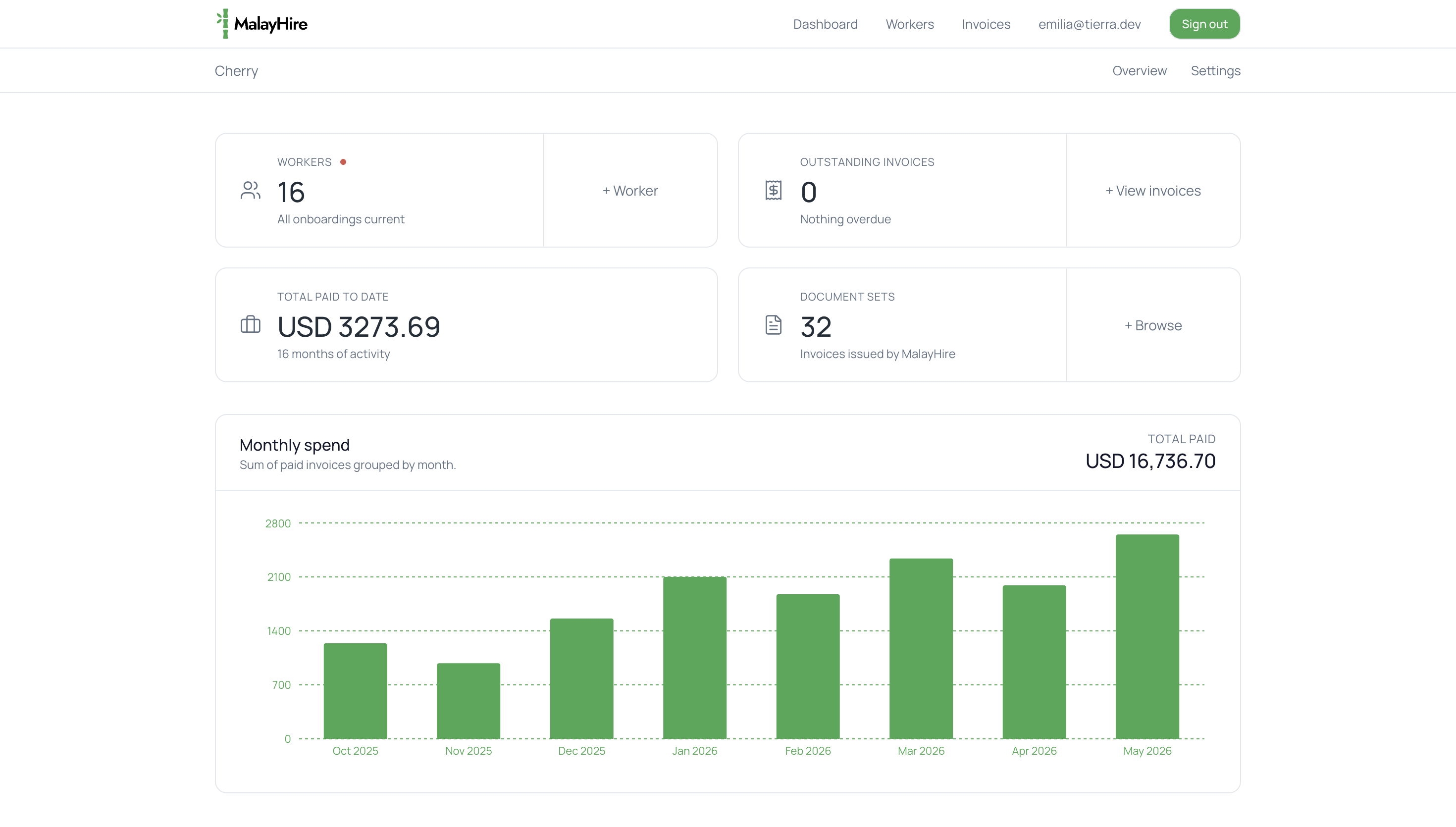
Manage your Malaysian team, payroll & EOR compliance in one place.