
The Real Cost of Labour in Malaysia: What Every Foreign Employer Should Know Before Hiring


The Real Cost of Labour in Malaysia: What Every Foreign Employer Should Know Before Hiring

Key Takeaways
- The headline salary is only the starting point—statutory contributions like EPF, SOCSO, and EIS add 13-17% to your direct labour costs, depending on the employee’s salary and citizenship status.
- Employers share the burden of EPF contributions at up to 13% of salary (for those earning below RM 5,000), while SOCSO and EIS chip in another roughly 2%, making the total mandatory outlay significantly higher than the base pay.
- Supplementary costs such as contractual bonuses, medical insurance, and annual leave are not optional extras—they are deeply embedded in Malaysia’s employment culture and have real financial implications.
- Comparatively, Malaysia offers a more affordable skilled-labour base than Singapore but a more structured and regulated environment than lower-cost neighbours like Indonesia or Vietnam, balancing value with compliance certainty.
- Foreign employers consistently underestimate PCB (income tax) administration and the financial impact of misclassifying local hires, which can trigger backdated contributions and penalties.
- Using a local Employer of Record eliminates the guesswork and manual overhead—fixed monthly fees cover all statutory management, so you know your true cost per employee from day one.
- Even a mid-level developer’s total cost in Kuala Lumpur can be modelled in less than an hour using real contribution rates, giving you a trustworthy budget before you ever make an offer.
- The biggest advantage in Malaysia isn’t just the lower absolute salary—it’s the combination of solid infrastructure, English fluency, and a fully digital statutory regime that lets companies scale without building a local entity.

Defining the Real Cost of Labour in Malaysia: It’s Not Just the Salary
Ask a hiring manager in London or San Francisco what an employee costs, and they’ll likely quote a gross annual figure plus maybe 20–30% for benefits and taxes. Bring that same mental model to Malaysia and you’ll wind up with a spreadsheet full of holes. The cost of labour in Malaysia isn’t just the monthly salary you negotiate; it’s a carefully orchestrated package of mandatory contributions, customary allowances, and regulatory filings that can add a consistent 15–20% on top of base pay—sometimes more.
What makes Malaysia distinctive is how codified these extras are. Unlike markets where employer contributions are optional perks, the country’s statutory framework—EPF, SOCSO, EIS, and PCB—leaves little room for interpretation. For anyone staffing a team in Kuala Lumpur or Penang, the real labour cost begins the moment you register with the authorities. And because these obligations are tied to employee citizenship status, wage brackets, and even age, the math isn’t one-size-fits-all. I’ve seen foreign firms budget only for gross salary, then scramble when the first EPF remittance lands. The cost of labour in Malaysia rewards those who do the homework upfront, and punishes those who cut corners.
This article is about getting that homework right. I’ll walk through the exact components that determine your true per-employee outlay, why cultural norms like contractual bonuses matter as much as statutory rates, and how a structured approach—especially through a local Employer of Record—can turn a complicated obligation into a predictable line item. By the time you reach the end, you won’t look at a Malaysian job offer the same way again.
Breaking Down Malaysia’s Mandatory Statutory Contributions
At the heart of labour cost are four statutory instruments that every employer must manage: EPF, SOCSO, EIS, and PCB. Each is calculated on a specific base and remitted to a different body, and together they form the non-negotiable floor of your employment cost. Understanding them individually is the only way to avoid nasty surprises during the first payroll run.
EPF – The Heavyweight of Employer Contributions
The Employees Provident Fund is the largest single deduction. For Malaysian citizens and permanent residents, employers must contribute between 12% and 13% of the employee’s monthly wage, depending on the salary threshold. Employees earning RM 5,000 and below see a 13% employer share; those above RM 5,000 also attract 12%, but the exact rate can shift for certain industries. Non-citizen permanent residents and foreign workers enrolled in EPF follow slightly different scales, often at a reduced employer rate of around RM 5 per month for the employer’s share if they are not mandatory contributors, but the rules have tightened in recent years. The key takeaway: for a local Malaysian hire earning RM 6,000, you’re handing over RM 720 a month in EPF alone—before anyone sees their net salary. That’s RM 8,640 a year that doesn’t appear on an offer letter but absolutely sits on your income statement.
SOCSO: More Than Just a Safety Tag
Social Security Organisation contributions split into two schemes: Employment Injury Scheme and Invalidity Scheme. Employers bear both sides of the cost, typically around 1.75% of the employee’s monthly wage (capped at a maximum salary of RM 4,000 for contribution calculation, though the cap has been increasing). For a wage within the ceiling, you’re paying roughly RM 70–RM 85 a month per person. It sounds modest, but across a team of twenty, that’s a couple of thousand ringgit every payroll cycle. SOCSO provides workers with medical coverage, temporary disablement benefits, and dependants’ benefits, so it’s not a dead cost—it’s a meaningful safety net that supports workforce stability.
- Employer contribution rate: approximately 1.25% for Employment Injury and 0.5% for Invalidity Scheme.
- Monthly wage ceiling for contributions is currently RM 4,000, but proposed increases will push it higher, raising your per-employee cost accordingly.
- Foreign workers are covered under the Employment Injury Scheme only, altering the calculus if your workforce includes expatriates.
EIS – A Small Levy with Big Implications
The Employment Insurance System is the newest of the triad, introduced to provide temporary financial assistance to workers who lose their jobs. Employers contribute 0.2% of the employee’s monthly wage, matched by the employee’s 0.2%. The ceiling is the same RM 4,000 salary benchmark. So the employer’s share maxes out at RM 8 per month per person—almost invisible on its own. But it’s another line item that, when bundled with EPF and SOCSO, starts to paint a fuller picture of why a RM 5,000 salary costs closer to RM 5,900 out of your account.
PCB – The Withholding That Doesn’t Hit Your Pocket (Directly)
Potongan Cukai Bulanan (monthly tax deduction) is an employer administration cost, not a direct contribution above the salary. You deduct income tax from the employee’s wages and remit it to the Inland Revenue Board. It doesn’t inflate your total labour cost the way EPF does, but it carries heavy compliance overhead. Miscalculate PCB, and you’re liable for the shortfall, plus possible penalties. Many global employers treat PCB as a fluffy “just withhold it” item, but without proper setup, you’ll spend hours rectifying filings. When modelling the true cost of labour in Malaysia, factor in the operational load of PCB management—something a local EOR handles natively.
Supplementary Costs That Catch Foreign Employers Off Guard
Mandatory contributions are only one side of the coin. Malaysia’s employment landscape also includes deeply embedded supplementary expectations that, while not always strictly legislated, are practically mandatory if you want to attract and keep talent. Ignore them and your total labour cost calculation will be dangerously optimistic.
Contractual Bonuses and Annual Leave
Practically every employment contract in Malaysia includes a 13th-month bonus, known as the Annual Wage Supplement, and often a performance bonus on top. While not legally required, it’s a competitive norm. Add to that a minimum annual leave entitlement of 8 days for the first two years, scaling up to 16 days, and you’re paying for weeks of non-productive time. A RM 5,000-a-month employee with a guaranteed 13th-month bonus effectively costs RM 5,416 a month when annualised, not counting leave. That’s before you even budget for medical leave or public holidays.
Medical and Insurance Benefits
Employers are required to provide basic medical coverage at a minimum, but most professional roles expect outpatient clinic visits and sometimes hospitalisation insurance. A typical employer-sponsored outpatient panel can cost RM 50–RM 100 per employee per month, while group hospitalisation coverage adds another RM 80–RM 150. These aren’t statutory contributions—they won’t show up on an EPF statement—but they’re part of the real cost of labour in Malaysia. And if you’re hiring through an EOR, ask whether these perks are bundled into the fixed monthly fee or priced separately; it can make a significant difference to your per-head budget.
How Malaysia’s Labour Costs Stack Up Against the Region
If you’re weighing ASEAN locations, the cost conversation often starts with “Singapore is too expensive, and Indonesia is too complicated.” Malaysia sits comfortably in between, but the numbers need nuance. Let’s look at broad comparisons without cherry-picking anecdotes.
- A skilled professional in Kuala Lumpur may earn 50–60% of their Singapore equivalent in gross salary, but when you add Singapore’s employer CPF contributions (up to 17%) and office rental, the gap widens dramatically favoured Malaysia.
- Vietnam and Indonesia offer lower nominal wages, but their social insurance regimes are fragmented, and employer compliance often demands more local intermediary costs, eroding some of the headline savings.
- Thailand’s social security contribution rates are lower (5% employer share up to a very low cap), but the limited talent pool for English-fluent tech roles can drive up outsourced recruitment fees, indirectly lifting labour cost.
- Malaysia’s statutory contribution system—while slightly more expensive than some neighbours—is fully digital and well- documented. That maturity reduces the hidden cost of compliance errors, legal fees, and administrative delays that plague less formalised markets.
- For roles requiring strong English proficiency and multicultural sensibilities, Malaysia often delivers the best total value: a salary midpoint below Singapore’s, with regulatory clarity above Indonesia’s and talent depth beyond Vietnam’s.
A Real-World Scenario: Modelling Total Labour Cost for a Mid-Level Developer in Kuala Lumpur
Numbers on a government website are helpful, but they only come alive when you plug them into a real role. Below is a hypothetical developer earning RM 8,000 per month, a common benchmark in the KL tech scene. All figures are in Malaysian ringgit.
Salary Breakdown Example
Let’s assume the employee is a Malaysian citizen under 60, earning exactly RM 8,000 per month. Employer EPF at 12% equals RM 960. SOCSO contribution (based on the ceiling salary band) roughly RM 69.50. EIS at 0.2% capped is RM 8. Basic outpatient medical insurance panel and group hospitalisation totalling RM 180 per month, plus an annualised 13th-month bonus (RM 8,000 ÷ 12 = RM 667). That puts the real monthly cost at RM 8,000 + RM 960 + RM 69.50 + RM 8 + RM 180 + RM 667 = RM 9,884.50. Suddenly, your “RM 8,000 developer” costs over RM 118,000 a year, not RM 96,000. And if the role includes SOCSO’s soon-to-increase ceiling, that number edges higher.
If you’re using a local EOR like MalayHire, these components are calculated, itemised, and remitted on your behalf within a fixed monthly fee. That converts an estimate into a guaranteed cost, which makes boardroom discussions far easier.
The EOR Advantage: Streamlining Contributions and Eliminating Surprises
An Employer of Record that lives and breathes Malaysian statutory law turns labour cost from a monthly headache into a flat, auditable figure. Instead of hiring a local team to handle payroll software, government portal interactions, and contribution audits, you hand over the full responsibility.
How a Local EOR Simplifies Cost Projections
A Malaysia-focused EOR like MalayHire knows that EPF employer rates shift slightly depending on the employee’s wage and citizenship status, and that SOCSO ceiling adjustments are confirmed in the annual budget. They bake these variables into a per-employee fee starting at $165 a month, covering all statutory handling. There’s no interpretation needed on your part—the monthly invoice tells you the exact total, and any regulatory change is absorbed into the pricing model. For a foreign SME, that’s the difference between assigning a full-time accountant to Malaysia payroll and simply approving a line item.
Beyond Compliance: Time Savings and Error Reduction
Statutory late payments attract significant fines, and PCB miscalculations can lead to employee complaints. I’ve watched companies spend days chasing KBKI and ASSIST portal logins, only to discover they’ve been contributing at the wrong rate for six months. The cost of labour in Malaysia includes a hidden risk premium if you self-manage without local expertise. A dedicated EOR absorbs that risk, ensuring every sen of EPF, SOCSO, and EIS is remitted on time. When you factor in the hours saved from error resolution, the administrative burden practically vanishes.
Common Mistakes Foreign Employers Make When Estimating Labour Costs
Even experienced HR directors stumble when they apply their home-country logic to Malaysia. These missteps are so predictable they’ve almost become clichés—but they’ll still blow a hole in your budget.
- Forgetting to annualise the contractual bonus: a RM 6,000 salary with a guaranteed 13th-month addition raises your true monthly employer cost by RM 500, and forgetting this inflates your budget by 8% overnight.
- Assuming SOCSO contributions are negligible because they look tiny: the aggregate across a growing team is material, and the rise in the salary ceiling will amplify the effect.
- Treating PCB as a non-issue: under-deducting income tax leads to back-year penalties and employee dissatisfaction; it’s not an employer cost per se but becomes one when mistakes happen.
- Using gross salary as the basis for hiring decision without modelling the total mandatory and customary outlays: this is the fastest route to an underfunded headcount plan.
- Ignoring the distinction between citizen and non-citizen employees: EPF rates, SOCSO coverage, and levy obligations change, and misclassification triggers audits.
- Believing that an international EOR automatically handles local nuances: not all global platforms incorporate Malaysian statutory updates quickly, leaving gaps in your contribution schedule.
Expert Tips for Building an Accurate Labour Budget
After dissecting every component, the question becomes: how do you stitch it all together without it turning into a messy spreadsheet? Here’s the approach I’ve seen work reliably for companies scaling in Malaysia.
- Start with the gross salary, then add a flat 17% for all statutory contributions—this covers EPF, SOCSO, and EIS with a small buffer for ceiling changes. For higher earners, adjust EPS accordingly.
- Annualise any guaranteed bonuses and divide by 12 to get the true monthly employer cost. If a bonus is discretionary, still budget a conservative percentage if you want to stay competitive.
- Get a fixed medical and insurance quote per head from a local broker, or lean on your EOR’s packaged plan. Avoid ballparking this number; precise figures prevent mid-year shocks.
- Model the cost both with and without an EOR: the management fee might look like an expense, but when you offset the in-house payroll hire, compliance risk, and time, it often neutralises itself.
- Build a quarterly review into your budgeting rhythm because Malaysia’s statutory rates and ceilings can shift with the annual federal budget, and you don’t want stale projections.
- If you plan to hire non-citizens, separate their cost model—foreign worker levy, different EPF treatment, and immigration processing fees change the math considerably.
What This Means for Your Malaysia Expansion
Understanding the cost of labour in Malaysia isn’t just an accounting exercise—it’s a hiring strategy. When you know that a RM 8,000 developer actually commands around RM 9,900 in total outlay, you negotiate differently, you budget with confidence, and you stop comparing apples to oranges when looking at markets like Singapore or Vietnam.
More than that, it shapes how you structure your local presence. Companies that try to self-manage contributions through a remote payroll service often discover that the real cost isn’t the salary or even the EPF—it’s the time lost navigating government portals in a language they don’t read, fixing errors that surface months later, and explaining to their CFO why there’s an unforeseen RM 15,000 charge from SOCSO. The companies that thrive in Malaysia are the ones that treat labour cost as a known quantity from day one, typically by partnering with a local EOR that has already mapped every regulation to a predictable price.
Whether you’re hiring a single sales lead in KL or building a forty-person tech hub in Cyberjaya, get the true numbers on paper before you start extending offers. The cost of labour in Malaysia is transparent once you know where to look—and incredibly frustrating when you don’t.
Frequently Asked Questions
What is the minimum wage in Malaysia for foreign workers in 2025?
Malaysia's minimum wage is RM1,700 per month as of February 2025, applying to all workers including foreign employees across all sectors. Employers must comply with this rate under the National Wages Consultative Council Act, ensuring no worker receives below this statutory threshold. Regional variations do not apply, as the rate is uniform nationwide.
How much does an employer pay for EPF, SOCSO, and EIS for a foreign worker in Malaysia?
Foreign workers are exempt from EPF contributions, but employers must pay SOCSO at 1.75% of wages and EIS at 0.2% for each employee. However, only Malaysian citizens and permanent residents contribute to EPF, so foreign employers save on that cost. These statutory rates remain mandatory for all registered employees, regardless of nationality.
What hidden costs should foreign employers budget for when hiring in Malaysia?
Beyond salary and statutory contributions, foreign employers must budget for recruitment agency fees, visa and work permit processing charges, medical insurance, and annual leave payouts. Additionally, termination costs such as notice pay and severance can add up to three months of salary. These supplementary expenses often increase total labour cost by 20–30%.
Is it cheaper to hire in Malaysia compared to Singapore or Thailand?
Malaysia offers a lower total labour cost than Singapore, with mid-level professionals earning roughly 40–50% less than their Singaporean counterparts. Compared to Thailand, Malaysia's labour costs are similar but slightly lower for skilled roles, making it highly competitive. However, mandatory contributions and benefits still add a significant premium to base salaries.
How do you calculate the total cost of an employee in Malaysia?
Start with the gross monthly salary, then add statutory contributions like SOCSO and EIS, plus any voluntary benefits like medical coverage or bonuses. For a typical foreign employee, these add-ons increase the base salary by about 15–20%. A simple formula is: total cost equals gross salary multiplied by 1.15 to 1.20, depending on benefits.
What are the common mistakes foreign companies make when estimating Malaysia labour costs?
Foreign companies often overlook mandatory annual bonuses, statutory contributions for foreign workers, and the cost of work permit renewals. They also underestimate recruitment and training expenses, which can add 10–15% to initial budgets. Another frequent error is ignoring termination liabilities, which can unexpectedly inflate costs during layoffs or resignations.
Can a foreign company hire employees in Malaysia without a local entity?
Yes, you can hire through an Employer of Record (EOR) service, which acts as the legal employer on your behalf. This approach handles statutory contributions, payroll, and compliance without requiring you to set up a local subsidiary. It’s a efficient way to manage labour costs and eliminate administrative surprises for foreign businesses.
What is the typical annual bonus or 13th month pay requirement in Malaysia?
Malaysia does not legally mandate a 13th month bonus, but it’s a common practice in employment contracts, often equivalent to one month’s salary. Many employers offer this as a contractual benefit, making it a predictable but essential part of total labour cost. Foreign employers should check individual contracts, as this requirement varies by agreement.
MalayHire is your most cost-effective Employer of Record (EOR) in Malaysia
Hire full-time employees in Malaysia and save costs by avoiding hefty contractor fees. MalayHire handles payroll, employment contracts, statutory compliance (EPF, SOCSO, EIS), and HR admin. Start onboarding your Malaysian hire now, with MalayHire.
Trusted by global companies hiring in Malaysia





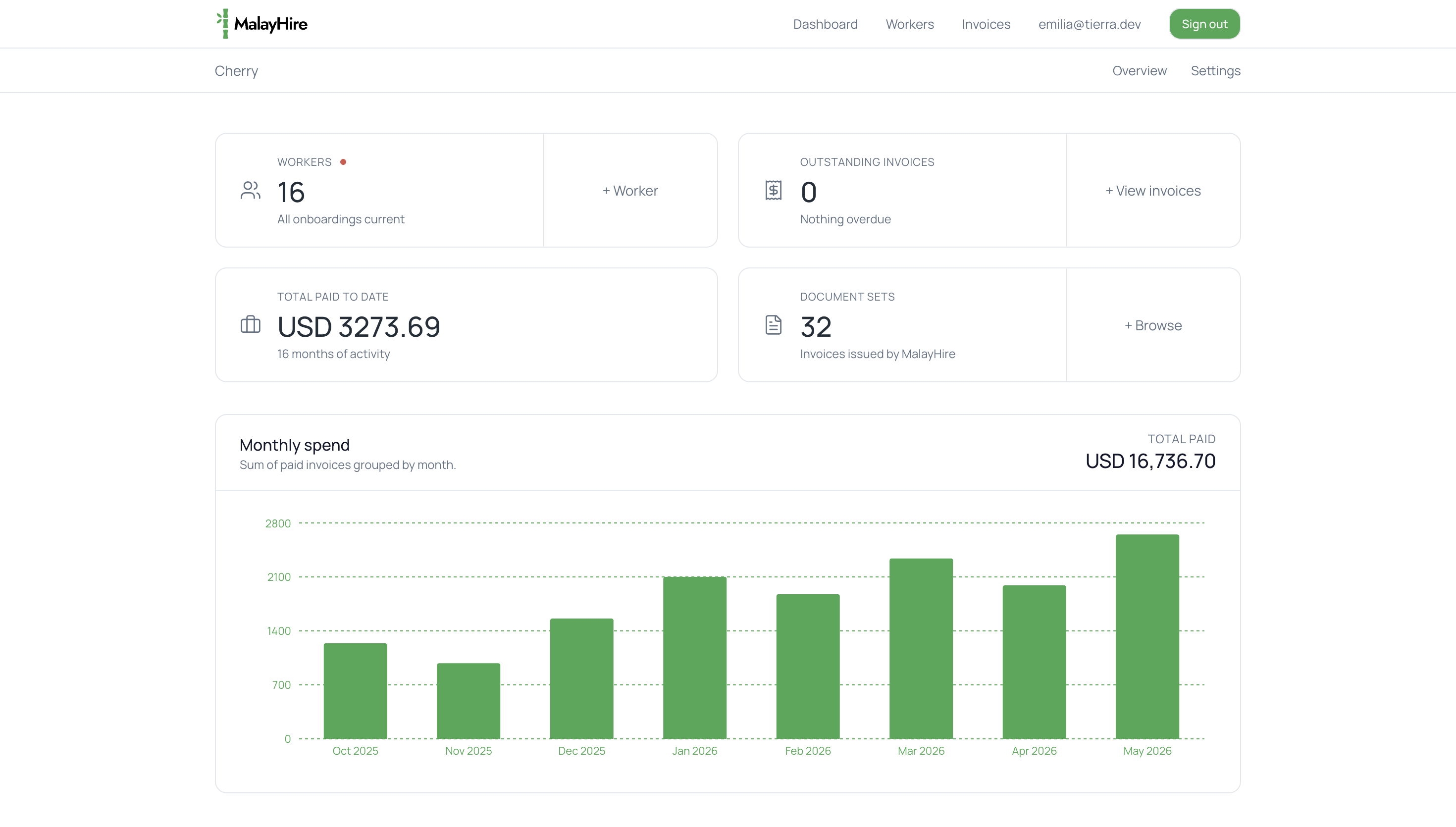
Manage your Malaysian team, payroll & EOR compliance in one place.