
Top Hiring Sectors in Malaysia 2025: The Tech-First Case Study Every Foreign Founder Needs


Top Hiring Sectors in Malaysia 2025: The Tech-First Case Study Every Foreign Founder Needs

Key Takeaways
- Tech, fintech, shared services, and green energy are the top hiring sectors in Malaysia 2025, but the real differentiator is how fast you can onboard talent.
- Malaysia's labour market rewards employers who pair local compliance knowledge with API-driven automation; manual processes create costly bottlenecks.
- A 48-hour EOR onboarding is realistic when contracts, payroll, EPF, SOCSO, and taxes are handled through digital infrastructure instead of spreadsheets and email chains.
- EPF contributions are split between employee and employer, with employers typically contributing 12–13% depending on salary bracket, and remittance is due by the 15th of the following month.
- SOCSO and EIS filings have their own monthly deadlines; missing them triggers late payment interest, and repeated misses invite audits.
- Traditional PEOs often take 2–4 weeks to onboard a single hire; API-native EORs compress that to days, which matters when competing for in-demand developers.
- The top sectors are competing for the same limited pool of senior developers, product managers, and compliance specialists; speed of hiring determines who actually gets them.
- Choosing a growth sector isn't enough—your payroll infrastructure determines whether you can close candidates before a competitor with faster onboarding does.

The Backdrop: Why Malaysia's Hiring Market Feels Different in 2025
If you've been watching the jobs market malaysia closely, you've probably noticed the same shift I have: the old way of hiring Malaysian talent—emails, PDFs, waiting for a local entity—is quietly becoming obsolete. The country's labour market is splitting into two camps. On one side, there are the sectors that are genuinely adding headcount: software development, fintech, regional shared services, green energy, and advanced manufacturing. On the other side, there are the employers still trying to hire through legacy processes that move at the speed of a signed courier document.
The top hiring sectors in Malaysia 2025 are not just about volume. They reflect a deeper change in how work gets done. More foreign companies are treating Malaysia as a remote-first or hybrid talent hub for Southeast Asia, not just a cost arbitrage play. That means competition for skilled workers has intensified, and the founders who understand this are the ones using digital EOR platforms to move faster than the traditional employment route. The conversation has shifted from 'should we hire in Malaysia?' to 'how quickly can we have someone on payroll and compliant?' That speed is what this article is really about.
The Talent Pool Shift
Malaysia has always had solid engineering talent, but 2025 is different. The country is producing more graduates in software engineering, data science, and cybersecurity, while global companies are simultaneously setting up regional hubs in Kuala Lumpur and Penang. This has pulled talent away from traditional back-office roles and into product and platform teams. For a foreign startup, that means a mid-level developer in KL can often run circles around a similar hire in other markets at half the total cost. But you can't access that talent slowly. The best candidates are off the market in days, not months, because they're being approached by multiple EOR-backed companies that can onboard them in under a week.
What Tech Growth Means for Wages
The wage curve in Malaysia's top sectors has steepened. Junior developers are still affordable, but senior product managers, DevOps engineers, and AI specialists command compensation that surprises first-time foreign employers. That's fine if you're budgeting properly. The problem is that many founders still use outdated salary benchmarks or assume the Malaysia labour market is uniformly cheap. When you combine competitive base pay with statutory contributions like EPF, SOCSO, EIS, and HRD Corp levy, the fully loaded cost is higher than the headline salary suggests. An API-based EOR gives you real-time cost breakdowns before you make an offer, so you don't get burned by a surprise bill after your new hire starts.
The 48-Hour Onboarding: Breaking Down a Real Technical Integration
Let me walk you through a realistic scenario that's playing out across the Malaysian tech scene right now. A Berlin-based fintech startup needs to hire two Malaysian developers for a six-month contract. They have no legal entity, no local bank account, and no time to spend weeks on compliance. They decide to use an EOR platform designed for rapid digital hiring—one that offers API integration, fixed monthly pricing starting at $165 per employee, and a 48-hour onboarding promise.
Here's what actually happens behind the scenes. Instead of filling out a dozen PDF forms, the startup's engineering lead triggers an API call from their internal HR system. That call sends the candidate's details—name, address, NRIC number, salary, start date—directly to the EOR's platform. The platform runs validation against Malaysia's regulatory databases, generates an employment contract in under two minutes, and sends it for e-signature. By hour six, the candidate has signed. By hour twelve, payroll has been configured with the correct EPF, SOCSO, and EIS contributions. By hour forty-eight, the new employee is officially on the books and ready to work. That's not magic; it's what happens when you remove manual steps.
Pre-Flight Checks Before You Hit Send
API integration sounds technical, but the actual requirements are straightforward. You need the candidate's full legal name as per their IC or passport, their tax identification number, bank account details for salary payment via local rails, and a signed offer letter. The EOR platform handles the rest: generating a Malaysia-compliant employment contract, registering the employee with EPF and SOCSO, and setting the correct contribution rates based on wages and age bracket. The only thing you really need to get right upfront is the salary figure. Everything else can be corrected later without major penalties—but salary errors affect statutory calculations, so double-check that number before you fire off the API request.
The 48-Hour Sequence, Hour by Hour
Hours zero to two: API call receives and validates candidate data. Hours two to six: employment contract generated and e-signature request sent to candidate and employer. Hours six to twelve: payroll configuration locked, including EPF employee and employer portions, SOCSO category, EIS contribution, and HRD Corp levy if applicable. Hours twelve to twenty-four: compliance team does a final document review—this is the only human touchpoint, and it's built into the system, not a separate email thread. Hours twenty-four to forty-eight: employee receives onboarding pack, bank details are verified, and the first payroll run is scheduled. By hour forty-eight, the hire is compliant. It's the same sequence a traditional PEO takes three weeks to finish.
Where the Hiring Action Actually Is: Top Sectors Driving Volume
Malaysia hiring trends in 2025 are not evenly distributed. Some sectors are essentially frozen, while others are practically begging for talent. The top hiring sectors in Malaysia 2025 cluster around a few clear demand drivers: digital transformation across ASEAN, the shift to cloud infrastructure, regional finance operations, and the energy transition. If you're a foreign employer deciding where to place your next hire, the sector you target changes your talent pool, your salary expectations, and your compliance obligations.
Here's a quick rundown of the sectors that are actually posting jobs this year, based on what I'm seeing across EOR onboarding volumes and local hiring news in Malaysia:
- Tech and software development: Full-stack developers, DevOps engineers, AI and machine learning specialists, and cybersecurity analysts are the most in-demand roles. Remote-first ASEAN hubs are driving volume.
- Fintech and digital payments: Malaysia's push toward cashless payments and regional payment rails has created demand for compliance officers, product managers, and risk analysts who understand local regulations.
- Shared services and business process outsourcing: Global companies continue to set up regional finance, HR, and IT support centres in Kuala Lumpur and Cyberjaya, hiring accountants, FP&A analysts, and multilingual support staff.
- Green energy and sustainability: Solar, waste-to-energy, and carbon accounting roles are growing, though the talent pool is smaller. Employers often need to offer more flexible working arrangements to attract specialists.
- Advanced manufacturing and electronics: Penang and Kulim are seeing renewed investment in semiconductor and precision manufacturing, creating demand for process engineers, quality control specialists, and supply chain managers.
- E-commerce and logistics: The continued growth of online retail has kept demand steady for warehouse operations managers, last-mile logistics coordinators, and e-commerce marketing leads.
Why Malaysia's Top Hiring Sectors Demand API-Native EOR Onboarding
It's no coincidence that the hottest sectors in Malaysia are also the ones where hiring speed matters most. A fintech startup trying to hire a compliance officer doesn't have three weeks to wait for a traditional PEO to process paperwork. That officer might receive three other offers in the same window. The same goes for a shared services centre trying to staff a new finance team by the end of the quarter. Manual onboarding is no longer just inconvenient—it's a competitive disadvantage.
This is where an API-first EOR changes the game. Instead of waiting for a sales call, a proposal, and then a pile of PDFs, you send data programmatically. The EOR platform handles the local statutory requirements—EPF registration, SOCSO contribution categories, EIS deductions, and HRD Corp levy where applicable—without you needing to understand every nuance of Malaysian employment law. That's the real value. You stay focused on your product or your expansion, and the platform does the messy local compliance work in the background, often in under two days.
Speed Is a Compliance Feature, Not a Shortcut
There's a misconception that faster onboarding means corners are being cut. In reality, the opposite is true. A well-built EOR platform automates the steps that are prone to human error, like calculating SOCSO categories based on age and wages or determining whether an employee falls under the HRD Corp levy threshold. By removing manual data entry, the platform reduces the risk of misclassification and late filings. That's why the 48-hour promise works—it's not skipping steps, it's running them in parallel through code instead of sequentially through email.
What API Integration Looks Like in Practice
For technical HR operations leads, the integration is often a simple REST API with a few endpoints: create employee, update payroll, fetch compliance status. You authenticate with a bearer token, send a JSON payload with the employee's details, and receive a webhook when the contract is signed or when the first payroll run is confirmed. No need to build your own Malaysia legal entity or parse EPF contribution tables yourself. That's the kind of infrastructure that makes the top hiring sectors in Malaysia accessible to a two-person startup in Berlin just as easily as a 500-person enterprise.
The Compliance Layer: EPF, SOCSO, EIS, and HRD Corp Timelines Explained
You can't talk about Malaysia's labour market without talking about statutory contributions. The four big ones—EPF, SOCSO, EIS, and HRD Corp—are what separate a compliant employer from one that gets a nasty letter from the authorities. Here's the practical picture: each contribution has a different base, a different deadline, and a different consequence for missing it. An EOR platform handles these automatically, but you should still know the basics because you'll see them on every payroll report.
The monthly rhythm works like this: EPF contributions are generally due by the 15th of the following month. SOCSO contributions follow a similar monthly schedule. EIS is bundled with SOCSO in terms of filing frequency. HRD Corp levy, which applies to certain employers, has its own quarterly or monthly filing depending on your registration category. Late payments attract interest, and repeated late filings can trigger an audit. When you onboard through a digital EOR, these deadlines are baked into the platform's calendar, and you receive automated alerts before anything is due.
EPF: The Big One
EPF is Malaysia's mandatory retirement savings scheme. Both employee and employer contribute, with the employee portion fixed at 11% for most workers under 60, and the employer portion typically 12% or 13% depending on the wage bracket. The employer remits both portions to the EPF board by the 15th of the following month. For a foreign employer, getting the wage bracket wrong is the most common mistake, especially when an employee crosses the RM5,000 monthly threshold. An API-driven EOR calculates this automatically based on the declared salary, so you never under- or over-contribute.
SOCSO and EIS: Protection and Insurance
SOCSO provides workplace injury and invalidity coverage, while EIS is employment insurance. Contributions are based on the employee's age and monthly wages, with employer and employee each paying a share. The filing deadline is typically the 15th of the following month, same as EPF. The tricky part is that SOCSO categories have maximum insurable wage ceilings that adjust periodically. If your payroll system uses old ceilings, you'll underpay and face penalties. EOR platforms update these automatically, which is why many foreign employers prefer to outsource rather than maintain internal payroll tables for a market they're new to.
HRD Corp: The One People Forget
HRD Corp levy applies to employers with a certain number of Malaysian employees, and it funds training and development. The registration threshold and levy rate can change based on industry and workforce size. Many foreign startups miss this because they don't realise it applies to them until their EOR provider flags it. Missed HRD Corp contributions don't just incur late fees; they can also affect work permit renewals and local credibility. A good EOR will register you with HRD Corp automatically when your headcount crosses the threshold, then deduct the levy as part of the monthly payroll run.
Traditional PEOs vs API-Based EORs: The Speed Delta
If you've ever compared a traditional Malaysian PEO with an API-native EOR, you know the difference is not just software—it's philosophy. Traditional providers are built on relationship management: you get a dedicated account manager, a series of onboarding calls, and a stack of documents to sign with a wet ink signature. That model works fine for a multinational that's opening a 50-person office and has a legal team. It does not work for a startup that needs one developer in Kuala Lumpur next week.
Here's the honest comparison:
- Traditional PEO: Onboarding typically takes 2–4 weeks, requires multiple sales calls and manual document exchange, and often includes setup fees that are opaque.
- API-based EOR: Onboarding can be completed in 48 hours, uses e-signatures and structured data, and has fixed monthly pricing that's transparent from day one.
- Traditional PEO: Statutory filing is handled by a local team, but you receive updates via email or portal and may not get real-time confirmation.
- API-based EOR: Statutory filing is automated, with webhooks or dashboard confirmations when EPF, SOCSO, and EIS are successfully submitted.
- Traditional PEO: Changing an employee's salary or upgrading to full-time requires a new amendment process that can take days.
- API-based EOR: You update the salary via an API call or dashboard, and the platform recalculates statutory contributions instantly.
- Traditional PEO: You often pay a percentage of payroll, which scales painfully as you add more employees.
- API-based EOR: Fixed monthly pricing per employee means your cost predictability improves as you scale.
When a Traditional PEO Still Makes Sense
There are still cases where a traditional PEO is the right call. If you're hiring a dozen employees at once and want a local account manager to handle complex immigration or union negotiations, the human touch matters. But for the typical foreign startup hiring one to five Malaysian remote workers in a competitive sector, the traditional model is simply too slow. By the time your PEO has scheduled the second onboarding call, an API-based EOR has already filed your first month's EPF contributions.
Common Mistakes Founders Make When Hiring in Malaysia's Hot Sectors
Malaysia hiring news is full of success stories, but the failures are less visible. In my experience working with foreign employers, the same five mistakes keep coming up, and they all relate to underestimating the operational side of hiring. If you avoid these, you're already ahead of most of your competitors.
- Assuming Malaysia is uniformly cheap: Salaries for senior tech roles in KL have risen sharply. Budget for the fully loaded cost including EPF, SOCSO, EIS, and HRD Corp, not just the base salary.
- Ignoring statutory contribution deadlines: EPF and SOCSO are due by the 15th of the following month. A single late payment triggers interest and starts a paper trail you don't want.
- Trying to hire through a foreign entity without local registration: Malaysia requires a local entity or an EOR for compliant employment. Contractors misclassified as employees open you up to back-taxes and fines.
- Relying on manual onboarding processes: Even a well-meaning HR team using spreadsheets will make errors when calculating SOCSO categories or HRD Corp thresholds. Automation reduces that risk.
- Underestimating the importance of a local bank account: Paying Malaysian employees via international SWIFT transfers is slow and expensive. Local rails like DuitNow or MEPS settle in real-time and are expected by candidates.
- Treating the EOR as just a payroll processor: The best EORs handle contracts, statutory filings, compliance updates, and even termination procedures. Use the full platform, not just the salary payment feature.
Your Malaysia Hiring Playbook for 2025
So how do you actually put this into practice? Whether you're hiring a single developer or building a ten-person remote team, the sequence is the same. Start with the sector, then the salary, then the infrastructure, then the statutory filing. Here's a step-by-step playbook that avoids the traps above.
- Identify your target role and salary range using current Malaysia salary benchmarking data specific to the top hiring sectors in Malaysia 2025.
- Choose an EOR platform with API integration and fixed monthly pricing. Avoid percentage-of-payroll models if you plan to scale.
- Prepare candidate documents: full legal name, NRIC or passport number, bank account details, and signed offer letter.
- Trigger the onboarding via API call or dashboard. The platform should generate a compliant employment contract within hours.
- Confirm statutory registration: EPF, SOCSO, EIS, and HRD Corp if applicable. The EOR should provide real-time confirmation.
- Set up local salary payment via Malaysia's local rails. If your EOR supports DuitNow or MEPS, use that for same-day settlement.
- Schedule monthly payroll runs with a clear calendar of statutory filing deadlines. The EOR should send automated reminders.
- Monitor compliance status through the platform's dashboard or API webhooks. Don't wait for a problem to surface.
What to Look for in an EOR API
Not all EOR APIs are created equal. You want an API that exposes endpoints for employee creation, payroll updates, statutory filing status, and document retrieval. Authentication should be token-based and secure over HTTPS. The API documentation should include a sandbox environment so your developers can test without real employee data. And the platform should offer a status endpoint that tells you when the next EPF or SOCSO filing is due. If an EOR can't show you its API docs before you sign, walk away.
Final Word: The Sector You Choose Matters, the Infrastructure You Use Matters More
The top hiring sectors in Malaysia 2025 are exciting, but they're also competitive. Tech, fintech, shared services, green energy—these are the right places to look for talent, but they won't wait for you to sort out your compliance. The founders who win in Malaysia's labour market this year will be the ones who treat onboarding like a product problem, not an administrative chore. They'll use API-driven EOR platforms to shrink a three-week process into two days, and they'll never miss an EPF or SOCSO deadline because the system handles it automatically.
Malaysia workforce trends are pointing in one direction: faster, more digital, more transparent. If your hiring infrastructure is still stuck in the paper era, you're going to lose candidates to competitors who onboard in 48 hours. That's the real lesson from the case study. It's not about choosing the hottest sector—it's about being ready to hire the moment you find the right person. And that readiness is something you can build today.
Frequently Asked Questions
How long does it take to onboard a new employee in Malaysia with an API-based EOR?
API-based EOR platforms typically complete employee onboarding in Malaysia within 48 hours, whereas traditional PEO methods often stretch to two weeks. The speed difference comes from automated statutory registration and instant payroll setup. This rapid timeline lets foreign founders secure top tech talent before competitors make offers.
Can foreign companies hire employees in Malaysia without setting up a local entity?
Yes, foreign companies can legally hire Malaysian employees without establishing a local entity by using an employer of record service. The EOR acts as the legal employer, handling payroll, statutory contributions, and employment contracts under Malaysian law. This approach enables immediate market entry while remaining fully compliant with local regulations.
What are the mandatory statutory contributions for employers in Malaysia in 2025?
Employers in Malaysia must contribute to the Employees Provident Fund, SOCSO, EIS, and HRD Corp for every eligible employee. EPF rates range from 12 to 13 percent of monthly salary, while SOCSO and EIS have smaller percentage deductions. HRD Corp levies a monthly levy of one percent for companies with ten or more workers.
Which tech roles have the highest hiring demand in Malaysia's top sectors for 2025?
Software engineers, data scientists, and cybersecurity specialists lead hiring demand across Malaysia's fastest-growing technology sectors. Fintech, e-commerce, and digital health companies actively recruit for API integration developers and cloud architects. These roles often remain unfilled for weeks because qualified candidates receive multiple competitive offers simultaneously.
How do traditional PEOs differ from API-based EOR onboarding speed in Malaysia?
Traditional PEOs depend on manual document processing and extensive back-and-forth communication, causing onboarding timelines of one to three weeks. API-based EOR platforms automate statutory submissions and payroll configuration, reducing the entire process to under two days. This efficiency directly impacts productivity because new Malaysian hires can contribute to critical projects sooner.
What common mistakes do foreign founders make when hiring top talent in Malaysia?
Foreign founders often overlook statutory contribution deadlines, miscalculate payroll taxes, and neglect to align contracts with local employment law. Another frequent error involves choosing a slow PEO provider that delays onboarding and loses prized candidates to faster competitors. Relying on outdated salary benchmarks also leads to unattractive offers for in-demand Malaysian tech professionals.
Is there a minimum salary threshold to hire foreign workers in Malaysian tech sectors?
Yes, Malaysia imposes a minimum salary of 5,000 ringgit per month for expatriate employment passes in most technology roles. However, local Malaysian hires have no such statutory minimum because employers negotiate salaries based on market rates. The Employment Pass exemption applies to critical tech positions filled by qualified foreign experts.
What is the EPF contribution rate for employees earning above the statutory wage ceiling?
Employees earning above Malaysia's monthly wage ceiling of 5,000 ringgit receive the standard EPF employer contribution of 12 percent. The employee's own statutory deduction remains at 11 percent of their total monthly salary. Any salary amount exceeding the ceiling does not attract additional mandatory EPF obligations.
MalayHire is your most cost-effective Employer of Record (EOR) in Malaysia
Hire full-time employees in Malaysia and save costs by avoiding hefty contractor fees. MalayHire handles payroll, employment contracts, statutory compliance (EPF, SOCSO, EIS), and HR admin. Start onboarding your Malaysian hire now, with MalayHire.
Trusted by global companies hiring in Malaysia





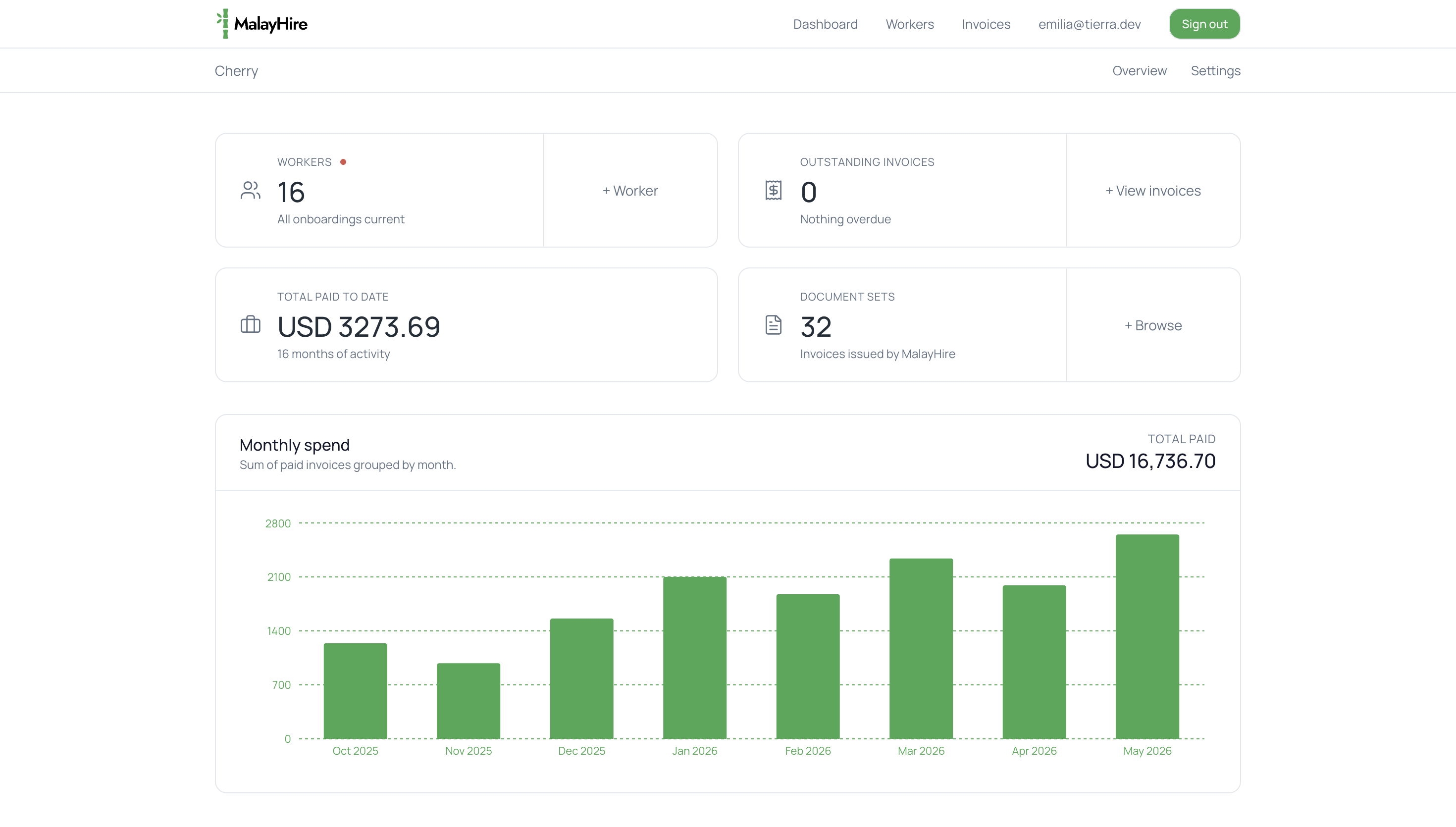
Manage your Malaysian team, payroll & EOR compliance in one place.